Blog
Advertising a New Product: A Meta Ads Launch Playbook
Published June 11, 2026
You've got the product page open in one tab, Meta Ads Manager in another, and a third tab full of advice that all sounds confident and slightly contradictory. One person says start broad. Another says laser-target interests. A third says creative is everything. Meanwhile, your real question is simpler: how do you launch without burning money you can't afford to lose?
That's the right question. Advertising a new product is risky, especially when you're still proving demand. Industry research summarized by StudioRed says new-product failure rates can range from 35% to 49%, and about 66% of new products fail within two years of launch (StudioRed product development statistics). That's why a first launch shouldn't be treated like a brand reveal. It should be treated like a controlled test.
For a bootstrapped founder, a small budget can help. It forces discipline. You can't afford vague messaging, messy landing pages, or ad sets that run because you “have a good feeling.” You need each dollar to answer a question: who clicks, who adds to cart, who buys, and which message earns that response.
This playbook is built for that reality. It treats Meta ads as a repeatable system. Not a gamble, not a creative lottery, and not a copy of what larger brands do with deeper pockets.
Table of Contents
- Your First Meta Ad Campaign A Playbook Not a Gamble
- Audit Your Foundation Before Spending a Dollar
- Choose Your Creative Angles to Build Trust Fast
- Build Your Ad Creatives and Copy Like a Pro
- Design a Budget-Aware Testing Plan
- Measure Results and Decide Whats Next
Your First Meta Ad Campaign A Playbook Not a Gamble
A first Meta campaign usually goes wrong before the ads even go live. The founder opens Ads Manager and starts making platform decisions before making business decisions. Campaign objective, audience setting, placements, budget split. Those matter, but they come after the basics.
The useful mindset is this: you are not buying sales first. You are buying information first. Sales are the outcome you want, but in the early stage your ad spend is also paying to learn which angle gets attention, which audience understands the product, and whether the page can convert cold traffic.
That shift changes how you launch. You stop asking, “What ad will work?” and start asking better questions.
- Message question: Which promise gets the strongest click?
- Audience question: Which group responds without needing too much education?
- Offer question: Does the product page reduce enough doubt to earn an add-to-cart or purchase?
- Economics question: Can the product acquire customers at a cost the business can live with?
Practical rule: If your budget is small, your first campaign should answer a short list of clear questions. It should not try to do everything at once.
Beginners often overbuild. They launch too many interests, too many creatives, too many assumptions. Then nothing gets enough signal to teach them anything useful. A better launch is narrower and cleaner. Fewer moving parts. Stronger observation.
That's also how bigger operators think when they're being honest about a new product. They don't assume the market owes them traction. They test for it.
Advertising a new product works best when you treat launch as a validation loop. Put a trustworthy page in front of the right person, tell a clear story, spend carefully, and decide quickly based on what the data is saying.
Audit Your Foundation Before Spending a Dollar
Sending paid traffic to an unready product page is one of the fastest ways to waste a small budget. If the page is weak, the ad account gets blamed for a site problem.
Fix the page before you buy traffic
Start with the product page on your phone, not your laptop. Most first-time founders build on desktop and only casually check mobile. Meta traffic will punish that habit. If the first screen is cluttered, the image crop is awkward, or the add-to-cart button is buried, cold traffic won't wait around.
Use this quick audit before launch:
- Clear promise above the fold: A stranger should understand what the product is, who it's for, and why it's better within seconds.
- Strong images first: Lead with photos or video that explain the product in use, not just polished pack shots.
- Low-friction buying path: Variant selection, shipping info, price, and add-to-cart should be easy to find.
- Objection handling: Answer the obvious doubts. Materials, sizing, compatibility, use case, shipping timing, and returns.
- Trust elements: Reviews if you have them, guarantees if you offer them, concise FAQs, and visible contact information.
- Mobile readability: Short paragraphs, clear buttons, no walls of copy, no tiny comparison charts.
A weak page usually shows the same symptoms. The headline sounds clever instead of clear. The page leads with brand mood instead of product utility. The first real answer to “why should I buy this?” appears too far down.
Your ad can win the click and still lose the sale if the page forces people to work for clarity.
Many first launches often break. The founder thinks they have an ad problem because click costs are painful or purchases are inconsistent. In reality, the traffic is arriving with interest and leaving with unanswered questions.
Know who the ad is for
The strongest positive predictors of new product success are market orientation and product advantage, according to a meta-analysis on product innovation success factors. The same analysis found factors like price and the product's newness were not significant predictors in that dataset (meta-analysis on product innovation success factors). For a founder, the practical reading is simple: know the customer thoroughly, and show why this product is a better fit for that customer.
Write down one primary buyer profile before touching ads. Not five. One.
A useful profile includes:
| Focus area | What to define |
|---|---|
| Problem | What specific annoyance or need pushes them to look for a solution |
| Context | When they feel the problem most strongly |
| Desired outcome | What “better” looks like in their own words |
| Objections | Why they might hesitate to buy from a new brand |
| Existing alternatives | What they use now, even if it's a workaround |
If you sell a smart water bottle, “health-conscious adults” is too broad. “Office workers who forget to drink water during long desk sessions” is useful. That gives you a setting, a frustration, and language for creative.
If you want help structuring this prep work, tools like product-page audit checklists, customer interview notes, or a guided workflow such as Social Loop AI can help organize the page review, buyer profile, and launch inputs before you build ads.
Choose Your Creative Angles to Build Trust Fast
New products don't just have a traffic problem. They have a credibility problem. Brax's guidance on ad angles illuminates the underlying issue: new products face a cold-start problem because they launch with little or no social proof, so early ads need to reduce perceived risk and build trust fast (Brax on advertising angles and the cold-start problem).
That means your first ads shouldn't chase cleverness. They should do trust work.
Here's a simple way to think about it. One product can support several different stories. You don't need one perfect ad. You need a few credible angles.
For a visual map of the core options, use this framework:
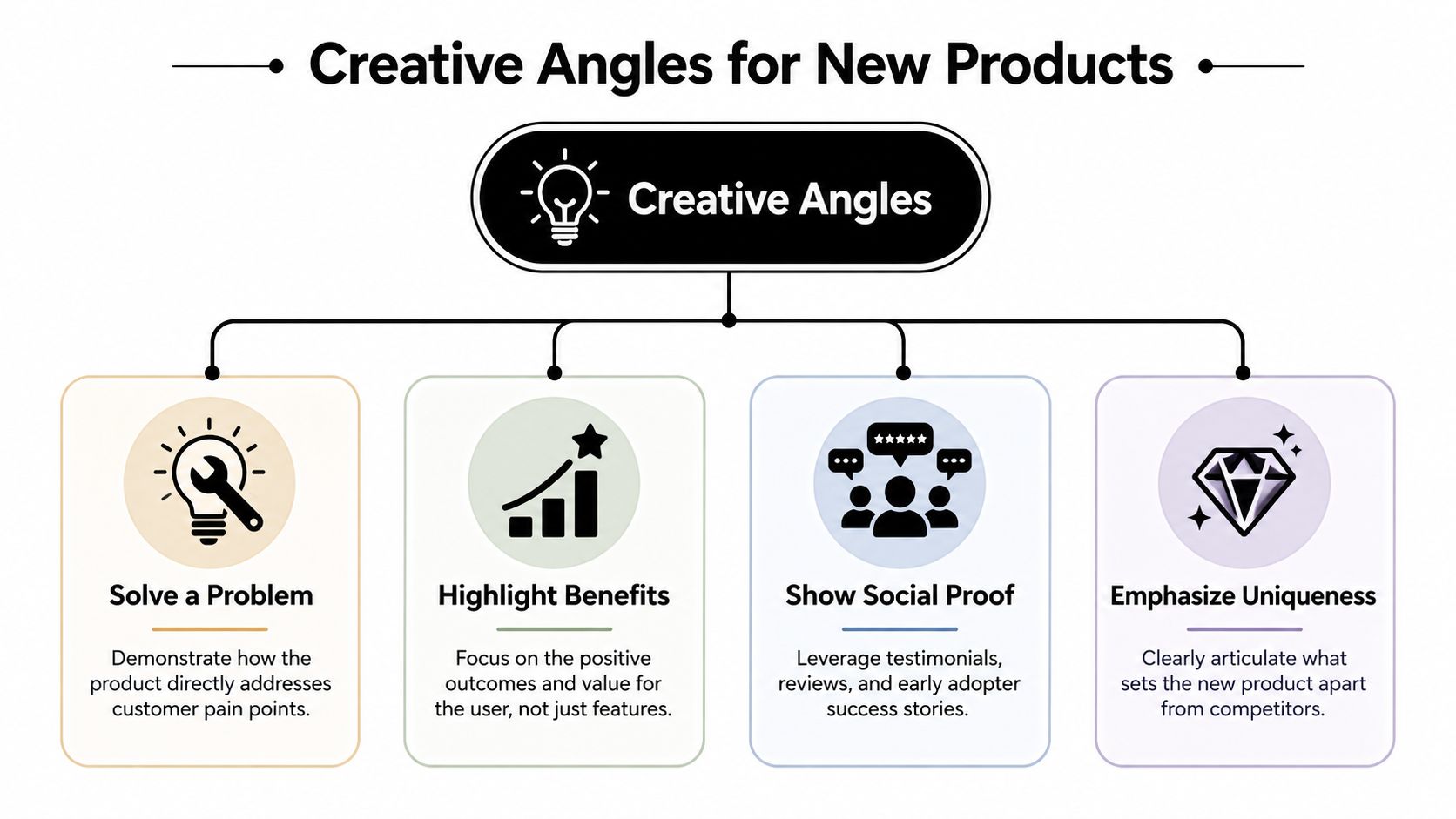
One product four different stories
Take that smart water bottle example. Same product, different angle.
Problem solving
The ad opens on someone at their desk late in the afternoon, tired and distracted. Text on screen: “You didn't forget your tasks. You forgot to drink water again.” The bottle's reminder feature becomes the hero. This works because it starts with a familiar pain, not a feature list.
Benefits first
This version doesn't dwell on the problem. It shows the better outcome. More consistency, fewer missed hydration breaks, a simple routine. It's less about tech and more about how the buyer feels using it.
Social proof
If you already have early customer comments, creator clips, or even direct messages giving positive feedback, use them. If you don't, start collecting simple usage footage and reactions from early buyers, friends in the target segment, or seeded creators. If you need a starting point, this guide on how to make UGC for ads is useful for building believable customer-style assets.
Uniqueness
This angle answers the question, “Why this one instead of any water bottle?” Maybe it's the reminder method, the design, the portability, or a simpler setup than competing products. Be careful here. Uniqueness only matters if it connects to a buyer's real use case.
Here's a practical benchmark for your own review:
If the product name were removed from the ad, could a stranger still tell what problem it solves and why it feels safe to try?
A short explainer can also help you think about this visually before you produce assets:
What beginners usually get wrong
The most common mistake is making the ad sound bigger than the proof behind it. New brands overclaim because they're nervous. They promise transformation, not utility. They speak like a category leader without category-level evidence.
Avoid that. For early campaigns:
- Use simple claims: Show what the product does in plain language.
- Reduce perceived risk: Highlight ease of use, fit, guarantee, or setup simplicity.
- Create light urgency carefully: Limited launch stock or first-batch messaging can work if it's true.
- Match proof to promise: If all you have is demonstration footage, lead with demonstration footage.
Trust compounds when the ad, landing page, and actual product all tell the same story. That's what gets a cold-start product through the awkward first stage.
Build Your Ad Creatives and Copy Like a Pro
You don't need expensive production to make Meta ads that can test well. You need clarity, speed, and enough variety to learn something. Most bootstrapped brands should start with usable phone footage, clean product visuals, simple text overlays, and direct copy.
Use a simple ad structure
A strong beginner ad usually has three parts.
Hook
This is the first line of text, the first visual beat, or the first spoken sentence in a video. It has one job: stop the scroll by making the viewer feel seen.
Examples:
- “Still forgetting to drink water while you work?”
- “This is the bottle built for people who hate hydration apps.”
- “A simple fix for desk-day dehydration.”
Body
Now earn the click. Explain the product in plain language and connect it to the benefit. Don't cram in every feature. Pick one core promise and support it.
Most bottles just sit there. This one nudges you to use it. Built for long workdays, simple routines, and people who want help without another complicated habit tracker.
Call to action
Tell people what to do next. Don't get cute here.
Examples:
- “See how it works”
- “Shop the launch”
- “Get yours today”
If you want a deeper breakdown of copy formats, swipe structures, and beginner-friendly hooks, this guide on how to write ad copy for ecommerce ads is a practical reference.
Make more variations than you think you need
A first launch usually needs a batch, not a masterpiece. Build multiple combinations from the same core ingredients.
Try mixing:
- Different hooks: pain point, benefit, objection, curiosity
- Different visual formats: product demo, founder talking, customer-style clip, static image
- Different body emphasis: convenience, result, simplicity, uniqueness
- Different CTAs: soft click, stronger purchase intent, learn-more framing
Here's a workable starter grid:
| Asset type | What to create |
|---|---|
| Short videos | Product in use, problem-solution demo, founder explanation |
| Statics | One clear image with one idea, not a collage of everything |
| Copy variants | Short primary text, medium explanation, concise headline options |
| Thumbnails and openings | Different first frames for the same video to test stopping power |
The reason this matters is simple. Creative testing on Meta often reveals that the same offer lands differently depending on framing. A founder may think the product is selling convenience, while the audience responds more to reduced frustration. If you only build one interpretation, you never learn that.
Don't try to sound like a brand at scale. Try to sound like a product that solves a real problem for a specific person.
For visuals, beginners often make two opposite mistakes. Either they use low-effort, sloppy assets that feel untrustworthy, or they overdesign everything until it looks like an ad nobody believes. The middle ground usually works better. Clean footage. Visible product use. Legible text. Natural pacing.
When advertising a new product, polished is helpful. Understandable is essential.
Design a Budget-Aware Testing Plan
Budget stress gets worse when spend has no structure. Founders open Meta, choose a daily number they can tolerate, and hope the machine sorts it out. That's not a plan. That's a leak.
A small budget works better when you treat it as testing capital. Every dollar should answer a specific question before you commit more.
Treat budget as testing capital
This matters even more if your product serves a narrow audience. Positioning guidance for underserved markets emphasizes validating demand cheaply and adapting budgets to the size of the market, rather than copying broad launch playbooks (positioning products in underserved markets).
That's exactly how a bootstrapped merchant should think. You are not trying to prove your product works for everyone. You're trying to find the first pocket of demand that responds clearly.
Use your budget in rounds.
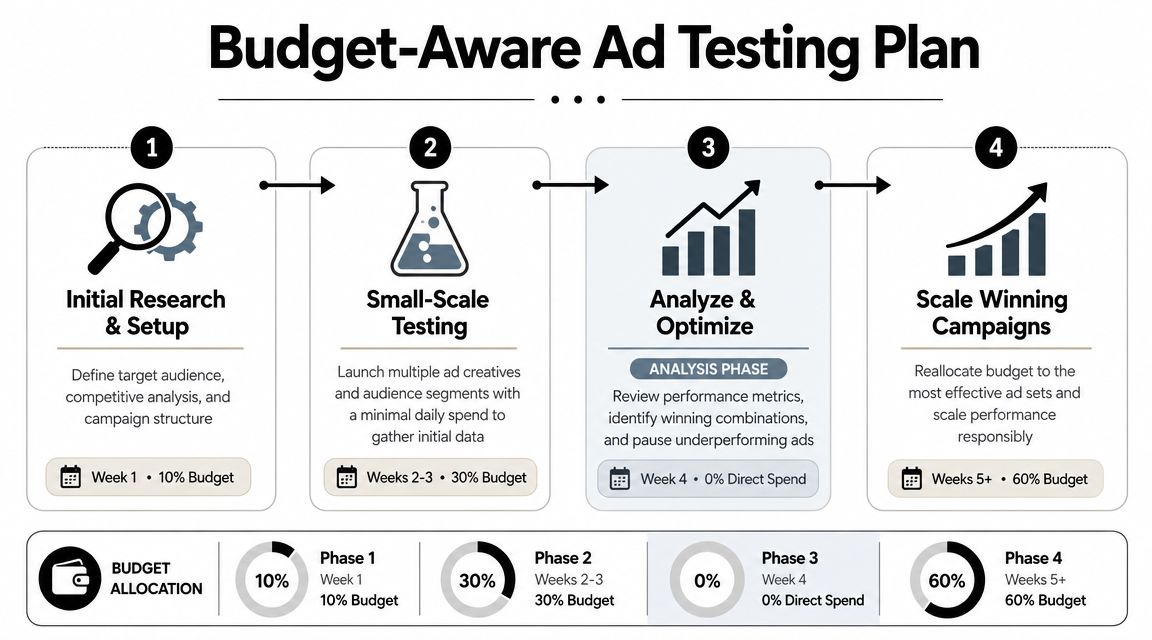
A useful way to frame this is:
- Question one: Which angle gets the best initial response?
- Question two: Which audience holds attention and clicks?
- Question three: Which combinations create real buying intent?
- Question four: Which winner deserves more budget?
If you need help thinking through allocation logic before launch, this piece on marketing spend optimization for early campaigns is a good planning reference.
A simple two-round structure
Round 1 is broad testing, but not chaotic testing. Keep the setup lean. Pick a handful of distinct creative angles and a short list of audience ideas. The goal is comparison, not coverage.
A practical Round 1 setup might look like this in principle:
| Round | Goal | What to test |
|---|---|---|
| Round 1 | Find response patterns | Several creative angles across a small set of audiences |
| Round 2 | Concentrate spend | The strongest creative and audience combinations from Round 1 |
What matters most is the discipline behind it.
In Round 1:
- Keep creatives meaningfully different: Don't test five near-identical versions and call that creative testing.
- Limit audiences: Too many ad sets spread the budget too thin.
- Use one landing page version first: Otherwise you won't know whether performance changed because of ad or page.
Then read the results with honesty. If one angle gets attention but weak buying intent, it may be good for awareness and weak for conversion. If one audience clicks but doesn't add to cart, your message may be resonating with curiosity instead of purchase intent.
Round 2 is where you earn the right to spend more. You pause the weak combinations and push harder into the combinations that showed the cleanest path from click to action.
Smaller budgets force better decisions because they punish vanity testing. That's a feature, not a drawback.
The founders who waste the least usually do one thing well: they enter each round knowing what would count as a useful answer.
Measure Results and Decide Whats Next
Once the ads are live, resist the urge to judge everything by emotion. Founders usually know within hours which ad they personally like. That opinion isn't useful. What matters is whether the numbers tell a coherent story.
Amazon Ads recommends waiting until a campaign has at least 14 days of data before optimizing based on ROAS, a reminder that launch decisions need enough signal to separate actual demand from noise (Amazon Ads guidance on optimization timing and new-to-brand metrics). Even if your Meta campaign decisions happen faster than that, the principle still applies. Don't overreact to tiny samples.
Watch the few metrics that matter
For a new product launch, keep the scorecard tight.
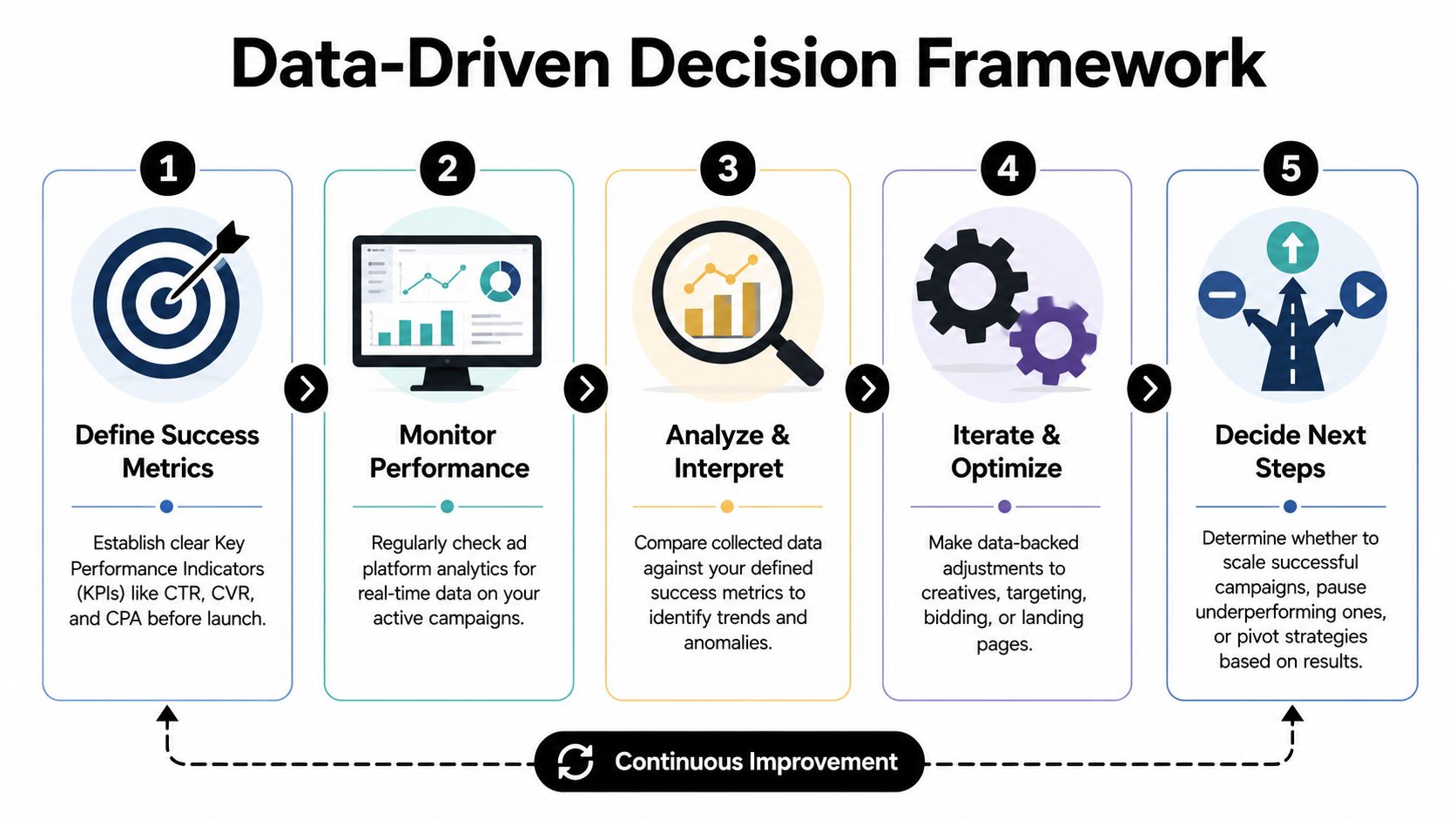
Start with these:
- Click-through rate: Does the audience care enough to click?
- Conversion rate: Product-marketing guidance defines conversion rate as conversions divided by total visitors. This tells you whether the page is turning interest into action.
- Cost per add-to-cart: Are people showing real purchase intent?
- Cost per purchase: Can this campaign acquire customers at a level the business can support?
- Customer acquisition economics: CAC and CLTV are part of the core framework for judging whether a launch can scale profitably, especially once you move beyond the first test window.
You don't need a huge dashboard at this stage. You need a small set of metrics tied to decisions.
A useful reading pattern looks like this:
| Signal | Likely interpretation | Next move |
|---|---|---|
| Strong clicks, weak conversion | Ad promise works, page or offer is weak | Fix landing page or offer framing |
| Weak clicks, decent conversion from few visitors | Product may convert, but hook is weak | Test new hooks and first-frame visuals |
| Good add-to-cart activity, weak purchases | Intent exists, friction shows up late | Check shipping, checkout clarity, trust gaps |
| Healthy purchase results | Message, audience, and page align | Scale carefully and keep testing creatives |
Use the scale iterate or kill decision tree
Every ad set should end up in one of three buckets.
Scale
Scale when the ad is producing purchases or strong downstream signals with acceptable acquisition economics. Don't jump from cautious to reckless. Increase budget in a controlled way and monitor whether efficiency holds as spend rises.
Iterate
Iterate when there's evidence of interest but a break in the chain. Maybe the click-through rate is strong but the page doesn't convert. Maybe the audience likes the message, but the CTA is too soft. In these situations, you change one major variable at a time.
Kill
Kill the ad set when it's not earning its keep and there's no clear positive signal worth preserving. Founders hang on to bad ads because of the effort it took to make them. Meta doesn't care how long you spent editing a video. If the market isn't responding, reallocate.
A helpful way to stay objective is to ask:
- Did this ad attract the right kind of attention?
- Did that attention turn into meaningful intent?
- Did intent turn into purchases at workable economics?
If the answer breaks at step one, rewrite the hook.
If it breaks at step two, fix the page or offer presentation.
If it breaks at step three, inspect checkout friction, pricing context, or audience quality.
The best launch operators aren't the ones who never miss. They're the ones who stop bad tests early and keep clean notes on why.
One more thing matters here. Track trial behavior and then validate what happens after the first response. VisionEdge Marketing recommends measuring rate of trial as an early indicator, then confirming purchase intent from that trial group, while optimizing for time to profitable revenue rather than just time to market (VisionEdge on measuring new product success). That's the right mindset for first-time founders. A launch isn't successful because the ads got attention. It's successful when attention turns into profitable customer acquisition.
Advertising a new product gets easier when you stop expecting one campaign to prove everything. Launch, read the signals, make the next decision, and keep the loop tight.
If you want a structured way to do that, Social Loop AI helps first-time ecommerce founders turn a product URL into a Meta launch plan, creative angles, ad drafts, and a practical testing workflow so you can make decisions with more discipline and less guesswork.