Blog
Affiliate Program Setup: A Dropshipper's Guide
Published July 18, 2026
You've got a store live, a product you believe in, and a paid ad account that feels like a moving target. One week your Meta campaigns look promising. The next week costs jump, tracking gets messy, or the account itself becomes the source of stress. That's a rough place to build a business from, especially when your margins are already thin.
That's where affiliate program setup starts to make sense for a dropshipper. Not as a magic replacement for paid traffic, and not as some “passive” growth channel, but as a practical way to add a second acquisition lane where you pay for outcomes instead of hoping your testing budget survives long enough to find them. If you're running Shopify or WooCommerce on a tight budget, a lean affiliate program can give you more stability without forcing a large upfront spend.
Table of Contents
- Why Your Dropshipping Store Needs Affiliates Now
- Planning Your Commissions and Incentives
- Choosing and Configuring Your Affiliate Platform
- Equipping Your Affiliates for Success
- Recruiting Your First Army of Affiliates
- Compliance Payouts and Common Pitfalls
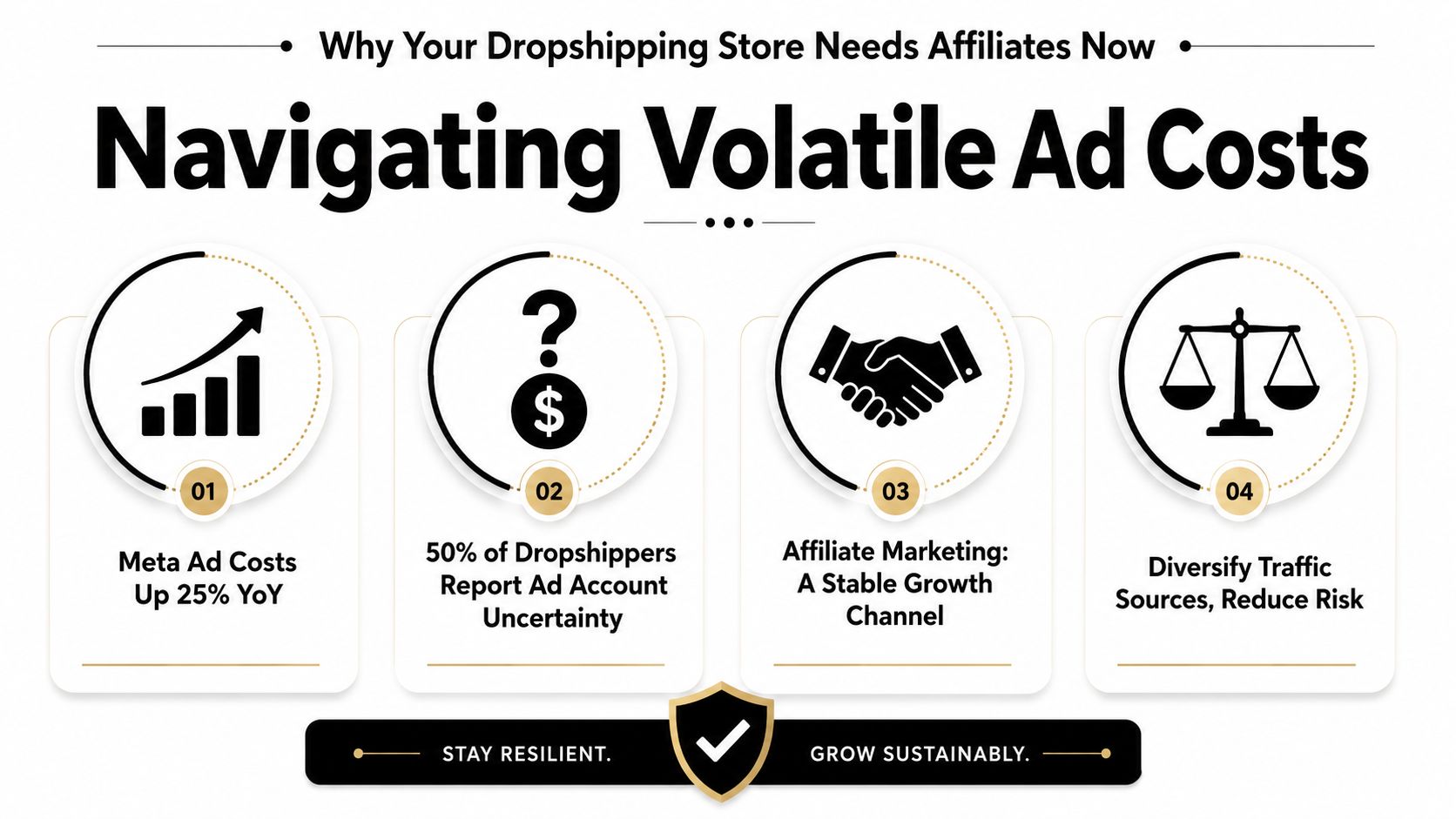
Why Your Dropshipping Store Needs Affiliates Now
For a new dropshipper, the biggest problem with paid acquisition isn't just cost. It's unpredictability. You can plan a test budget, write decent creatives, and still end up reacting to platform volatility instead of building a repeatable customer acquisition system.
Affiliate marketing gives you a different risk profile. You're not paying to show ads and hoping the economics work later. You're paying after a tracked sale or lead, which makes it easier to protect cash when every order matters. That's one reason affiliate marketing has moved from “nice to have” to standard operating procedure for ecommerce brands.
The economics are hard to ignore. For every $1 spent, businesses receive an average ROI of $6.50, 81% of advertisers and brands actively use affiliate programs, and the global industry was valued at $18.5 billion in 2024 with a projection of $31.7 billion by 2031 according to New Media's affiliate marketing statistics. That tells you two things. The channel is mature, and the infrastructure around it already exists.
Affiliates lower pressure on your ad account
A first affiliate program won't replace Meta. It will reduce how dependent you are on one platform. That distinction matters. When one channel underperforms, you still want orders coming in from creators, niche publishers, customer advocates, or email list owners who already speak to your target market.
Practical rule: If one ad account problem can interrupt most of your acquisition, your business needs a second channel that isn't tied to daily media spend.
That's why affiliate program setup pairs well with a beginner-friendly paid traffic plan. If you're still building your ad foundation, this guide on a referral marketing strategy for new ecommerce brands is a useful companion because it helps you think beyond single-channel customer acquisition.
Why this works for thin-margin stores
Dropshippers don't have the luxury of waste. A bloated affiliate program can lose money fast, but a disciplined one is budget-friendly because you control the offer, the approvals, the tracking rules, and the payout timing. You can start small with a handful of relevant partners instead of trying to recruit a huge network.
That's the opportunity. Affiliates let a small store borrow trust and audience access without paying large sponsorship fees upfront. For a founder watching every dollar, that's often the difference between a channel you can test now and one you have to postpone.
Planning Your Commissions and Incentives
Most affiliate programs fail before launch because the owner copies a commission rate from another brand and never checks whether the math works for their own store. In dropshipping, that mistake shows up fast. Product cost, shipping, payment fees, refunds, and occasional discounts leave less room than most beginners expect.
The industry gives you a benchmark, not an answer. The global average affiliate commission rate is 9.2%, Cost Per Sale is the standard model, 62% of affiliate traffic comes from mobile devices, and 17% of affiliate traffic was fraudulent in 2022 according to Hostinger's affiliate marketing statistics roundup. Those numbers are useful, but your store margin decides what's sustainable.
Start with contribution margin, not industry averages
Use a simple formula before you promise a commission:
| Item | What to include |
|---|---|
| Revenue per order | Product price after any planned discount |
| Direct costs | Product cost, shipping subsidy, transaction fees |
| Operating buffer | Returns, support time, app fees, packaging extras |
| Available affiliate pool | What's left before profit |
If the remaining pool is tight, don't force a “competitive” rate that only looks good on paper. A smaller but reliable commission beats a generous offer you'll cut later. Affiliates notice when a program changes terms too quickly, and trust is harder to rebuild than to protect.
For physical products, a cautious starting point is often smarter than an aggressive one. You can always add incentives for proven partners after you see order quality, refund behavior, and average order value.
The right commission is the highest rate you can pay repeatedly without dreading every affiliate sale.
Pick a structure affiliates can understand quickly
For a first-time dropshipper, CPS usually makes the most sense because it aligns payout with completed revenue. Within that model, you have a few practical options:
- Flat percentage commission works well when your catalog has similar margins. It's easy to explain and easy to audit.
- Category-based commission makes sense if some products are margin-rich and others are fragile. Don't pay the same rate on a high-return item and a dependable bestseller unless you've checked the numbers.
- New customer bonuses can work if your repeat purchase rate is healthy. For a very new store, keep this simple so you don't create payout confusion.
- Product-specific pushes help you steer affiliates toward items that ship cleanly, convert well on mobile, and produce fewer support tickets.
If you sell a mix of bundles and single items, think carefully about whether affiliates should earn on the full cart or only the promoted product. Simpler rules reduce disputes.
Build incentives that don't wreck margin
Cash isn't your only lever. Budget-conscious stores can motivate affiliates with:
- Tiered rewards for proven partners such as a higher rate after consistent approved sales.
- Store credit if your products support repeat buying.
- Early access to launches so creators get something fresh to promote.
- Exclusive bundles that raise average order value without lowering your base pricing.
Avoid the beginner trap of offering too much too early. Strong affiliates care about payout, but they also care about conversion rate, product fit, clean tracking, and whether you respond quickly when they need help.
A practical setup often looks like this:
- Start with a base commission you know is sustainable.
- Hold back higher incentives for affiliates who drive approved orders.
- Use private increases instead of public rate inflation.
- Review profitability after the first run of tracked sales.
If you want one standard for every applicant, keep it lean. If you want to reward performance, do it after the affiliate has earned trust.
Choosing and Configuring Your Affiliate Platform
Software choice matters, but not for the reason most app pages suggest. Beginners get distracted by dashboards, branding features, and affiliate portal design. Those are nice. What matters first is whether the platform tracks sales correctly, handles reversals cleanly, and fits your store's budget without turning setup into a week-long technical project.
For most new dropshippers, the shortlist usually includes UpPromote or GoAffPro on Shopify, and AffiliateWP on WooCommerce. They're commonly considered because they're accessible to small stores, they don't require enterprise infrastructure, and they cover the core workflow: affiliate signup, link generation, coupon support, commissions, and payout management. The best one isn't universal. The best one is the app you can configure correctly and audit confidently.
What matters more than feature lists
Start your decision with four filters.
| Platform question | Why it matters to a dropshipper |
|---|---|
| Can I afford it at low volume? | App fees hurt more when you only have a handful of affiliate sales. |
| Can I understand the dashboard quickly? | If reporting is confusing, you'll delay approvals and payouts. |
| Does it support coupon and link tracking cleanly? | Beginners often need both while they test what affiliates actually use. |
| Can it handle refunds and order changes automatically? | Manual cleanup becomes messy fast. |
If two platforms look similar, choose the one with the cleaner workflow for approving affiliates, checking attributed orders, and reviewing pending commissions. Fancy extras don't help if you can't trust the basics.
Some operators also use adjacent tools around the program. For example, Social Loop AI is built for first-time ecommerce owners who need a structured way to launch Meta ads and social creatives from a product URL, while an affiliate app handles partner links and payouts. That split can make sense when you want paid traffic and affiliate traffic working side by side without trying to force one platform to do everything.
A simple comparison mindset for Shopify and WooCommerce
If you're on Shopify, ease of setup usually matters most. A practical beginner choice is the app that installs quickly, creates a usable affiliate portal, and supports coupon tracking without requiring custom work. Review how each app handles signup approvals, order attribution, and commission reversals before you commit.
If you're on WooCommerce, control is often the trade-off. Tools like AffiliateWP tend to appeal to store owners who want tighter WordPress-native management, but that control only helps if you're comfortable managing plugin interactions and checkout behavior.
Use this decision lens:
- Choose simplicity if you're launching your first product and need speed.
- Choose flexibility if you already know you'll want custom workflows later.
- Choose reliability over aesthetics every time.
A beautiful affiliate portal doesn't compensate for broken tracking.
Your pre-launch tracking checklist
Before you invite a single partner, test the setup like an operator, not like an optimist. A reliable technical setup requires validating key edge cases, including quick registration of test conversions, accurate commission calculations that exclude tax and shipping unless explicitly defined, cross-device tracking, and automatic commission reversals for refunds according to Advertise Purple's affiliate setup guide.
Run these checks yourself:
- Place a real test order using an affiliate link. Confirm the conversion appears in the dashboard quickly.
- Check commission math against the exact order breakdown. Tax and shipping should only count if you decided they count.
- Test across devices because affiliate traffic often starts on one device and finishes on another.
- Process a refund test and make sure the commission status updates correctly.
- Open product links from mobile and inspect the landing page. If the page loads poorly or the cart is awkward on a phone, affiliates will send traffic that doesn't convert.
A cheap app with disciplined testing usually beats an expensive app left on default settings. That's especially true when you're running lean and can't afford attribution mistakes.
Equipping Your Affiliates for Success
Most new affiliates don't need motivation first. They need materials. If you approve someone and send nothing except a login link, many of them will never post, never email, and never mention your product again. The fastest way to increase useful affiliate activity is to remove the work between approval and promotion.
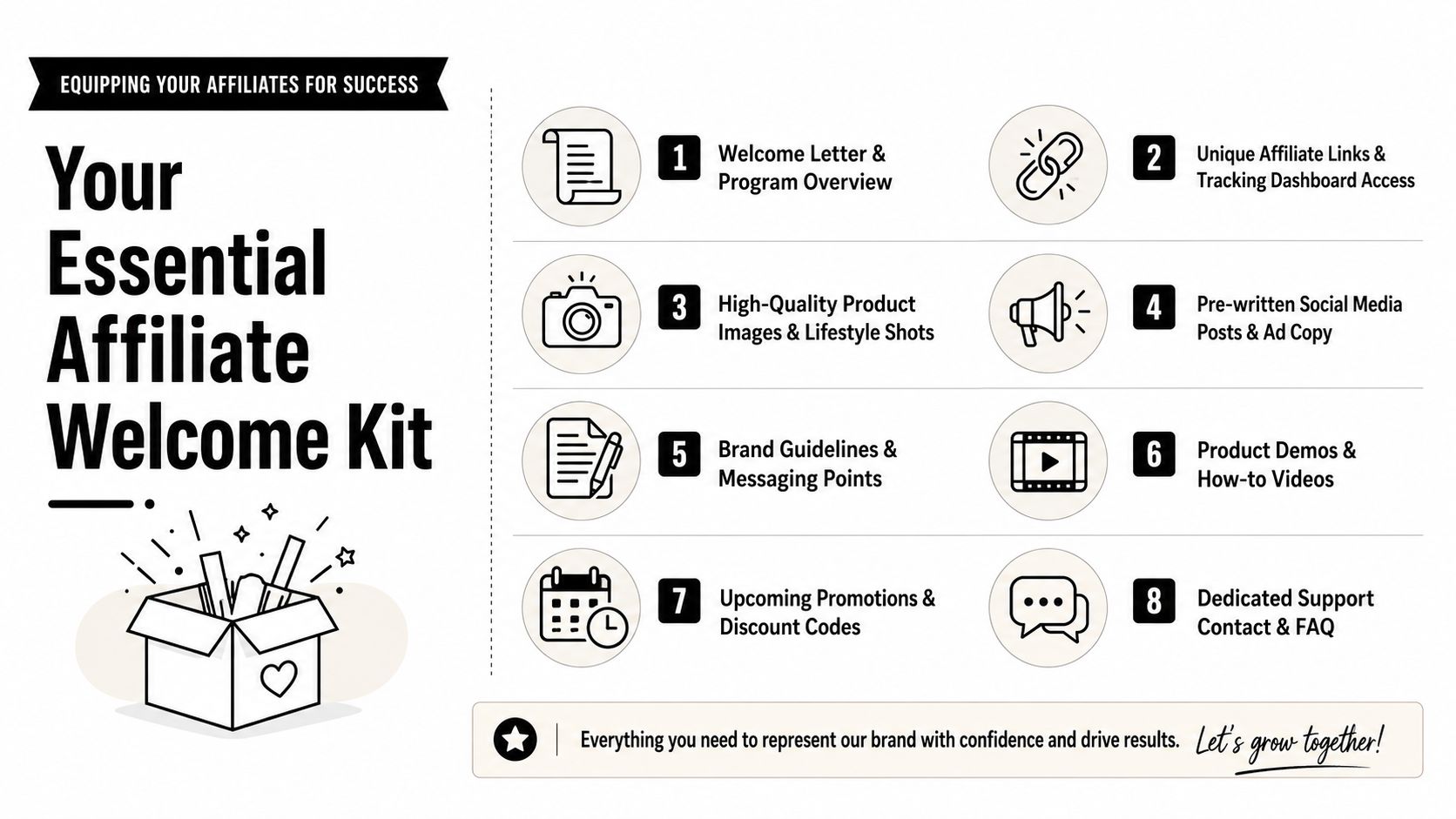
Start with a proper welcome kit.
Build a welcome kit people can use immediately
Successful programs provide standard IAB banner sizes of 300×250, 728×90, and 160×600, and they use a structured 30-day onboarding cadence to increase active affiliates according to Modash's guide to building an affiliate program. That's useful because it turns vague “support” into specific deliverables.
Your first version doesn't need a designer on retainer. It needs assets that are usable and organized:
- A short welcome note that explains who the product is for, what claims affiliates should avoid, and where they can find links and codes.
- Deep links to your best products instead of sending everyone to the homepage.
- Three banner sizes that fit common placements.
- A small swipe copy pack with email angles, social captions, and a few hook variations.
- Product photos and lifestyle images that don't require affiliates to crop screenshots from your site.
- A one-page FAQ covering payout timing, returns, coupon rules, and support.
If you want help producing cleaner promotional copy, this guide on AI affiliate writing for ecommerce offers is useful for building scripts, captions, and swipe text without sounding generic.
A quick visual walkthrough can also help affiliates understand how to promote the offer.
Use a 30-day onboarding rhythm
Good affiliates still go cold if you disappear after approval. A simple onboarding cadence keeps the relationship active without turning your program into a full-time job.
Here's a practical schedule:
-
Day 1
Send the welcome kit, affiliate link, approved discount structure, and top product recommendations. -
Day 7
Follow up with the products that are converting best, plus fresh copy angles they can test. -
Day 14
Ask if their links are working properly and whether they need landing pages, bundles, or creatives. -
Day 21
Share a performance snapshot. Tell them which content types or products seem to be gaining traction. -
Day 30
Re-engage anyone who signed up but hasn't promoted yet. Sometimes they just need a narrower starting point.
Affiliates don't need more information. They need fewer decisions.
One more practical point. Give them deep links to a small number of products, not your full catalog. A curated set performs better than dumping your entire store on a new partner and expecting them to sort it out.
Recruiting Your First Army of Affiliates
Your first affiliates probably won't come from a giant marketplace. They'll come from people already close to your niche: existing customers, creators with modest but relevant followings, bloggers with tight audience trust, and community owners who can move a small amount of qualified traffic.
That's good news for a budget-conscious founder because it means you can recruit without paying recruitment platform fees or upfront sponsorship costs.
Start with people already close to the product
The easiest early wins usually come from three groups:
- Existing customers who liked the product enough to mention it naturally.
- Micro-influencers in your niche who are open to performance deals.
- Small publishers or newsletter owners who speak to the exact buyer you want.
Start by reviewing your own order history, tagged social mentions, comments, and DMs. If someone has already shown interest, the outreach is warmer and the audience fit is usually better.
Your message should stay direct. Tell them what the product is, why you think it fits their audience, what the affiliate arrangement looks like, and how simple the setup is. Don't write a long pitch deck disguised as an email.
How to approach micro-influencers without sounding spammy
Most bad affiliate outreach fails because it's mass-produced. It praises the creator vaguely, offers no product context, and asks for promotion before trust exists.
Use a tighter structure:
- Mention the specific post, angle, or audience trait that made you reach out.
- Explain the product in one or two plain sentences.
- Offer an affiliate relationship, not a vague “collab.”
- State what support they'll get, such as assets, links, and a clear payout process.
- Make the next step easy.
If you need a starting framework, adapt an outreach structure from this sales introduction email template and simplify it for affiliate recruitment.
A plain example:
I run a small store in the home workout niche. I found your content through your resistance band tutorials, and your audience fit looks strong for our product. We're opening a small affiliate program and can provide a tracked link, promo support, and ready-to-use creative assets if you'd like to test it.
That's enough. If they're interested, they'll reply.
Who to approve and who to reject
Not every applicant helps your store. A smaller, relevant group will usually outperform a large pile of random affiliates.
Watch for these green flags:
- Audience fit that matches your product category and price point.
- Original content instead of repost-heavy accounts.
- Clear communication when they apply or reply.
- A realistic promotion plan, even if their following is small.
Reject or pause applicants when you see:
- Coupon-only behavior with no actual audience.
- Brand mismatch between your product and their content style.
- Fake engagement patterns or low-quality traffic sources.
- Pressure for custom discounts immediately before any proof of performance.
A good first cohort is often only a handful of people. That's enough to test your workflow, creative support, conversion path, and payout process before you scale recruitment.
Compliance Payouts and Common Pitfalls
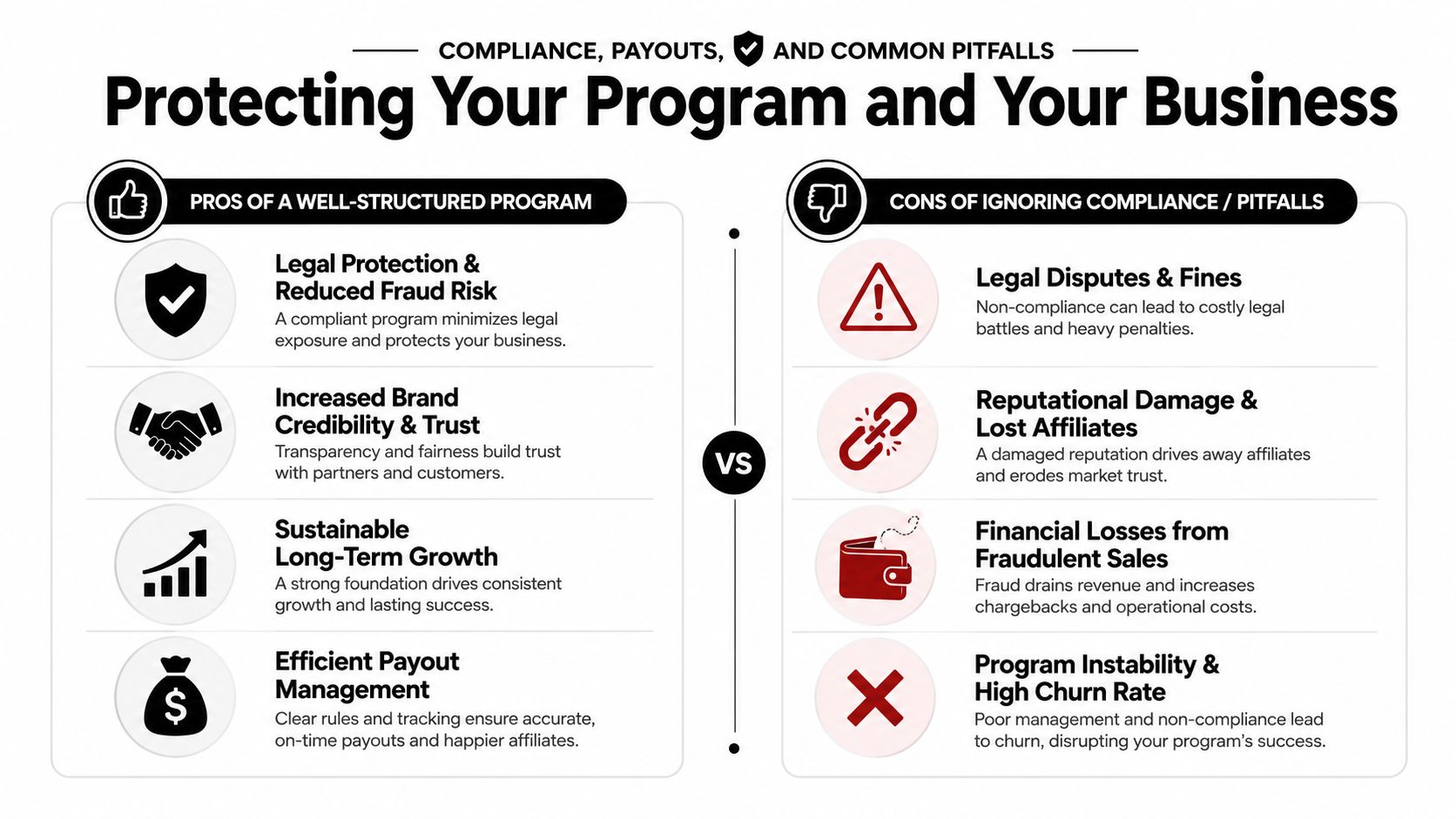
Founders often treat compliance as something to clean up later. That's a mistake. Once affiliates start driving orders, money and expectations show up immediately. If your terms are vague, your payout process is inconsistent, or your coupon rules are sloppy, small problems turn into disputes fast.
The basics don't need to be complex. You need written program terms, a clear approval standard, a predictable payout schedule, and simple disclosure guidance so affiliates know they must identify sponsored or compensated promotion. Professionalism matters here because affiliates notice when a store looks improvised.
Set rules before money starts moving
Keep your operating rules plain and visible:
- Define approved traffic methods so affiliates know what's allowed.
- State when commissions become payable such as after the return window closes.
- Explain reversals for refunded or canceled orders.
- List prohibited behavior including misleading claims, trademark misuse, or unauthorized discount promotion.
Payouts should feel boring. That's the goal. A consistent monthly or scheduled cycle is easier to manage than ad hoc payments every time someone asks.
If affiliates have to guess how and when they'll be paid, some of them will stop promoting before they ever start.
Coupon poaching is a setup problem
One of the biggest fears for dropshippers is coupon poaching. That happens when discount codes spread beyond the intended affiliate or get used by buyers who were already on the way to purchasing, which cuts margin and muddies attribution.
The practical fix isn't legal threats. It's technical control. The most effective prevention is using unique, single-use codes or embedded discount logic within tracking links that auto-apply at checkout, as explained in Linkjolt's discussion of affiliate recruitment and coupon poaching. That setup gives each affiliate a controlled offer and reduces the chance of code leakage wrecking your economics.
For a lean store, focus on these safeguards:
- Assign unique codes instead of shared public coupons.
- Prefer auto-applied discounts tied to affiliate tracking when your platform supports it.
- Review coupon sites manually if they start appearing in your traffic mix.
- Approve affiliates selectively so random code distributors don't enter the program.
The biggest pitfall isn't that abuse exists. It's assuming you'll deal with it after launch. Day-one controls are cheaper than cleaning up margin loss later.
If you're building your first store and want a practical system for launching paid traffic alongside affiliate growth, Social Loop AI helps new ecommerce owners turn a product URL into a Meta ads launch plan, creative angles, and ready-to-test ad assets without hiring an agency.