Blog
8 Customer Testimonial Examples for Ecommerce in 2026
Published July 24, 2026
You've got the store live, the product pages look clean, and the first few visitors are still bouncing. The problem usually isn't the offer alone, it's that buyers don't yet have a reason to believe you. Customer testimonial examples solve that belief gap by turning someone else's result into proof a new shopper can trust.
That matters even more for new ecommerce owners on a tight budget. You're not trying to build a giant brand wall of social proof on day one, you're trying to place the right proof in the right place, especially in Meta ads, landing pages, product pages, and email follow-ups. The strongest testimonials are specific, named, and reusable across channels, because testimonials stopped being decoration a long time ago and became conversion assets used throughout the funnel, from homepages to pricing pages to ads, with industry guidance converging on real names, photos, job titles, and concrete numbers as the credibility stack WordStream's customer testimonial guidance.
Table of Contents
- 2. Written Case Study / Success Story Testimonial
- 2. Written Case Study / Success Story Testimonial
- 3. User-Generated Content (UGC) Testimonial / Unboxing
- 4. Star Rating / Numerical Score Testimonial
- 5. Expert / Influencer Endorsement Testimonial
- 6. Specific Problem→Solution Testimonial
- 7. Rapid-Win / Quick-Results Testimonial
- 8. Multi-Format Testimonial Package
- 8-Point Customer Testimonial Comparison
- Turn Your Customers into Your Best Sales Team
2. Written Case Study / Success Story Testimonial

A written case study works well when a buyer needs proof, but not a full sales page. It gives you room to show the problem, the decision, the way the product fit into the customer's routine, and the result they noticed. For a new ecommerce store, that format is useful because it answers the question behind most hesitations, “Will this work for someone like me?”
The cleanest structure is Situation, Task, Action, Result. It keeps the story easy to scan and stops the testimonial from drifting into a generic praise quote. Smartsheet's testimonial-based case study template, along with broader case study structure guidance, points toward the same idea, tie the story to a concrete before-and-after and keep the outcome believable. For ecommerce, that means you do not need a long brand narrative. You need a short story with a real buyer, a clear constraint, and an outcome that feels earned.
A written testimonial also gives you more control over the ad angle. A Problem→Solution version is useful for cold traffic because it mirrors the buyer's own hesitation. A Social Proof version works better on landing pages and email because it reduces the feeling that the customer is taking a risk. If you are collecting stories from customers and want a simple process, how to make UGC is a good starting point for turning raw responses into usable assets.
A simple structure to copy
- Situation: The customer explains what was not working.
- Task: They say what they wanted to change.
- Action: They explain how they used the product.
- Result: They describe the outcome in plain language.
Keep the writing to two or three short paragraphs, so it still feels like a customer story, not a long B2B case study that gets skipped. Start with the pain point, then show the decision and the result. If the product has a practical benefit, name the specific change the customer noticed, faster setup, less effort, fewer mistakes, or a better-looking result. Those details matter more than polished praise because they help a new shopper see themselves in the story.
For dropshippers, this format is especially useful when the product solves a narrow problem or needs a little explanation before purchase. It also gives you a clean asset for Meta ads, because you can cut the same story into a headline, a short landing page block, and a retargeting creative without rewriting the whole thing.
2. Written Case Study / Success Story Testimonial
Written testimonials give you room to explain the whole journey, not just the highlight. That makes them ideal for shoppers who need a little more proof before they click buy, especially when the product is new or the category feels crowded. The best written customer testimonial examples read like a compact case story, with a problem, a decision, an implementation step, and a result.
The cleanest structure is Situation, Task, Action, Result, because it keeps the story organized and easy to skim. Smartsheet's testimonial-based case study template recommends grounding the story in tangible results with data, statistics, and before-and-after comparisons, which is exactly why this format works so well for landing pages and email sequences Smartsheet's testimonial-based case study template. For ecommerce, you don't need a long brand essay. You need a believable mini-story that shows a buyer, a constraint, and a visible payoff.
A simple structure to copy
- Situation: The customer explains what wasn't working.
- Task: They describe what they wanted to change.
- Action: They explain how they used the product.
- Result: They name the outcome in plain language.
Keep the writing in two or three short paragraphs so it doesn't feel like a case study from a B2B site nobody will finish reading. If possible, lead with the best result first, then back into the context. That order works better for ecommerce because readers want the payoff before they commit to the details.
A good written story is also easier to repurpose than a long-form interview. You can trim it into an email snippet, break it into ad copy, or pair it with a photo on a product page. The more concise the language, the easier it is to reuse without losing authenticity.
3. User-Generated Content (UGC) Testimonial / Unboxing
UGC is the format that feels least like a brand is talking about itself. A real customer opens the package, uses the product in their own space, and talks casually about what they noticed. That's why UGC-style customer testimonial examples often outperform polished brand assets on Meta, where people are much more likely to trust something that looks native to the feed.
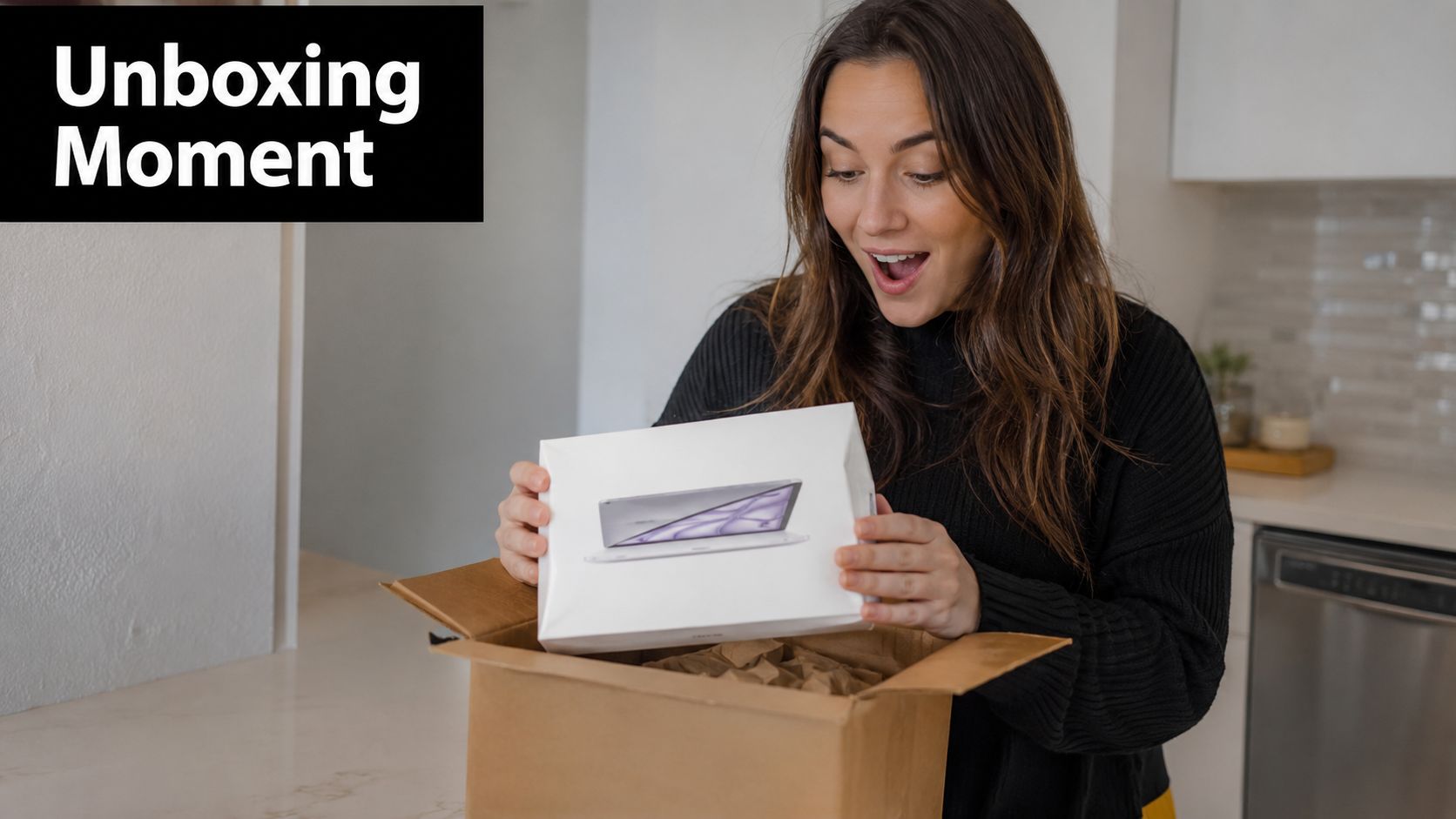
The power here is authenticity. The customer doesn't need to sound like a spokesperson, and they shouldn't. What you want is a phone-shot clip that shows the unboxing, a quick feature demo, and a final thought. For new ecommerce brands, that's often the cheapest way to create believable creative because you're using real users instead of studio production. If you need a practical workflow for that type of content, Social Loop's UGC guide is a relevant internal reference for building the production side.
Keep the ask human
Ask for honest feedback, not a performance. If you offer a small credit or free product, make it clear that the incentive is for participation, not for praise. The best clip often includes a small hesitation or surprise, because that sounds like an actual buyer response rather than a polished endorsement.
Use this rule: if it sounds like a founder wrote it, it won't feel like UGC.
You can also create a small content library by sourcing multiple customers and giving each one a different prompt. One person can focus on setup, another on first impression, another on how the product fits into daily use. That variety gives you more angles to test without needing a bigger budget.
4. Star Rating / Numerical Score Testimonial
Sometimes the strongest proof is the shortest. A star rating or numerical score works because it's fast to scan and easy to compare, which is useful when someone is deciding whether to keep reading or head to checkout. These customer testimonial examples don't tell the whole story on their own, but they lower hesitation quickly when they're paired with a short comment.
The practical move is to show the aggregate score prominently and then add a brief written line underneath. A verified purchase badge matters because it gives the rating more weight, especially on product pages where shoppers are already evaluating risk. You'll also want to rotate the visible reviews so the page doesn't feel stale. Freshness matters because older feedback loses relevance for many buyers, according to the testimonial guidance compiled by SendTrumpet's article on how testimonials influence trust SendTrumpet on customer testimonials.
Where this format earns its keep
On checkout pages, star scores reduce second-guessing. In ads, a compact rating line can work as a trust cue when the creative already carries the message. In product grids, the stars do a lot of heavy lifting before the shopper even clicks.
The downside is obvious, ratings without context can feel thin. That's why the best version includes one sentence that names the product's practical value, like faster shipping, better quality, or easier setup. If you only show stars, you get attention. If you pair the stars with a real comment, you get credibility.
For new dropshippers, this format is cheap to deploy because you can collect it through an automated post-purchase email flow. It's one of the easiest ways to turn early customers into a visible proof layer without needing a full content campaign.
5. Expert / Influencer Endorsement Testimonial
Authority changes how a testimonial lands. When a niche expert or micro-influencer says a product is useful, buyers borrow that person's credibility and apply it to your store. This is especially helpful when you're new and don't yet have a long review history, because the endorsement fills in the trust gap with borrowed reputation.
The best expert testimonial is specific, not generic praise. A digital marketing creator should explain what the product replaced, why it saved time, or how it changed the workflow. A product photographer should talk about the output quality. A dropshipping educator should explain how it fits into a launch process. Send the product first, then ask for an honest reaction with clear usage rights and disclosure terms.
You don't need celebrity scale for this to work. A smaller creator with a tightly matched audience can be more convincing than a bigger name whose followers don't care about ecommerce tools or product discovery. That's why audience fit matters more than raw reach for this type of social proof.
What to ask for
- Full handle and role: So the audience can verify who's speaking.
- Profile link: So the endorsement feels real and traceable.
- A use-case statement: So the testimonial connects to a buyer problem.
- Disclosure language: So the partnership stays transparent.
This format works best for awareness and retargeting, where the buyer has already seen your product once or twice. It's less about instant conversion and more about making the store feel established. If you're early stage, use it selectively. One good authority quote can lift a product page, but a weak endorsement that sounds forced can hurt more than help.
6. Specific Problem→Solution Testimonial
This is the most useful format when your ad needs to answer one objection at a time. A buyer sees the exact pain point they already have, then watches the product solve it in plain language. That's why problem-focused customer testimonial examples usually convert well in segmented ads, because they mirror the customer's inner dialogue.
The best structure is simple. The customer says what they couldn't do, what they tried before, what the product changed, and what happened next. The wording should be concrete. “Slow” is weak. “It took me a week to make one ad” is far more useful. “I couldn't afford a designer” is stronger than “I needed help.” Specificity reduces doubt because it shows the testimonial came from a real situation, not a marketing prompt.
Match the proof to the objection
If the ad says “No design skills needed,” the testimonial should come from a first-time seller who lacked design experience. If the ad says “I don't have time,” the testimonial should mention a fast workflow. If the ad says “I'm nervous about setup,” the testimonial should show an easy first step and a quick result. The message and the proof have to line up.
That alignment matters because a generic success quote won't answer the hesitation sitting in the buyer's head. For ecommerce founders, the best use is to build a small set of testimonial variants around your top objections, then pair each one with the matching ad angle. That's a much better use of limited budget than blasting the same praise everywhere and hoping it lands.
7. Rapid-Win / Quick-Results Testimonial
Speed is a selling point when the customer wants confidence early. A rapid-win testimonial says the product delivered value quickly, which reduces the fear that the buyer will spend money and wait too long to see anything useful. In ecommerce, that kind of customer testimonial example works well for tools, templates, and launch support because the payoff can be felt almost immediately.
The important part is the timeframe. A quick result without a time marker feels vague. Once the customer says “in the first day,” “in the first week,” or “in 30 minutes,” the statement becomes much more believable and easier to visualize. That doesn't mean you should promise magic. It means you should show early momentum in a way that feels realistic.
This is also a good format for FOMO-style ads because it makes the path to value look short. Someone who's hesitant about effort wants to know whether the product will take over their schedule. A rapid-win testimonial answers that directly by showing the setup was manageable and the first result came quickly.
Results vary based on effort, product-market fit, and how closely the buyer follows the instructions.
That kind of plain disclaimer can help because it makes the testimonial sound more honest. New ecommerce owners don't need hype. They need proof that a first win is possible without a huge learning curve. If you can collect a few short stories like that, they become useful across prospecting, retargeting, and email follow-up.
8. Multi-Format Testimonial Package
One customer story can power half your marketing if you collect it in the right formats. A multi-format package gives you a written quote, a short video, and a usable photo from the same person, which makes it easier to test different channels without chasing new approvals every time. That's one of the smartest customer testimonial examples for budget-conscious founders because it multiplies output from a single happy customer.
The biggest advantage is distribution. A short quote can sit on a landing page, the video can run in Meta ads, and the photo can support email or a product page. Social Loop AI's own framing around testimonial advertising points toward this kind of reuse, where one testimonial can be turned into multiple assets for different placements and intentions Social Loop AI on testimonial advertising. For a new store, that kind of asset reuse matters because you're not wasting time collecting proof one channel at a time.
Build the package once
A simple testimonial kit can ask for three things. First, a short quote about the main result. Second, a 20 to 30 second phone video. Third, one clean photo of the product in use. If you label and store those assets clearly, you can tag them by angle, audience segment, and objection, which makes future ad testing easier.
This is also the format that scales best as you grow. Once a customer is happy enough to give one piece of proof, it doesn't take much more effort to collect the rest. That's the difference between testimonials as scattered evidence and testimonials as a system.
8-Point Customer Testimonial Comparison
| Format | 🔄 Implementation complexity | ⚡ Resource requirements | 📊 Expected outcomes | 💡 Ideal use cases | ⭐ Key advantages |
|---|---|---|---|---|---|
| Video Testimonial with Before/After Results | Medium–High 🔄 (customer filming + edit) | Medium ⚡ (phone/video editing, releases) | High 📊 (strong engagement & conversions) | Ecommerce ads, landing pages, DTC testing | Emotional visual proof; highly repurposable ⭐⭐⭐⭐⭐ |
| Written Case Study / Success Story Testimonial | High 🔄 (interviews + polished writing) | Medium (editing, interview time) ⚡ | High 📊 (deep trust, SEO, long shelf-life) | Landing pages, email sequences, B2B or premium offers | In-depth credibility; addresses multiple objections ⭐⭐⭐⭐ |
| User-Generated Content (UGC) Testimonial / Unboxing | Low 🔄 (simple capture, unscripted) | Low ⚡ (customer phone footage, small incentives) | High 📊 (authenticity → high trust & engagement) | Social feeds, Reels, Meta ads, community-building | Highest authenticity at low cost; algorithm-friendly ⭐⭐⭐⭐⭐ |
| Star Rating / Numerical Score Testimonial | Low 🔄 (automated collection, minimal curation) | Low ⚡ (post-purchase emails, review system) | Moderate–High 📊 (reduces purchase friction; scalable) | Checkout, product pages, ad copy with FOMO | Scannable social proof; easy to collect at scale ⭐⭐⭐⭐ |
| Expert / Influencer Endorsement Testimonial | Medium–High 🔄 (outreach, vetting, agreements) | High ⚡ (payments, product samples, legal) | High 📊 (authority transfer; awareness & credibility) | Brand awareness, authority-building, creator partnerships | Leverages third-party credibility and reach ⭐⭐⭐⭐ |
| Specific Problem→Solution Testimonial | Medium 🔄 (targeted sourcing per objection) | Medium ⚡ (research + tailored asks) | High 📊 (higher conversion when matched to segment) | Segmented ads addressing objections, retargeting | Directly addresses buyer hesitations; easy to test ⭐⭐⭐⭐⭐ |
| Rapid-Win / Quick-Results Testimonial | Low–Medium 🔄 (capture timeframe + validation) | Low–Medium ⚡ (verify claims, brief media) | High short-term 📊 (drives urgency & fast conversions) | Courses, tools, impulse buys, time-sensitive offers | Creates FOMO and motivates immediate action ⭐⭐⭐⭐ |
| Multi-Format Testimonial Package (Quote + Video + Photo) | High 🔄 (coordination + multi-format capture) | High ⚡ (incentives, production, asset management) | Very High 📊 (versatile assets across channels) | Large campaigns, A/B testing, cross-channel strategy | Maximum asset efficiency; supports broad testing ⭐⭐⭐⭐⭐ |
Turn Your Customers into Your Best Sales Team
You've now got a practical set of customer testimonial examples that map to the way real buyers decide. The smartest move isn't collecting every possible testimonial type. It's matching the proof to the channel and the objection. A video testimonial works because it shows emotion and usage. A written case story works because it gives depth. UGC works because it feels native. A star rating works because it's fast. An expert endorsement works because it transfers authority. A problem-solution quote works because it answers doubt directly. A rapid-win story works because it shortens the perceived path to value. A multi-format package works because it gives you more impact from the same customer.
For new ecommerce owners, the win is system design. Ask for testimonials right after a positive moment, keep the request simple, and store every asset in a way that makes reuse easy. Then deploy each testimonial where it fits best, on product pages, in Meta ads, in email sequences, and in retargeting. That approach lines up with the broader marketing consensus that testimonials are no longer optional decoration, they're conversion assets that belong across the funnel WordStream, Smartsheet, and TestimonialHero.
If you're launching on a limited budget, start with one strong customer and build out from there. A single person can give you a quote, a video, a photo, and a problem-solution angle that you can test in multiple formats. That's usually more useful than chasing a huge volume of weak praise. The best social proof is specific, believable, and easy to deploy.
A CTA for Social Loop AI if you want help turning product pages and customer stories into Meta-ready ad angles, launch plans, and reusable creative assets without hiring an agency.