Blog
Facebook Ads Testing Strategy: A Beginner's Playbook
Published July 30, 2026
You're staring at Ads Manager, and nothing feels clear. One creative has a few clicks, another barely spent, and the audience you thought would love the product is acting like it's never seen it before. That's the exact moment a facebook ads testing strategy stops being theory and starts being survival, because without a system you're just paying to stay confused.
The beginner mistake is assuming the dashboard will hand you a winner if you wait long enough. In practice, Meta can optimize on noise if you let too many variables move at once, or if you cut a test before it has enough volume and time to mean anything. A disciplined testing round turns that mess into a repeatable production line, where losers get pruned, middle performers get retested, and winners earn the right to scale.
Table of Contents
- What a Facebook Ads Testing Strategy Does for You
- Set Goals, Hypothesis, and Audience Before You Spend a Dollar
- Pick 2 to 3 Angles and Allocate Budget Like a Pro
- Design Creatives and Variants That Deliver Clear Signals
- Size Your Round Length and Daily Budget Correctly
- Read Your Results Without Fooling Yourself
- Decide What to Scale, Pause, or Retest Next
What a Facebook Ads Testing Strategy Does for You
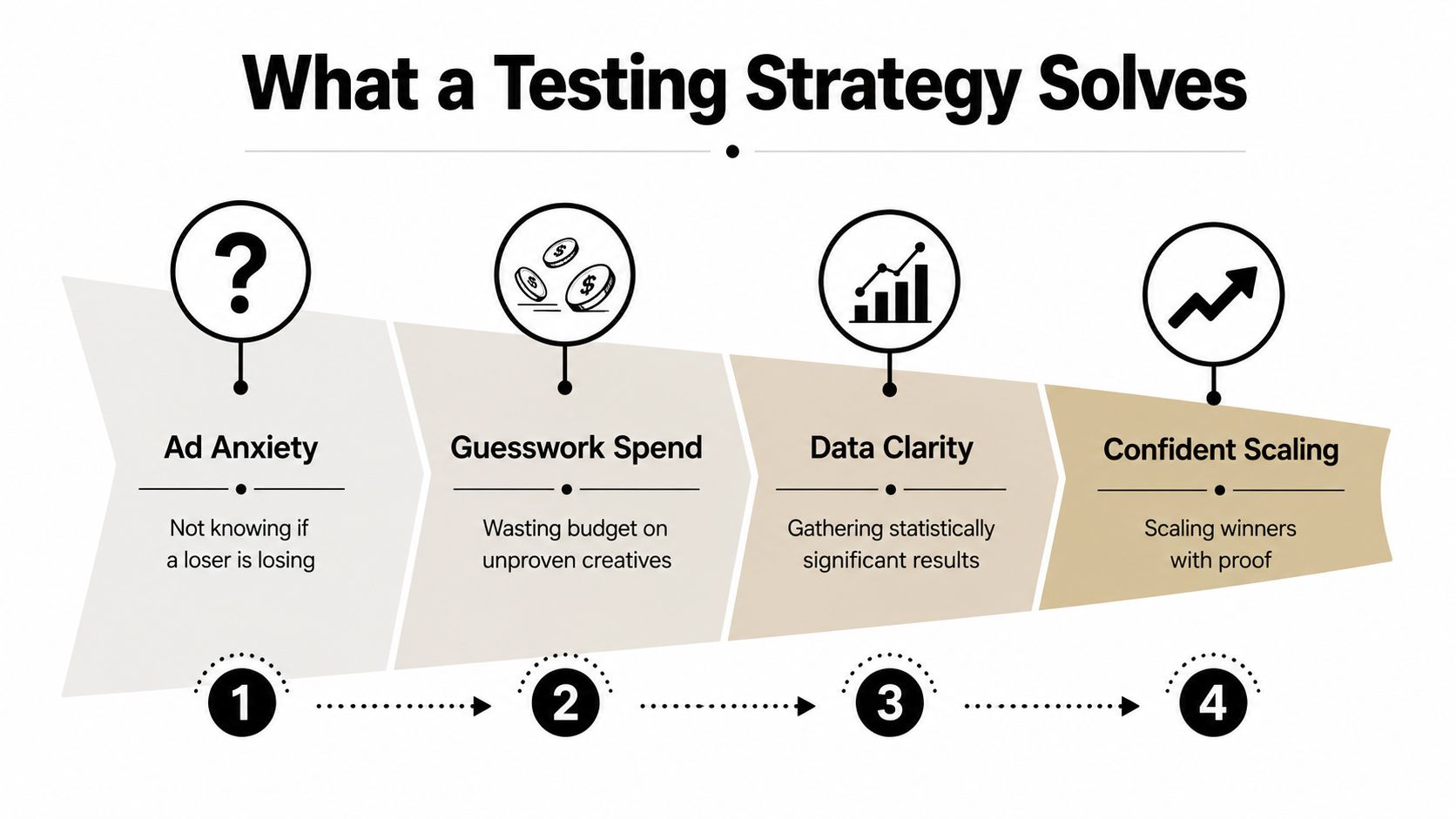
The first time a new ecommerce advertiser launches three creatives into one audience, the dashboard often produces the same emotional result, a bad one. One ad gets a few early clicks, one burns almost nothing, and one looks decent until the spend drips away without a purchase. At that point, it is hard to tell whether the loser was weak, or whether it just got unlucky in a small sample.
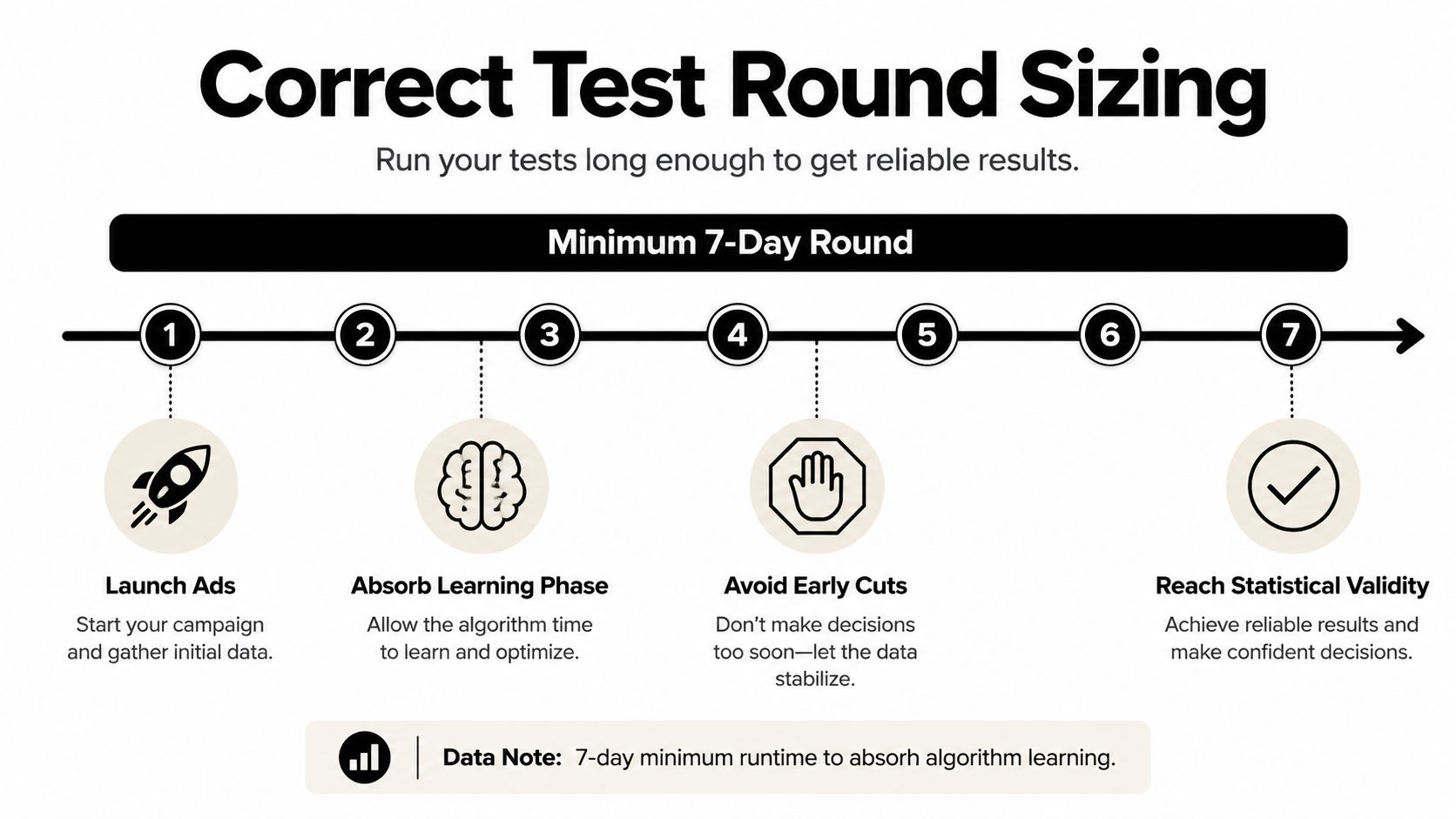
A facebook ads testing strategy gives each ad a fair shot by holding one variable steady and letting the result run long enough to separate signal from noise, weekday swings, and Meta's learning behavior. Practical testing setups usually use separate ad sets for a single variable, then wait for enough volume before calling a winner. Many teams look for roughly 300 to 500 clicks or about 10,000 impressions per test, plus a floor of 7 days, and some frameworks also want 50+ conversion events per variation before they trust the read KlientBoost.
The core job is not to guess faster
Beginners often treat testing like a hunt for the “best ad” in the shortest time possible. That usually turns into guesswork with nicer labels. The job is to build a system that shows which creative, audience, or placement deserves more money, and which one should stop using budget.
Practical rule: if you cannot explain what changed between one ad set and the next, you cannot trust the result.
That is why the scale, pause, retest loop matters. A winner gets more spend. A loser gets shut off. A middle performer gets a fresh variable and another round. That is production-line discipline, not brainstorming.
The same mindset keeps you from overreacting to a single screenshot. One good day does not build a store. A repeatable testing process does.
Set Goals, Hypothesis, and Audience Before You Spend a Dollar
Strong tests start before Ads Manager opens. If the goal is fuzzy, the test becomes a pile of unrelated data points, and you end up arguing with yourself about what “good” even means. Write the round like a simple experiment, not a creative mood board.
A clean hypothesis keeps the round honest. Use a sentence like, if we show [angle] to [audience], then [metric] will improve, and fill in the blanks before launch. For a beginner ecommerce round, the single deciding metric should usually be CPA or ROAS, not CTR, because clicks can look healthy while purchases stay weak.
Define one buyer profile for the round
The audience should be specific enough that the result teaches you something. If you're testing a product for new parents, don't split the test across half a dozen unrelated buyer types. Pick one profile, then let the ads speak to that person consistently.
A useful way to keep that profile grounded is to write it out in plain language and keep it to one buyer type per round. If you need a template for that work, this buyer persona definition guide is a decent companion for tightening the audience before launch.
A good pre-flight brief usually fits on one page:
- Goal: what outcome decides the round.
- Hypothesis: what change should improve that outcome.
- Audience: who the ads are meant for.
- Primary KPI: the one metric that ends the argument.
- Test variable: the single thing that changes in this round.
The tighter the brief, the less you'll talk yourself into a weak winner later.
Broad versus narrow targeting is a choice, not a default. Broad can work, but only if the test still teaches you which angle or creative earns attention. Narrow can help when the offer is specialized, but it can also shrink sample size and slow learning. The point is to pick deliberately, then keep the audience still while the ad variable does the talking.
Pick 2 to 3 Angles and Allocate Budget Like a Pro
Small budgets die when they're spread too thin. Ten concepts look organized in a spreadsheet and useless in real life, because the account ends up with ten noisy data points instead of one clear winner. Recent guidance is moving toward 2 to 3 angles per round, not a giant pile of creative guesses, and a tiered split that puts 70% of test budget into angles, 20% into hooks, and 10% into formats Viral Mojo.
The logic is simple. Angles are the biggest strategic bets, hooks are the attention layer inside those bets, and formats are the delivery layer. If budget is small, the biggest slice should go to the choice most likely to change purchase behavior.
The beginner-friendly angle set
Five starting points usually cover a strong first round without turning into chaos.
- Problem to Solution: call out the pain, then show the fix.
- UGC: make the ad feel like a real person's experience.
- Social Proof: lead with evidence, reactions, or proof of demand.
- FOMO: frame the offer as something people may miss.
- Identity: speak to who the buyer wants to be.
A clean way to allocate a test is to give each angle equal treatment. If one gets more spend than the others, you're not testing, you're favoring. Equal ad set budgets keep the read honest and make the round easier to interpret later.
| Tier | Budget Share | Daily Spend | What Gets Tested |
|---|---|---|---|
| Angles | 70% | $35 | Problem to Solution, UGC, Social Proof |
| Hooks | 20% | $10 | Different opening lines or first frames |
| Formats | 10% | $5 | Image, video, carousel, or layout changes |
The exact dollar amount can change, but the structure shouldn't. If you only have enough budget for two angles, test two. If you can support three clean ad sets, test three. The rule is to keep the budget concentrated enough that each concept earns a real read.
Design Creatives and Variants That Deliver Clear Signals
Creative testing only works when the variants are meaningfully different. If you swap a single word or shift a button color, the budget usually cannot pick up a clean read. That is why repeatable testing is a production line, not an art contest.
In one analysis of 200+ audited accounts, only 5% to 7% of tested Meta ads became winners, and the examples showed 50 ads producing 3 winners in 30 days and 612 ads producing 42 winners in 90 days Opascope. Beginners usually push back on that reality. Most ads lose, and the process has to assume that from the start so it can keep producing fresh concepts anyway.

Build variants around one change
The cleanest variant changes only one thing at a time. Hook versus hook. Body copy versus body copy. Image versus video. If two variables move together, the result gets muddy and the winner is hard to trust.
The hook deserves the most attention because it is the first layer that earns or loses attention. If the opening frame or first line fails, the rest of the creative rarely gets a fair shot. Tag each creative with its angle, audience, and objection so the readout explains why the ad worked, not just that it worked.
Practical rule: if you cannot name the variable, do not launch the variant.
A beginner batch does not need to look like an agency deck. Ten image ads per batch is a realistic production target, because the goal is to generate enough distinct ideas for the small winner rate to show up. Social Loop AI is one tool that turns a product URL into a launch plan, buyer profile, and a batch of tagged Meta ad creatives, which can help teams keep this production-line approach organized without pretending the work is pure inspiration. For a step-by-step on creating authentic UGC, see this UGC creation guide.
That structure matters more than polish. Winning accounts are usually not the ones with the fanciest concepts, they are the ones that keep shipping new, clearly labeled tests fast enough to find the small fraction that deserves scaling. If you want the round to stay readable, the creative has to stay disciplined.
Size Your Round Length and Daily Budget Correctly
A test that ends too early is worse than no test, because it gives you confidence in a weak read. A test that drags on without a stop rule burns money just to avoid making a call. The better setup is a fixed round length, enough budget to produce real volume, and a decision at the end that you can stand behind.
The round should last long enough to catch normal weekday swings and give each variant a fair chance to collect signal. If you want to understand why that matters, this explanation of statistical significance helps frame the problem without turning testing into guesswork. The practical issue is simple, a tiny budget can make one ad look better just because it saw fewer chances to fail.
Budget the round from the result you need
Start with the cost of the result you are trying to buy. If a purchase usually takes a bigger spend to produce, a small daily budget will stall before it says anything useful. If the product is cheaper or the funnel converts efficiently, you can learn with less spend, but the round still has to run long enough to collect a readable sample.
The cleanest way to size the test is to work backward from the number of meaningful outcomes you need per variant, then divide that by the number of days you are willing to let the round run. If one ad set needs enough spend to generate a clear purchase signal, and another needs only enough to prove the click path is broken, they should not be budgeted the same way. Small-budget ecommerce accounts usually waste the most money by giving every test the same tiny daily cap, then wondering why nothing is decisive.
| Example round | Daily spend | What it supports |
|---|---|---|
| Lower-ticket product test | $30 | Slower sample accumulation, tighter scope |
| Higher-ticket product test | $100 | Faster read, more room for multiple variants |
Equal budgets across ad sets beat clever budget shuffling at the testing stage because they make comparisons cleaner. CBO can be useful later, but during testing it can hide the true winner by starving one variant before it has a fair chance. Keep the round stable, because constant edits change the conditions before the result has time to mature.
A simple operating rule works better than cleverness. Set the budget so each test can survive the full round, then judge it on the final read, not on the first day's noise.
If the budget cannot support a meaningful round, shrink the scope instead of shrinking the sample to dust. Two clean tests beat six half-finished ones every time.
Read Your Results Without Fooling Yourself
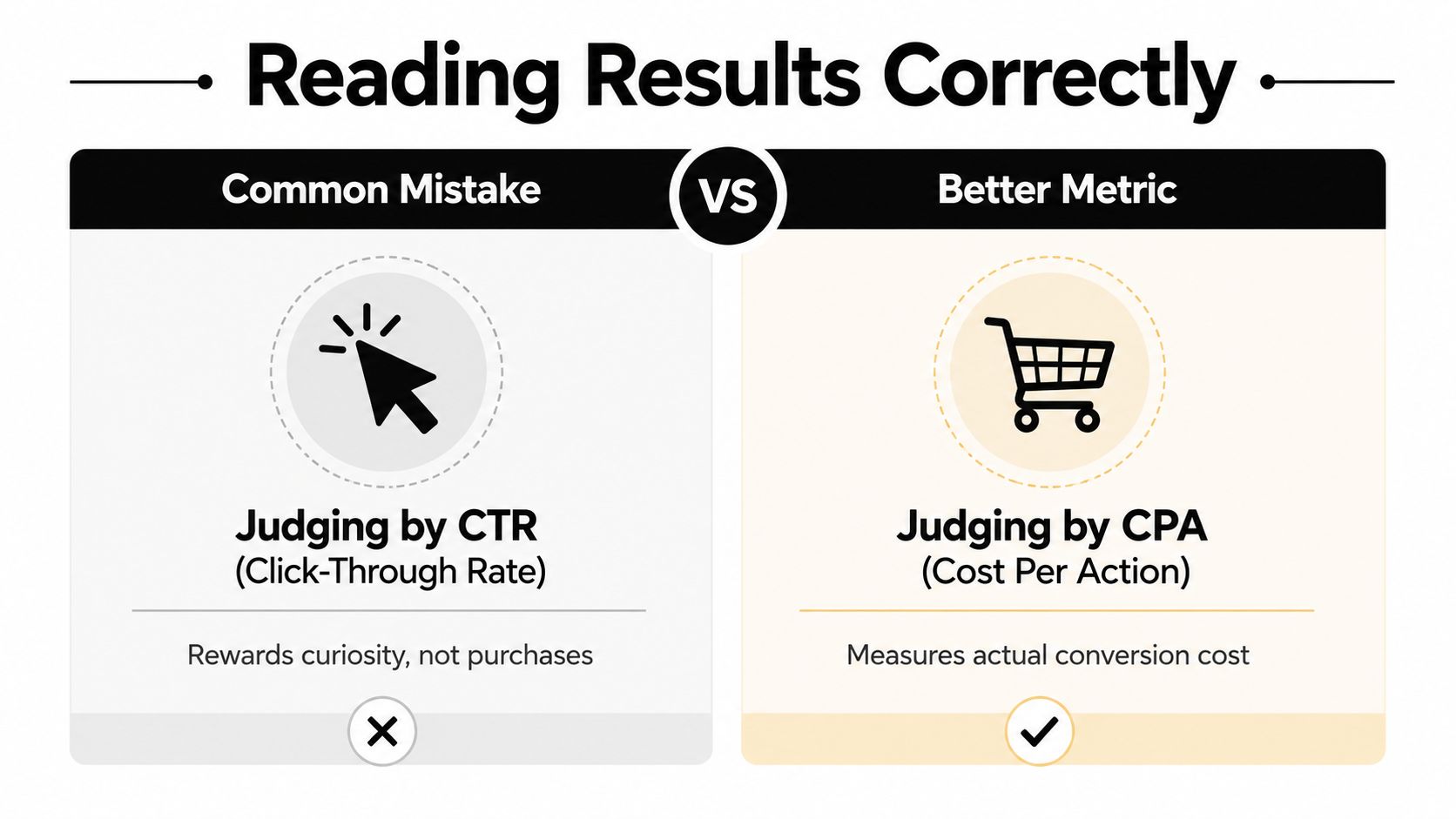
After the round ends, the biggest temptation is to crown the ad with the best click rate. That's a bad habit. CTR rewards curiosity, not purchases, so it can make a flashy ad look stronger than it really is. During testing, the metric that matters is the one tied to the business outcome, usually CPA.
The earlier section on test sizing already covered why the sample has to be meaningful before you decide anything. This is the same principle from the other side. If the impressions are thin and the conversions are tiny, the result can look cleaner than it is.
Compare the right numbers
CTR, CPC, CPM, hook rate, and hold rate all help diagnose what happened. They don't all decide the winner. A high-CTR ad can still be a loser if the resulting purchase cost is too high. A quieter ad can be the better business decision if it converts more efficiently.
A quick way to avoid self-deception is to compare the readout like this:
- CTR: useful for diagnosing attention, not for declaring profit.
- CPC: useful for seeing whether the ad is expensive to click.
- Hook rate: useful for understanding whether the opening is pulling people in.
- CPA: the main business decision metric at the testing stage.
If an ad has one conversion and the rest of the data looks thin, treat it as fragile. That's not a winner, it's a candidate for more testing. For a deeper explanation of why sample size changes the quality of the read, this statistical significance guide is worth keeping handy.
Simple rule: a test should tell you what to do next, not just what looked exciting for one afternoon.
The practical read is straightforward. If the ad is good on curiosity but poor on purchase cost, it loses. If it's quieter but converts efficiently, it earns the right to move forward.
Decide What to Scale, Pause, or Retest Next
A testing round only matters if it leads to an action. Otherwise, it becomes a museum of half-useful data. The decision tree should stay simple enough that you can use it every week without debating your own notes.
The cleanest version is scale, pause, or retest. Scale the winner by lifting budget carefully, pause anything that missed the CPA target or never got enough traction, and retest the middle of the pack with one fresh variable while keeping the original constant. In practice, that means you're not redoing everything. You're isolating the reason the ad was close, then trying again with one better layer.
Use the same rules every round
Budget increases should stay restrained. A common scaling guardrail is to increase budget by no more than 20% per day, or duplicate the winning ad into a new campaign with broader audiences so you don't disturb the original test structure. The same workflow cluster also recommends reserving about 10% to 15% of budget for testing while the rest supports scaled campaigns YouTube walkthrough.
The most common beginner mistakes are easy to spot:
- Killing winners too early: one bad hour is not a verdict.
- Scaling losers after a lucky spike: one good day doesn't fix a weak offer.
- Changing too many things at once: if everything moves, nothing is learnable.
If nothing converts, don't panic and rewrite the whole account. Check whether the offer is weak, the creative is too vague, the audience is too broad for the angle, or the sample size never got big enough to read. That troubleshooting order saves money because it starts with the biggest likely break, not the smallest cosmetic issue.
A beginner-friendly facebook ads testing strategy becomes powerful when it turns into routine. One round creates the next. One winner funds the next batch. One loser teaches the next hook. That loop is what separates random spending from a real acquisition system.
If you want a faster way to turn product pages into structured Meta test rounds, Social Loop AI can help you map the buyer, choose test angles, and turn a budget into a launch plan with creatives you can run. It's built for first-time ecommerce advertisers who need a cleaner way to test, learn, and scale without hiring an agency.