Blog
Incrementality Testing: Measure True Ad Impact
Published July 19, 2026
You open Ads Manager, see a strong ROAS number, and feel relieved for about five minutes. Then you check Shopify. Total store sales don't seem to match the story your ad platform is telling.
That gap is where most new store owners start questioning attribution for the first time. If Meta says the campaign worked, but your overall business barely moved, did the ads really create those sales, or did they just get credit for people who were already going to buy?
That's what incrementality testing is for. It helps you answer the question that matters most: what did this ad spend cause?
Table of Contents
- Is Your Meta ROAS Lying to You
- Understanding True Causal Lift
- Four Common Incrementality Testing Methods
- How to Run a Lift Test on Meta
- Interpreting Your Test Results and iROAS
- Common Pitfalls for Small E-commerce Brands
- From Data to Decisions How to Scale with Confidence
Is Your Meta ROAS Lying to You
A platform can report that a purchase happened after someone saw or clicked an ad. That doesn't automatically mean the ad caused the purchase.
That distinction is where many Shopify owners get stuck. A customer might already know your brand, already want the product, and converts after seeing one more retargeting ad. Meta logs the conversion. Your business gets the sale. But the harder question remains: would that customer have bought anyway?
This is why platform ROAS can feel persuasive and incomplete at the same time. It often measures attributed outcomes, not guaranteed causal outcomes. If you're still getting comfortable with platform metrics, this guide to return on ad spend and how marketers use it is a useful companion.
Practical rule: Attribution tells you who got credit. Incrementality testing tells you what created extra sales.
For a new store owner, that difference changes everything. It affects whether you keep scaling a campaign, whether you cut retargeting, and whether your “winning” ad set is just harvesting demand from people who were already close to buying.
The problem with reported success
Think about three common situations:
- Existing customers see your ad: They were likely to return anyway.
- Branded search closes the sale: Meta still appears in the path, so it can claim value.
- Retargeting catches warm visitors: The ad may influence timing, but not necessarily create a net-new order.
None of that means Meta is useless. It means the reported number isn't the final answer.
What incrementality changes
Incrementality testing is different because it asks a clean business question: what happened because the ads ran, compared with what would have happened if they had not run?
That's why it matters so much for small advertisers. When your budget is tight, you can't afford to fund channels that look good in-platform but don't move the whole store.
Understanding True Causal Lift
If the phrase sounds technical, the idea is simple.
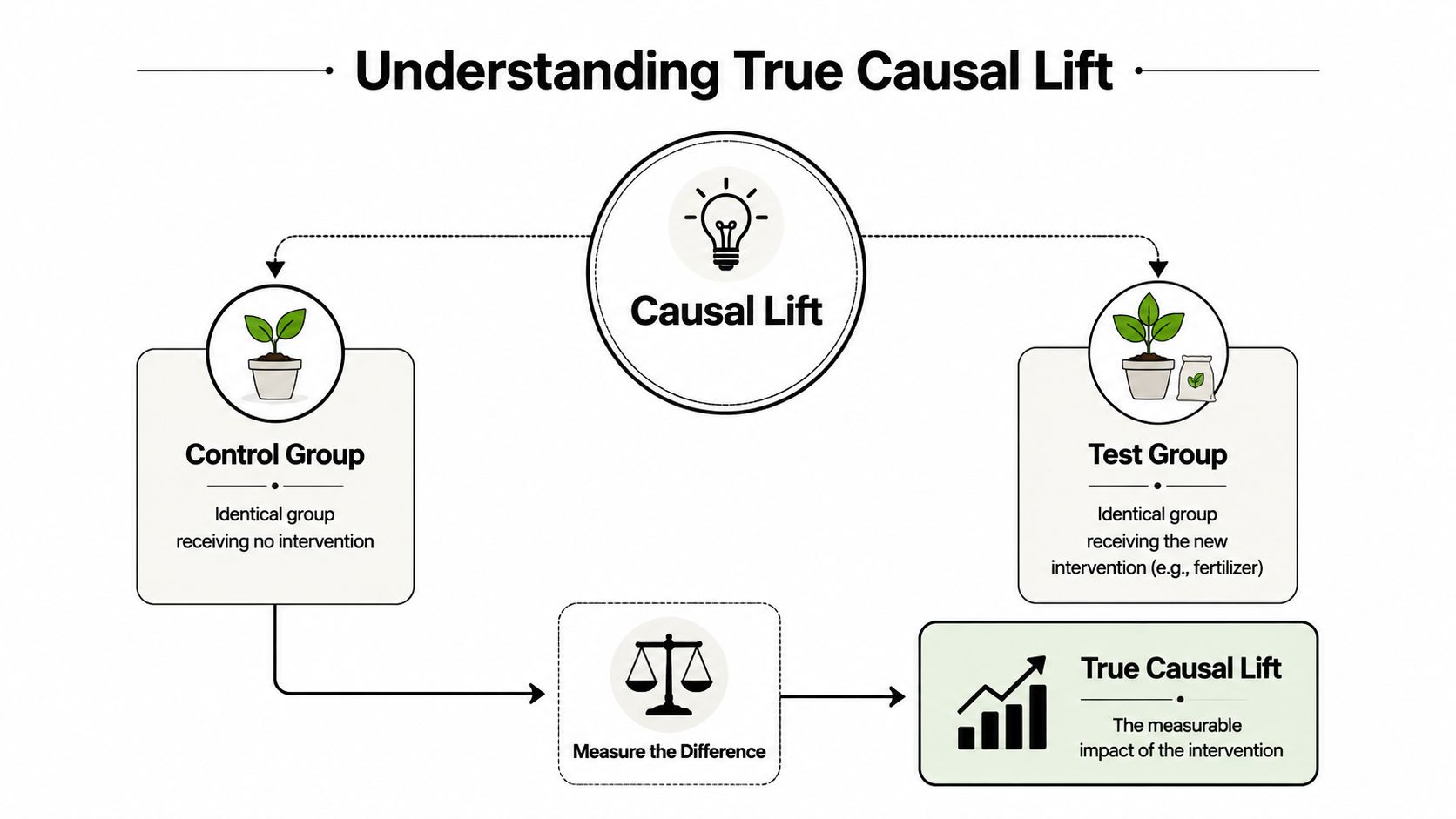
Take two nearly identical groups. Show ads to one group. Don't show ads to the other. Compare the results. The difference is your causal lift.
Correlation is not causation
A person who sees an ad and then buys has a correlation with the ad. That's not the same as proof of impact.
A simple analogy helps. If you test fertilizer on one plant and leave another similar plant untreated, you can compare growth. If the treated plant grows more, the difference is the effect of the fertilizer. In advertising, the fertilizer is your media spend.
The untreated group is your control group. The exposed group is your test group. Some marketers also call the control group a holdout group.
According to Digital Applied's explanation of causal lift in paid media, incrementality testing is the only marketing measurement methodology grounded in causation rather than correlation, and it requires a statistically significant control group representing a minimum of 10% of total test and control reach. The same source explains the basic incrementality formula as (Test Conversion Rate – Control Conversion Rate) / Test Conversion Rate.
The twin test idea
The easiest mental model is this: picture your audience split into twins.
- Twin A sees your ads
- Twin B doesn't
- Everything else stays as similar as possible
If Twin A buys more often than Twin B, the gap is what your ads likely caused.
That's the heart of incrementality testing. Not “who saw the ad before buying,” but “what changed because ads were present.”
Here's the example many people remember best. Google's measurement guide explains that if a test group converts at 5% and a control group converts at 3%, the incrementality is 40%, using the formula (5% - 3%) / 5% = 40%. In plain English, that means 40% of conversions in the test group were caused by the campaign rather than happening organically. You can see that example in Google's guide to incrementality testing.
Why small stores get confused here
New advertisers often assume they need perfect user-level certainty. They don't. What they need is a fair comparison.
That comparison can happen through geos, holdouts, or platform lift studies. The mechanics vary, but the logic stays the same. Measure a treated group against a comparable untreated group, then judge the difference, not the raw platform-reported conversions.
Four Common Incrementality Testing Methods
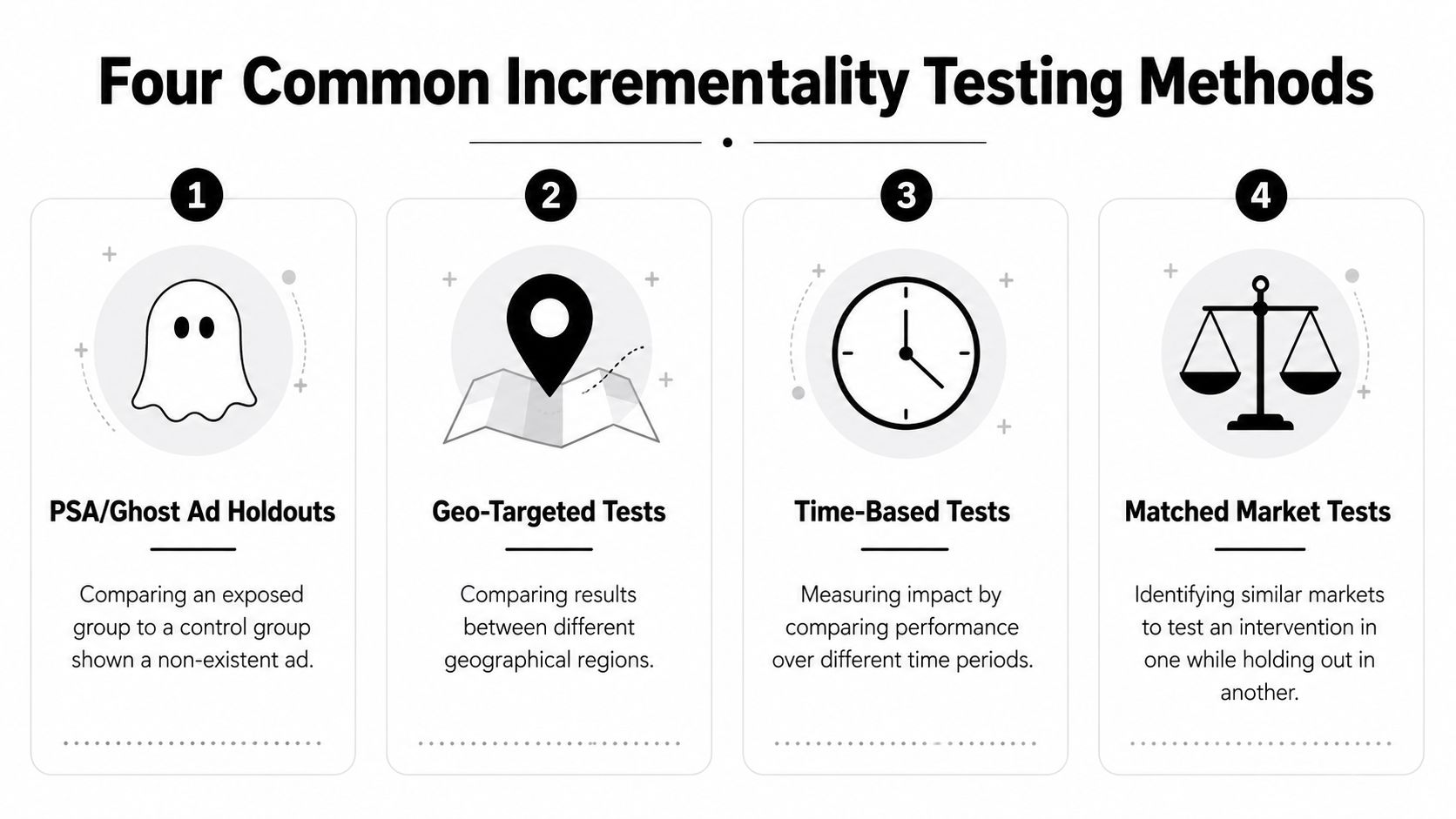
You don't need an enterprise analytics team to understand the main options. What you do need is a realistic view of which method is reliable, which is messy, and which is feasible for a small store.
A quick comparison for small brands
| Method | How it works | Strength | Weak spot |
|---|---|---|---|
| PSA or Ghost Ad Holdouts | One group is eligible for the campaign, another is withheld or shown a neutral alternative | Strong causal setup inside major platforms | Usually depends on platform tools and access |
| Geo-Targeted Tests | You advertise in one set of regions and hold out similar regions | Practical for small e-commerce brands | Bad market matching can distort results |
| Time-Based Tests | You run ads, stop ads, then compare periods | Easy to understand | Seasonality and timing can mislead you |
| Matched-Market Cohorts | You pair similar markets and compare one against the other | Good when geos are well matched | Setup takes care and clean historical data |
Which method is most practical
For many small Shopify brands, geo-targeted tests are the most accessible path. You can compare similar states, cities, or regions without needing highly advanced infrastructure.
That matters because a lot of beginner accounts don't have enough volume for granular audience holdouts at first. A geo test can be easier to explain, easier to monitor, and easier to keep clean.
By contrast, time-based tests sound attractive because they're simple. Turn ads on. Turn ads off. Compare the result. The problem is that your business never stands still. Day of week, payday timing, creator mentions, email sends, weather, and product stock changes can all shift performance. You might think you're measuring ad impact when you're really measuring a calendar effect.
A clean test doesn't just compare results. It isolates one variable while the rest of the business stays boring.
How each method feels in practice
A platform holdout test is often the cleanest conceptually. Meta can split who is eligible to see the ad and compare exposed versus withheld users. If you have access and enough data, this is strong.
A geo-lift test is often the best compromise between rigor and practicality. It works especially well when your offer is broad, shipping works across regions, and you can find similar markets.
A matched-market cohort test is a more disciplined version of geo testing. Instead of picking two areas that “feel similar,” you use historical business data to find markets that behave alike.
A time-based test should usually be a last resort. It can still teach you something, but it's the most vulnerable to false confidence.
For low-budget operators, the goal isn't to choose the most advanced method on paper. It's to choose the method you can execute without contaminating the result.
How to Run a Lift Test on Meta
If you're using Meta Ads, the cleanest place to start is usually a lift study or a structured geo-style holdout plan inside Meta's testing workflow.

Choose a test worth running
Don't start with your favorite campaign just because it gets the most attention. Start where the answer would change your budget decision.
Good candidates usually share two traits:
- High spend: The campaign matters enough to affect your store economics.
- High uncertainty: You're not fully sure whether the reported value is real.
A recent discussion on budget-aware geo-lift testing for small advertisers argues that the highest learning value comes from channels sitting at the intersection of high spend and high uncertainty, including tests built for new products with daily budgets under $50.
For a new store, that often means one of these:
- Retargeting that looks amazing but feels suspicious
- Branded search support channels
- A prospecting setup that spends steadily without obvious storewide lift
Set up rules that keep the test clean
A valid test needs stable conditions. If you keep changing the campaign while the experiment runs, you won't know what caused the outcome.
According to Astrojadu's e-commerce incrementality guide, test and control markets should show less than 5% historical variance across key metrics, using at least 6+ months of data, with a minimum of 50 conversions per market. The same guide says the test should run for at least 2 weeks, ideally 4 weeks, and that you should make zero budget changes mid-test and no creative modifications.
That sounds strict, but the logic is simple. If budget, creative, offer, and timing all change during the test, you haven't run one experiment. You've run several overlapping ones.
A simple pre-launch checklist
- Pick one KPI: Use one primary goal, such as Purchases.
- Match your groups carefully: If you're using geos, choose markets with similar past behavior.
- Freeze the offer: No surprise discount in one group.
- Freeze the creative: Don't swap hooks halfway through because one ad “looks tired.”
- Avoid noisy periods: Skip major sale windows and unusual promo weeks.
- Document outside factors: Stock issues, competitor pressure, or shipping disruptions matter.
Reality check: Most bad incrementality tests fail before launch, not after. The setup creates the confusion.
Launch and protect the experiment
Inside Meta, use the Experiments area if available in your account and set the study around the campaign or audience you want to evaluate. Keep the structure simple. One clear treatment. One clear comparison.
During the run, resist the urge to optimize every day. That habit is useful in normal campaign management and harmful in an experiment. Your job here is not to chase daily efficiency. It's to preserve the conditions long enough to learn.
This walkthrough can help if you want to see the interface and terminology in context:
What to watch while the test is live
- Delivery consistency: Make sure the test is spending as planned.
- Group separation: Prevent your control setup from receiving equivalent exposure elsewhere.
- Business anomalies: Note unusual events instead of pretending they didn't happen.
A clean lift test often feels boring while it's running. That's a good sign.
Interpreting Your Test Results and iROAS
When the report arrives, don't jump straight to the headline number. Read it like a store owner, not like someone looking for permission to keep spending.
What the report is really telling you
The core output is iROAS, or Incremental Return on Ad Spend. Google defines it as incremental revenue divided by incremental spend in its overview of incrementality testing and measurement quality.
That metric matters because it focuses on what revenue the business would have missed if the campaign had not been active. Not credited revenue. Not influenced revenue. Missed revenue.
A credible report should also include:
- Confidence intervals: A plausible range for the iROAS result
- Statistical significance: Often confirmed with p-values below 0.05
- Cumulative impact curves: A pattern that rises during treatment and flattens when lift stops
If your report lacks those, be careful. A single point estimate without uncertainty can look more precise than it really is.
How to read iROAS without fooling yourself
Let's say your platform ROAS looked strong, but the lift study shows weaker incremental performance. That doesn't mean the platform is broken. It means the platform gave credit to some conversions that likely would have happened anyway.
A basic understanding of statistical significance in experiments and marketing tests is helpful. A result can look directionally interesting without being strong enough to trust for a budget decision.
Ask these questions:
- Did the test detect real lift, or is the range too wide to be confident?
- Is the iROAS high enough for your margin structure?
- Did the result stay stable through the full test period?
- Would this finding change what you do next week?
If the result doesn't change your decision, the test taught you less than you think.
The point of interpretation isn't to prove your campaign was good or bad. It's to decide whether to scale, hold, rework, or stop.
Common Pitfalls for Small E-commerce Brands
Small brands usually don't fail because incrementality testing is impossible. They fail because they copy enterprise advice that doesn't fit a lean store.
The too small to test myth
A lot of new merchants assume they need massive traffic before testing causality. That belief stops good learning before it starts.
A more practical benchmark appears in this explanation of incrementality testing for low-volume dropshippers, which says a 10% lift can be confidently detected with only about 1,000 users per group. The same source recommends that beginners start on lower-performing channels where potential revenue loss is smaller.
That's a healthier way to begin. Don't gamble your whole account on the first test. Probe the area where attribution feels weak and the downside is manageable.
Mistakes that ruin useful learning
The most common issues are usually operational, not mathematical.
- Testing the wrong thing: If the channel is already obviously working or obviously failing, the test may not teach much.
- Changing variables midstream: Budget edits, creative swaps, and promo changes muddy the result fast.
- Stopping too early: Small stores get impatient because daily data looks noisy.
- Treating one inconclusive test as a final verdict: Sometimes the lesson is that your design was weak, not that the channel has no value.
A better mindset is to treat incrementality testing as a repeated discipline inside a broader data-driven marketing process for budget decisions. One clean test won't solve every attribution problem. It will, however, stop you from making blind scaling decisions.
Small brands don't need perfect experiments. They need honest ones.
For a solo founder, that often means fewer moving parts, one clear question, and enough patience to let the comparison finish.
From Data to Decisions How to Scale with Confidence
Test results only matter if they change how you spend.
If iROAS looks healthy and the confidence range supports the result, that's a reason to scale carefully. If the result is weak, flat, or negative, pause the campaign or reduce spend and inspect the underlying issue. Sometimes the offer is weak. Sometimes the creative is attracting people who would buy anyway. Sometimes the audience is too warm.
The biggest opportunity for smaller advertisers is speed of learning. As noted in the earlier video-backed discussion, many guides still miss how to run rapid, budget-aware geo-lift tests for launches with daily budgets under $50, and the most valuable place to test is often where spend is meaningful but certainty is low.
That's the main benefit of incrementality testing for a new store. It replaces “Meta says this worked” with “the business evidence supports this decision.” Once you start thinking that way, scaling gets calmer. You spend more on proven lift and less on credited noise.
If you want help turning a product URL into a practical ad launch plan, test angles, creatives, and next-step decisions you can use, Social Loop AI is built for first-time store owners who want a budget-aware way to launch, learn, and scale with more confidence.