Blog
Instagram Ads Cost in 2026: A Dropshipper's Guide
Published June 7, 2026
Instagram ads usually cost about $0.40 to $2.00 per click, $2 to $6 per 1,000 impressions, and $0.03 to $0.08 per engagement. But those numbers are only a starting point, because Instagram sells ads in a live auction, so your real cost changes based on who you target, what you ask the algorithm to optimize for, where the ad appears, and how strong your creative is.
If you're a first-time dropshipper, you're probably staring at the budget field in Ads Manager wondering whether you're about to buy data or just burn cash. That's a normal reaction. Instagram doesn't have a fixed rate card. It works more like bidding on storefront space in a crowded shopping district. Some days your budget goes further than expected. Other days, the same budget barely gets traction because more advertisers are chasing the same audience.
That's why the right question isn't just “what is Instagram ads cost?” It's “what controls it, and how do I keep my first tests cheap enough to learn without wrecking margin?”
Table of Contents
- Why Your Instagram Ads Cost Is a Moving Target
- Understanding the Instagram Ad Auction and Key Metrics
- The Four Main Drivers of Your Ad Spend
- How to Plan Your First Instagram Ad Budget
- Practical Tactics to Lower Your Instagram Ad Costs
- Automating Your Test Plan with Social Loop AI
Why Your Instagram Ads Cost Is a Moving Target
A new dropshipper usually hits the same wall fast. You find a product, build a Shopify store, upload a few creatives, open Meta Ads Manager, and then freeze when the platform asks for budget. You want one clean answer. Instagram doesn't give one.
The platform sells ad inventory through a real-time auction, so you're not buying clicks from a menu. You're bidding against other advertisers for attention in the same feed, the same Stories stack, and the same Reels session. That's why two stores can run similar products and still see very different costs.
Instagram's scale is one reason this feels both accessible and unpredictable. Zapier's breakdown of Instagram ad pricing notes that Instagram's U.S. ad revenue is projected to reach $42.52 billion in 2026, up from $37.13 billion in 2025, and its share of Meta's total U.S. ad revenue is projected to reach about 53.1% in 2026. That tells you there's massive advertiser demand. More demand means tighter auctions.
At the same time, small businesses still enter the platform every day because the starting point isn't absurdly high. The same source notes that many small businesses begin with roughly $100 to $500 per month, while Meta suggests at least $5 per day for learning. So yes, beginners can get in the game. No, that doesn't mean the minimum budget is enough to produce clean answers.
Practical rule: Treat your first spend as tuition. You're paying to learn which audience, angle, and placement deserve a bigger budget later.
If you think of Instagram ads cost as a fixed expense, you'll make bad decisions early. If you treat it like a moving market, you'll start asking better questions. Is your audience crowded? Is your ad good enough to win attention cheaply? Are you paying for low-cost impressions that never turn into clicks?
That shift matters more than memorizing a benchmark.
Understanding the Instagram Ad Auction and Key Metrics
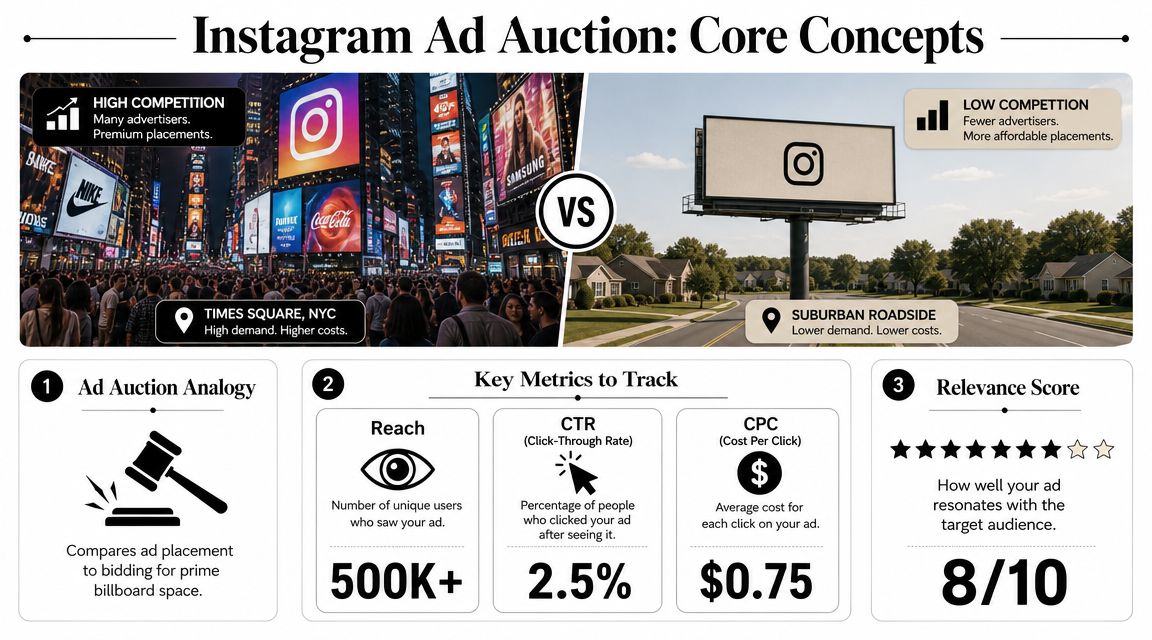
Instagram ad costs are set in an auction. Your budget enters a live bidding environment where advertisers compete for the same impressions, clicks, and conversions at the same time.
How the auction works in practice
The cleanest way to read the auction is to compare it to a real estate auction. A quiet property with fewer bidders can sell at a reasonable price. A desirable property with ten serious buyers gets expensive fast. Instagram works the same way.
A broad audience can give Meta more room to find cheaper placements. A narrow audience with strong buying intent often attracts more advertisers, which raises the bid pressure. Placement matters too. Reels, Stories, and Feed do not clear at the same price because user behavior and available inventory are different in each one.
That context is why Birch's explanation of Instagram advertising costs is useful. It explains that Instagram ads run through a real-time auction, and that benchmark ranges move based on supply, demand, audience competition, and campaign quality. In practical terms, CPM can sit around $3 to $6 or climb to $15.26, while CPC often lands between $0.40 to $1.25, $0.50 to $2.00, or more when competition heats up.
For a dropshipper, the takeaway is simple. Your budget buys testing data, not guaranteed traffic.
Later in the campaign, this video will make more sense because you'll hear the same auction logic in plain English.
The metrics that matter during testing
Beginners usually watch too many numbers. Start with the three that tell you where the problem sits.
- CPM means cost per 1,000 impressions. It shows what you pay to get in front of people.
- CPC means cost per click. It shows whether the ad is strong enough to earn curiosity.
- CPA means cost per acquisition. It shows what you pay for the result you care about, usually a purchase or lead.
These metrics work like checkpoints. If CPM is high, the auction is expensive or your targeting is too tight. If CPM is fine but CPC is weak, the creative is not pulling people in. If clicks are coming through but CPA is ugly, the issue is often your product page, offer, or product-market fit.
Cheap CPM can still produce junk traffic. Higher CPM can still be profitable if the clicks convert.
If you want a cleaner framework for reading these numbers, review this guide to ad performance metrics for ecommerce campaigns before making scaling decisions.
Benchmark ranges are a compass, not a quote
Benchmarks help you avoid unrealistic expectations, but they do not tell you what your account will pay this week.
WordStream's 2026 Instagram cost overview puts average costs at about $0.40 to $2.00 per click, $2 to $6 per 1,000 impressions, and $0.03 to $0.08 per engagement. The same source notes that Hootsuite's broader benchmark average is higher at $1.31 CPC and $15.26 CPM. That gap is the lesson. Averages blend cheap placements, expensive audiences, strong creative, weak creative, smart accounts, and sloppy ones.
| Campaign Objective | Average CPM (Cost Per 1,000 Impressions) | Average CPC (Cost Per Click) |
|---|---|---|
| Reach or awareness | $2 to $6 | Varies by click intent |
| Traffic or click-focused campaigns | Can range up to higher auction benchmarks | $0.40 to $2.00 |
| Broad benchmark average from Hootsuite data | $15.26 | $1.31 |
Use these ranges to set guardrails for a test. Do not use them to predict profit. In live accounts, placement mix changes the outcome fast. A campaign that leans into Reels may buy cheaper attention but weaker buyer intent. A campaign that gets more delivery in Stories or Feed may cost more per impression and still produce better economics if those users click and buy.
The Four Main Drivers of Your Ad Spend
Instagram ads cost usually moves for four reasons. Once you see them clearly, the platform stops feeling random.
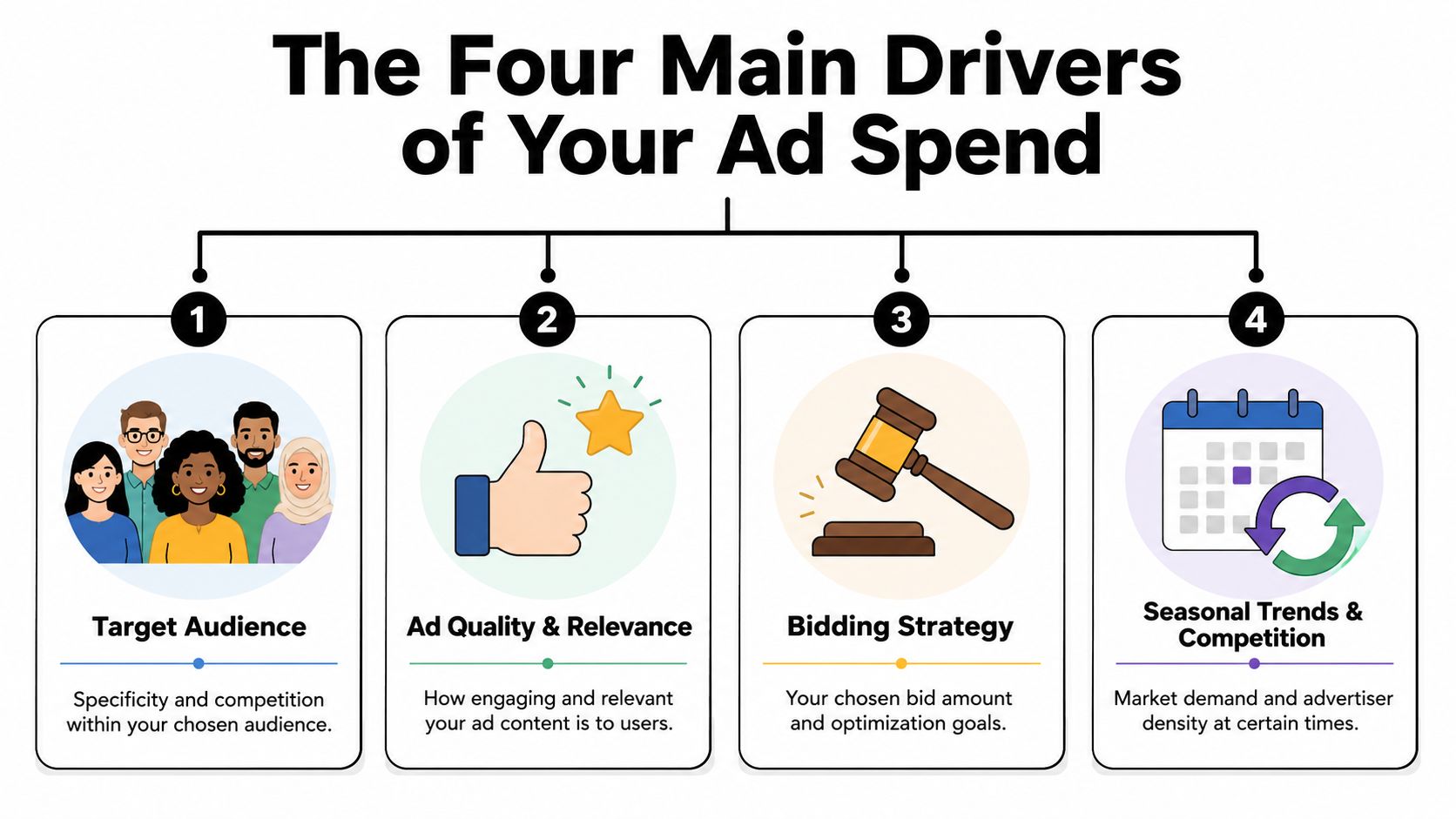
Audience competition
Targeting is the first lever. A broad audience gives the system more room to find cheaper inventory. A cramped audience does the opposite.
If you target a tiny slice of shoppers with stacked interests, narrow age bands, and a small geography, you're bidding on the digital version of a house in a hot neighborhood. More advertisers want the same people. Prices rise. Delivery gets less stable.
This is why many first campaigns struggle. The beginner thinks narrow targeting feels safer. In reality, it often makes the auction more expensive and less forgiving.
Creative quality and relevance
Your creative changes how hard Instagram has to work to get someone to engage. Weak creative usually drives up your effective cost because fewer people stop, click, or care.
The platform won't tell you this in plain language, but the pattern is easy to see in live accounts. When a creative earns attention quickly, the same budget tends to stretch further. When it looks like a generic product post or a recycled supplier image, costs get heavier and performance gets noisy.
Good creative doesn't just improve results. It changes the price you effectively pay for every useful action.
That's why dropshippers should spend more time on hooks, angles, and message-market fit than on micro-adjusting targeting.
Objective and bid behavior
What you ask the system to optimize for matters. A click objective and a purchase-focused setup don't behave the same way.
If you optimize for reach, Instagram looks for cheap impressions. If you optimize for clicks, it looks for users more likely to tap. If you optimize for conversions, it hunts for people with stronger buying signals. Those are not the same users, and they don't cost the same.
Beginners often get trapped by low vanity costs. A campaign can look cheap on the surface and still attract weak traffic. That's why your chosen objective has to match the stage of testing you're in.
Placement and seasonality
This is the lever most new advertisers ignore, and it matters a lot. Instagram doesn't price Feed, Stories, and Reels the same way.
Gupta Media's placement-level Instagram data reported that in January 2025, Stories averaged $7.25 CPM, $0.94 CPLC, and a 0.77% link CTR, while Reels averaged $4.29 CPM, $1.21 CPLC, and a 0.35% link CTR. That's the cleanest proof that cheaper impressions don't always produce cheaper traffic.
| Placement | Average CPM | Average CPLC | Link CTR |
|---|---|---|---|
| Stories | $7.25 | $0.94 | 0.77% |
| Reels | $4.29 | $1.21 | 0.35% |
A beginner often sees the lower Reels CPM and assumes Reels is the bargain. But if Stories bring more efficient clicks for your offer, the “cheaper” placement can cost you more where it counts.
Seasonality adds another layer. When more advertisers enter the auction, costs usually tighten. That's why a budget that worked in one period can feel sluggish later even if your store hasn't changed.
How to Plan Your First Instagram Ad Budget
You launch your first campaign with $10 a day, split it across too many ad sets, and by day three you have a few clicks, no clear winner, and no idea what to do next. That is the usual beginner outcome.
A first budget should buy clarity.
Start with a testing budget, not a scaling budget
The goal of round one is simple. Find out whether the product, offer, creative angle, and placement deserve more money.
That changes how you budget. Instead of trying to force profit from the first campaign, set up a small test that can produce a readable result. For a new dropshipper, that usually means one product, one offer, and a handful of clearly different creatives. If you need help producing those variations, use a few UGC-style ad concepts that are built for testing instead of making tiny edits to the same ad.
Keep the account clean:
- Test one product at a time: Mixing products makes the signal hard to read.
- Use a small set of distinct creatives: Different hooks beat cosmetic variations.
- Limit audience experiments early: Too many ad sets spreads the budget thin.
- Give each ad set enough room to spend: Underfed tests create random-looking results.
A risk-averse budget works like a real estate auction. You do not show up and bid on every property on the block. You pick a few that fit your numbers, bid carefully, and watch what the market tells you before committing more cash.
Use simple CPM math to set realistic expectations
Before you spend, translate your budget into likely traffic.
If CPM is high and click-through rate is weak, a small daily budget buys very little data. If CPM is moderate and the creative gets strong response, the same budget can produce enough clicks to make a decision. That is why budget planning is tied to placement and creative, not just the number you enter in Ads Manager.
Use this logic before launch:
- Estimate how many impressions your daily budget can buy
- Estimate how many clicks those impressions might turn into
- Ask whether that click volume is enough to judge the test
- If not, simplify the campaign or raise the budget slightly
A common pitfall for beginners is misunderstanding impression costs. Reels can look cheap on impression cost, but if Stories drive stronger click quality for your product, the lower CPM does not help much. Cheap reach and useful traffic are not the same thing.
Build a budget around decisions, not hope
The platform needs enough activity to find patterns. If you spread a small budget across too many creatives, placements, and audiences, every ad set stays half-starved. Results swing day to day, and you end up making decisions from weak evidence.
A better first plan is tighter:
- Launch a narrow test
- Let it run long enough to show a pattern
- Cut clear losers without drama
- Shift spend into the best creative or placement
- Add complexity only after you find a promising angle
That last point matters. Beginners often assume low spend is the safe option. In practice, low spend across too many variables is what creates expensive confusion.
If margins are tight, keep the test small and disciplined. A simple campaign with readable data beats a busy account that teaches you nothing.
Practical Tactics to Lower Your Instagram Ad Costs
Lowering Instagram ads cost isn't about finding a secret button in Ads Manager. It's about removing friction from the path between impression and purchase.
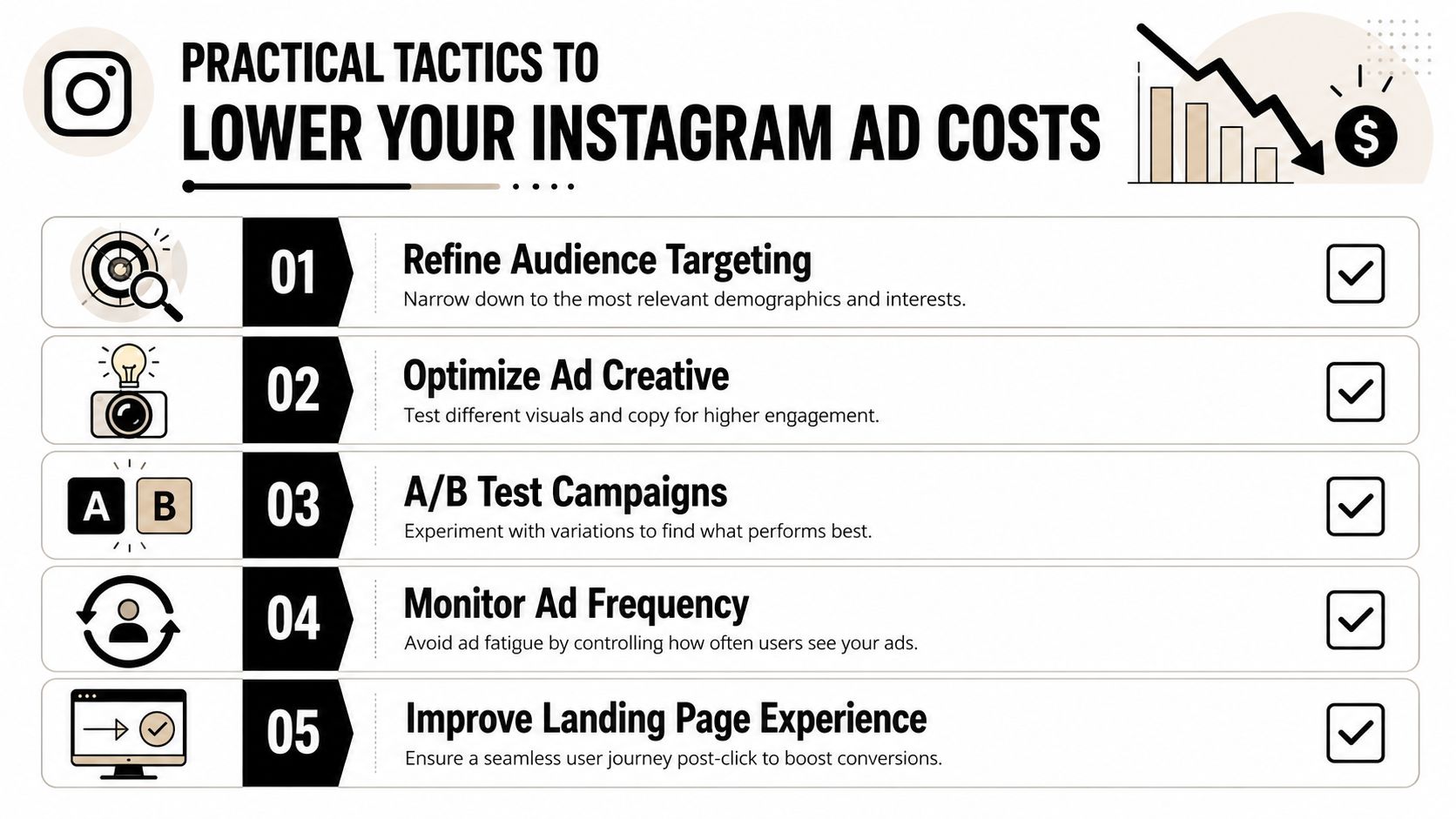
Fix the click path before buying traffic
A lot of dropshippers obsess over ad settings while sending traffic to a weak product page. That's backwards.
Before you spend, check the basics:
- Message match: The promise in the ad should appear immediately on the landing page.
- Mobile clarity: The first screen should make the product, benefit, and next step obvious.
- Offer simplicity: If the pricing, bundle, or shipping terms are confusing, clicks get wasted.
If the page is clunky, every click becomes more expensive because fewer visitors convert. You don't need a fancy funnel. You need a page that feels trustworthy and easy to buy from.
Test creatives like a buyer, not like a designer
Many first-time advertisers test “variations” that are too similar. Same message, same visual logic, slightly different colors. That usually doesn't teach you much.
Test creative angles instead.
- Problem-solution angle: Lead with the pain the product removes.
- Social proof angle: Show why other buyers trust it.
- Identity angle: Frame the product around the kind of person who buys it.
- UGC-style angle: Make the ad feel like a native recommendation instead of a polished brand asset.
If you need a better feel for what native-looking creative should resemble, these examples on how to make UGC-style ads are a useful reference.
The fastest way to waste budget is to keep polishing a weak idea instead of testing a different angle.
Use simple retargeting without overcomplicating it
Retargeting still has a place, especially when your prospecting campaign produces interest but buyers hesitate. The mistake is building a giant retargeting maze before you have enough traffic to justify it.
For a beginner, simple usually wins:
- Retarget site visitors: Remind interested people what they viewed.
- Retarget video viewers or engagers: Show a stronger buying message to warmer users.
- Change the message: Don't show the exact same creative again. Address objections, trust, or urgency.
Another practical move is to cut weak ads fast and reallocate budget toward the creatives that earn cleaner engagement and stronger clicks. Efficient accounts don't try to rescue every ad. They protect budget by backing what already shows traction.
Automating Your Test Plan with Social Loop AI
A lot of first campaigns fail before launch. Not because the product had no chance, but because the setup was sloppy. The audience was guessed. The creatives were generic. The budget was split too thin. The landing page had obvious friction.
Why beginners struggle with testing
Experienced media buyers run structured tests almost automatically. They know how to turn a product into buyer angles, how to adapt those angles into multiple creatives, and how to allocate budget without starving the campaign.
New dropshippers usually don't have that system yet. They have a product URL, a vague audience idea, and too many choices in Ads Manager.
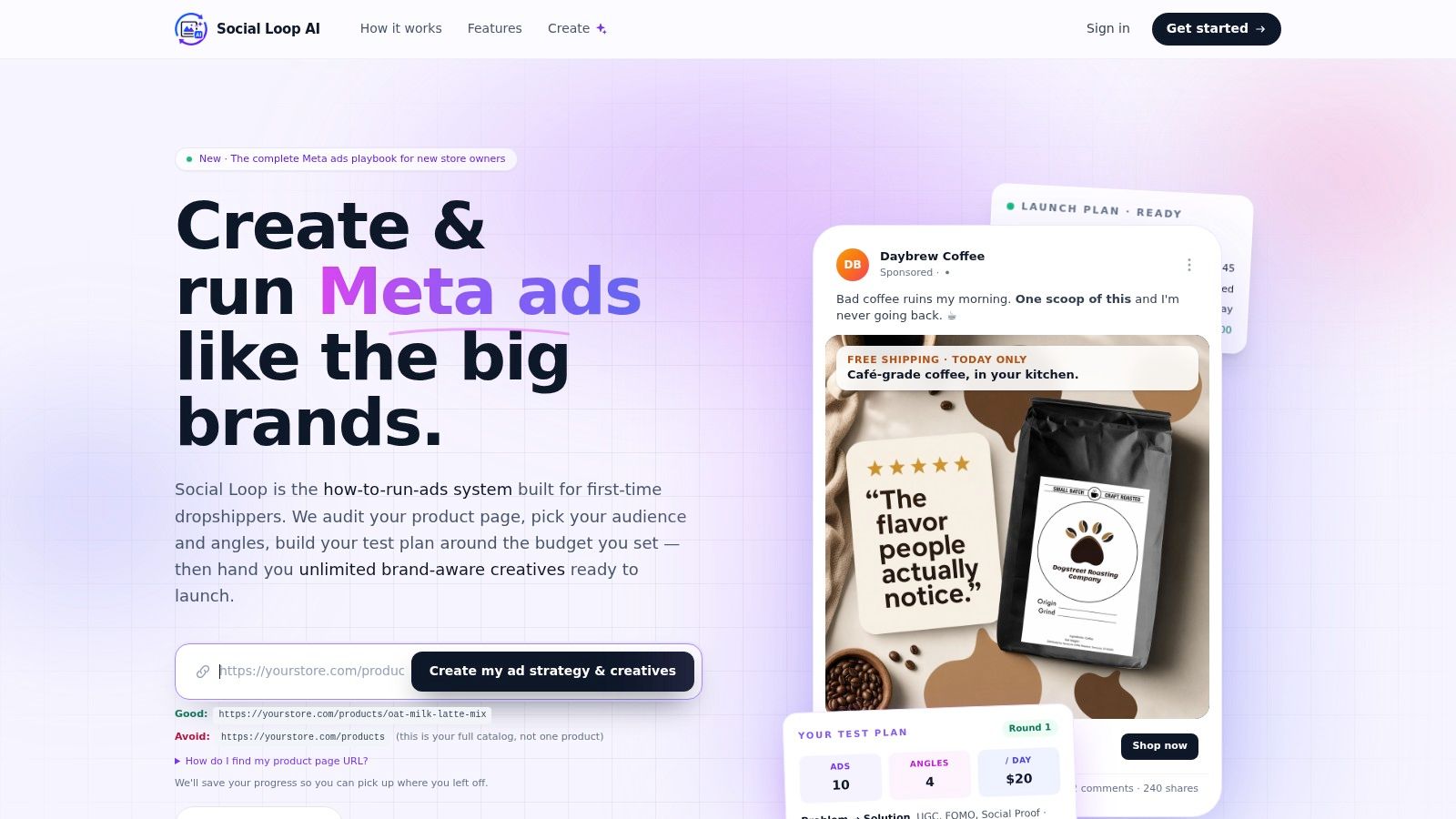
That's the gap Social Loop AI is built to solve. Instead of asking a beginner to invent a strategy from scratch, it turns a product page into a practical Meta launch plan. The platform guides the user through audience definition, creative angles, landing-page readiness, and a testing structure that fits the available budget.
How Social Loop AI reduces bad first decisions
For a beginner, the biggest savings often come from avoiding preventable mistakes. That includes launching with weak hooks, sending traffic to an unprepared page, or spreading spend across random ad concepts that don't connect to a real buyer profile.
Social Loop AI helps de-risk that process in a few practical ways:
- It builds a clearer buyer profile: Better audience definition means fewer random guesses.
- It generates angle-based creatives: Instead of one generic ad, you get a batch built around distinct hooks and objections.
- It converts spend into a test plan: A daily budget becomes a usable round-by-round launch structure.
- It checks landing-page readiness: That matters because poor post-click experience can wreck the economics of even a decent ad.
If you want to see how that system applies specifically to Meta and Instagram launch planning, take a look at Social Loop AI's Instagram ads workflow.
For first-time dropshippers, that kind of structure matters more than another list of vague “best practices.” It gives you a repeatable way to test like a professional before you've earned that instinct the hard way.
If you want a faster, less guess-heavy way to launch your first campaigns, Social Loop AI helps turn a product URL into a buyer profile, ad angles, creative batches, and a practical test plan you can use. It's built for beginners who want to control ad spend, avoid obvious mistakes, and run Instagram ads with a clearer process from day one.