Blog
Master Market Research for Products in 2026
Published July 17, 2026
Most advice about market research for products breaks at the exact moment a beginner needs it most. It tells you to find demand, check competitors, maybe browse Google Trends, then jump straight into ads. That's incomplete. Demand discovery without a testing plan is just organized optimism.
A tighter sequence is what protects your budget. You identify a customer problem, verify that buyers care enough to act, translate that insight into a few ad angles, then test those angles with small spends before you commit inventory or serious creative effort. That's the difference between research that looks smart in a spreadsheet and research that helps you survive launch week.
Table of Contents
- Your Product Idea Is Not Enough
- Define Your Ideal Customer Not Just a Persona
- Uncover Demand Signals and Competitive Gaps
- Transform Research into Testable Ad Angles
- Run Budget-Aware Validation Tests
- Interpret Metrics and Make the Launch Decision
Your Product Idea Is Not Enough
A product idea matters. It just isn't enough.
New founders often treat product selection like the whole game. Find a clever item, pick a supplier, build a Shopify store, and hope Meta ads uncover the audience. In practice, the product is only half the equation. The other half is whether you can prove that a specific audience responds to a specific promise at a price and message that make sense.
That's why the market research industry itself is so large. The global market research industry generated revenue exceeding $82 billion in 2022, more than double its size in 2008, which shows how central validated demand has become to product development and launch decisions according to market research industry data. Serious businesses don't rely on taste alone. They buy clarity before they buy scale.
Practical rule: If your research can't tell you what ad angle to test first, you don't have enough research yet.
For a first-time founder, that changes how you define success. You're not trying to prove your idea is brilliant. You're trying to answer a more useful question. Can this product, for this audience, with this message, get enough positive response to justify the next spend?
That means your process has to connect all the way through the launch. Research should shape your audience hypothesis, your offer framing, your landing page copy, and your first ad set. If it stops at “people seem interested,” it hasn't done its job.
A lot of beginners also skip the operational side. They collect notes, screenshots, and competitor links, but never turn them into a sequence of tests. If you need a clearer framework for that handoff from insight to launch execution, this guide on building a product launch strategy is a useful companion.
Define Your Ideal Customer Not Just a Persona
Generic personas sound professional and perform terribly. “Female, 25 to 40, interested in fitness” doesn't help you write an ad, choose a hook, or decide which objection to answer first. It gives you demographic comfort and strategic fog.
A better starting point is a customer hypothesis. That's a testable statement about who the buyer is, what job they need done, what blocks them, and what message is most likely to earn the click.
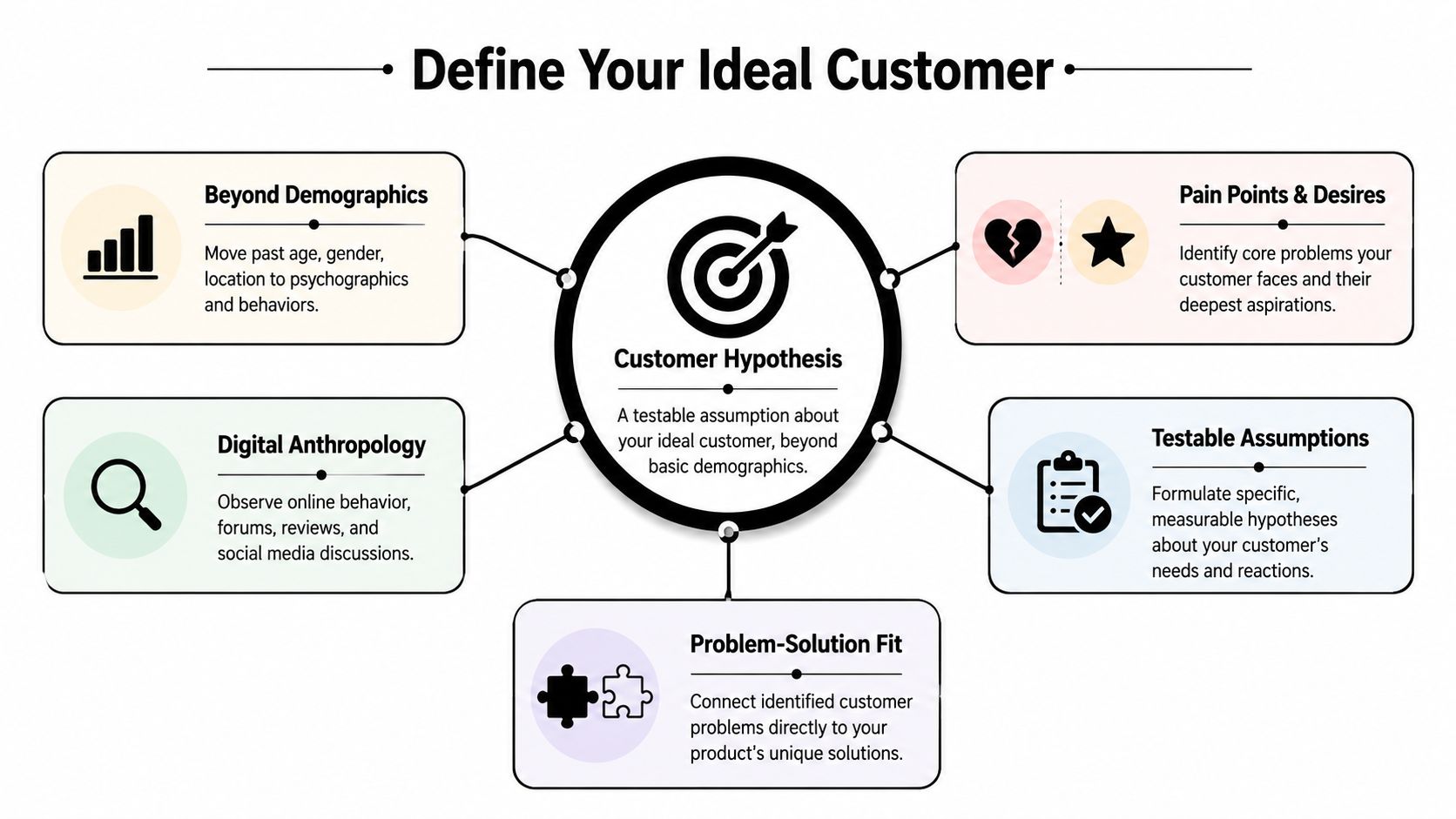
An estimated 80% of new ecommerce products fail due to inadequate demand validation before full inventory investment, and early-stage brands are advised to use a 60/40 split between quantitative and qualitative research according to this ecommerce market research reference. That split makes sense in real work. Numbers show pattern. Language shows motive.
Stop describing and start hypothesizing
Here's the shift.
| Weak persona | Sharp customer hypothesis |
|---|---|
| Women interested in fitness | New mom who can't get to the gym, feels guilty about losing routine, wants short at-home sessions that don't require setup |
| Men who like gadgets | Desk worker who buys small devices to reduce friction during work and gets annoyed by anything that needs a manual |
| Pet owners | Apartment dog owner dealing with muddy paws and embarrassed by the mess at the door |
The right side gives you something to test. It suggests hooks, visual scenes, and likely objections. It also tells you what not to say.
A useful customer hypothesis usually includes:
- Current frustration that already costs the buyer time, money, comfort, or status.
- Trigger moment that makes the problem feel urgent now.
- Failed alternatives they've already tried.
- Decision filter they use when comparing options.
- Likely objection that stops the purchase unless your page or ad handles it.
If you want a cleaner framework for making this more concrete, this breakdown of buyer persona definition is worth reviewing.
Where to get the raw language
You don't need an expensive panel to begin. For first-pass qualitative work, I'd pull from places where people complain in public and explain themselves in their own words.
Start with these:
- Reddit threads: Search for problem-led phrases, not product-led phrases. “How do I stop...” is better than “best product for...”
- Amazon and competitor reviews: Ignore the polished praise first. Read the worst reviews and the most detailed middle reviews.
- TikTok and Instagram comments: Buyers often reveal hesitation in short comments that sound casual but are strategically useful.
- Support FAQs and return-policy pages from competitors: These expose where hesitation shows up often enough that brands had to address it.
Read for repeated friction, not isolated opinions. One dramatic complaint can mislead you. Repeated wording across multiple places usually means there's a stable buying objection underneath.
As you collect inputs, sort them into a simple note set:
- Problem language buyers already use
- Desired outcome in their own words
- Objections they repeat
- Alternatives they mention
- Phrases that sound emotionally loaded
That last category matters more than beginners think. If reviews keep saying “too bulky,” “annoying to clean,” or “didn't look like the photos,” those aren't just comments. They are ad and landing-page instructions.
Uncover Demand Signals and Competitive Gaps
A demand signal isn't “this niche exists.” It's evidence that people are already trying to solve a problem and feel enough friction to switch, search, compare, or complain. Good market research for products looks for those signals and then checks whether the market is still enterable.
The cleanest screening framework comes from the SBA. Effective market research requires answering six quantifiable questions: Is there demand, what's the market size, what are the economic indicators, where are the customers, how saturated is the market, and what is the competitive pricing according to the SBA's guide to market research and competitive analysis. For new dropshippers, saturation matters more than most realize. A decent product in a crowded, undifferentiated market is hard to launch on a small budget.
Use the six-question screen
Treat the six questions like a filter, not a school assignment.
Demand
Look for active problem-solving behavior. Threads asking for alternatives, reviews comparing versions, repeated “does this work?” comments, and videos showing hacks all point to a buyer trying to fix something.
Market size
You don't need a giant category to win your first product. You need a category big enough to support repeated testing and clear enough that Meta can find adjacent users. Niche is fine. Tiny and fragmented is not.
Economic indicators
Does the likely buyer have the willingness and ability to pay for a solution in this category? You're not just checking income in the abstract. You're checking whether this problem sits high enough in their priorities to earn spend.
Customer location
Where do these buyers live and browse? A product with heavy demand signals in comments may still be a poor test if the practical audience is difficult to reach with your ad setup or shipping model.
Market saturation
Many first launches succumb to market saturation. Search the product type on Amazon, TikTok, Meta Ad Library, and Google Shopping. If every listing looks identical and every ad says the same thing, the market may be saturated at the angle level even if the category is still active.
Competitive pricing
Pricing research isn't just “what's the average price.” It's whether there's room for your offer to feel credible. If low prices dominate, you need a reason to charge more. If premium positioning dominates, you need proof, packaging, or a stronger promise.
How to spot a real gap
Defining a gap is often misunderstood. It is commonly believed to mean no competitor exists. That's rarely true.
A workable gap usually looks like one of these:
| What you find | What it suggests |
|---|---|
| Buyers complain about setup, cleaning, sizing, or instructions | Simplicity can become the angle |
| Reviews say products feel cheap or misleading | Trust and realism can become the angle |
| Competitors focus on features but buyers talk about emotion | Reframe around relief, confidence, convenience, or identity |
| Listings are crowded but messaging is generic | You may have a creative gap, not a product gap |
A quick practical workflow helps:
- Check Reddit for problem threads. What are people trying to solve?
- Read competitor reviews. What specifically disappoints them?
- Scan product pages. What promises does the market keep repeating?
- Compare language. Where does buyer language differ from brand language?
That mismatch is often the opening. If buyers say “I need something fast and mess-free” while brands keep saying “premium ergonomic design,” somebody is talking about the actual job and somebody isn't.
A lot of founders stop at search trends and broad niche talk. Better work comes from combining customer voice with direct competitive analysis. If you want a stronger system for that, this guide to data-driven marketing is a solid complement.
A competitive gap that you can't express in one clear sentence probably isn't ready for paid traffic.
Transform Research into Testable Ad Angles
At this stage, most beginner research fails. The notes are good. The screenshots are good. The spreadsheet looks busy. Then launch day arrives and the founder still doesn't know whether to lead with Problem to Solution, UGC, Social Proof, or a comparison angle.
That hesitation is common. A major gap in market research advice is the lack of frameworks that turn data into a specific Meta ad test plan. It matters because 72% of new ecommerce owners pause before launching due to uncertainty about which angle to test first, and data from 19,000+ winning ads points to a recurring issue: beginners struggle to map research findings to hooks and creative angles, as discussed in this analysis of underserved market angles.
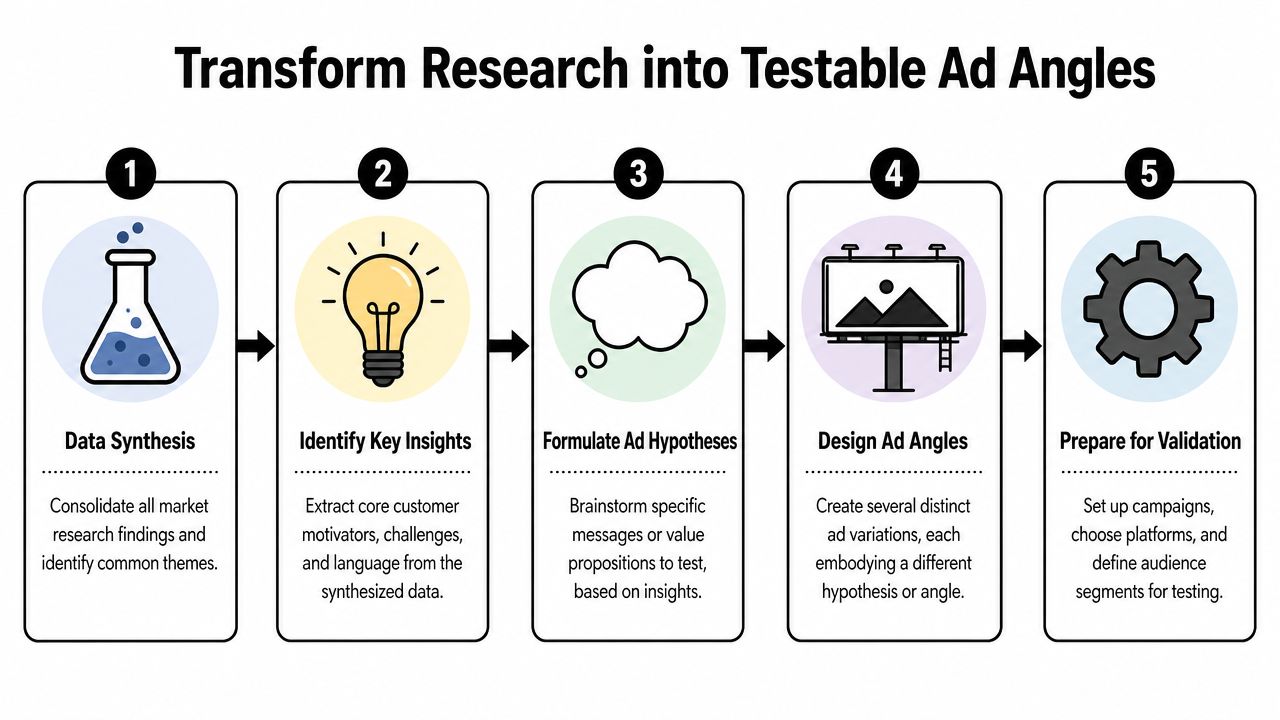
Turn findings into messaging hooks
An ad angle is the lens you use to frame the product. Same product, different promise.
If your notes are strong, your angle options should come directly from what buyers said and what competitors failed to solve.
Here's a simple mapping table:
| Research finding | Better angle to test | What the ad should emphasize |
|---|---|---|
| Buyers say current options are confusing | Simplicity and ease of use | Fewer steps, clearer result, less setup |
| Reviews mention embarrassment or insecurity | Identity or emotional relief | How the buyer feels after solving it |
| Competitors all look polished and overproduced | UGC style authenticity | Real use, ordinary setting, believable demo |
| Buyers compare a lot before purchasing | Us versus them | Direct contrast on one meaningful point |
| Objection is “not sure it will work for me” | Problem to solution | Show the pain, then the mechanism, then the result |
| Product category looks commoditized | Outcome-specific promise | One narrow result for one type of buyer |
What doesn't work is inventing angles in a vacuum. If you haven't seen evidence for an angle in reviews, comments, or competitor behavior, it's probably just copywriting preference.
Build a lean angle board
For a first launch, keep the angle board tight. You do not need endless creative variation. You need a few clearly different bets.
A useful board usually includes:
-
Your safest angle
The one with the strongest overlap between buyer pain and competitor weakness. -
Your clearest emotional angle
Not broad inspiration. A specific feeling like relief, confidence, convenience, or control. -
Your proof-driven angle
Demo, before-and-after framing, product-in-use, or objection handling. -
Your contrast angle
Why this approach is easier, cleaner, faster, or less frustrating than the common alternative.
If two angles use different words but rely on the same promise, they are the same angle. Test distinct ideas, not copy variations disguised as strategy.
Once each angle is named, write three things for each one:
- Hook
- Core promise
- Objection to answer on the page
That last point matters. The ad earns the click. The page closes the gap between curiosity and action. If your angle is “mess-free cleanup,” but your page headline talks only about “premium quality,” the test is already compromised.
Run Budget-Aware Validation Tests
Early testing isn't about proving profitability. It's about proving signal. You're looking for evidence that a specific message gets attention from the right audience and that your landing page can continue the story without creating friction.
That distinction matters because many first-time founders quit too early. 68% of first-time dropshippers abandon their product after a single failed ad test, often because the landing page wasn't optimized beforehand. The same research says 81% of failed launches stemmed from poor page-to-angle alignment, not lack of market demand, according to this analysis of niche data and launch failure.
Start with the page, not the ad account.
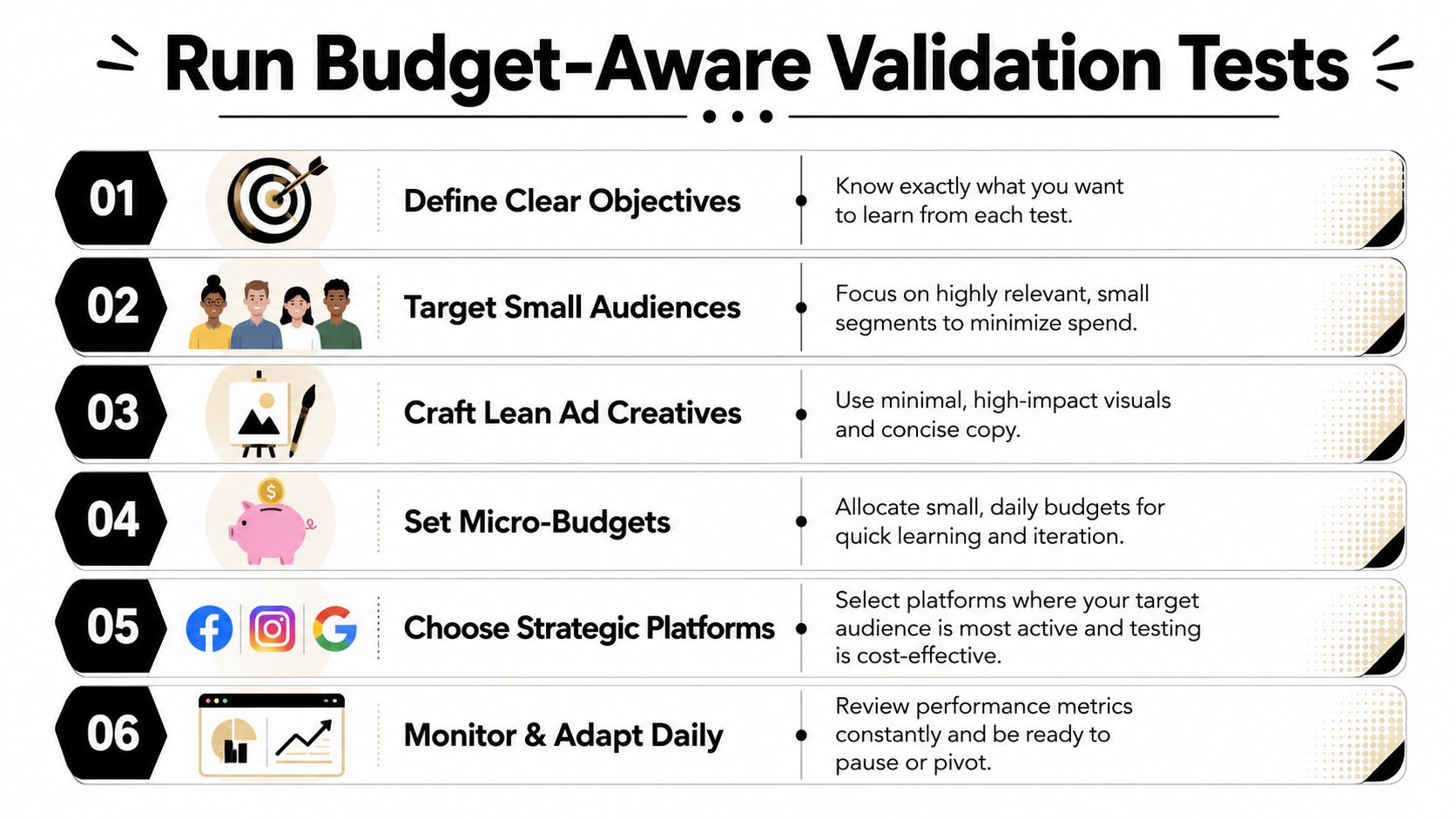
Check the page before you blame the product
The landing page has one job in a validation test. It must continue the angle cleanly enough that the click has a fair chance to become intent.
Score your page before launch using a simple readiness checklist:
| Page element | What to check |
|---|---|
| Headline | Does it match the exact angle from the ad? |
| Hero image or video | Does it show the outcome, not just the object? |
| First screen copy | Does it answer the main objection quickly? |
| Product explanation | Can a cold visitor understand it without effort? |
| Social proof | Does it support the same promise as the ad? |
| CTA | Is the next step obvious and low-friction? |
If the ad says “easy setup in seconds” and the page opens with a vague lifestyle headline, that's misalignment. If the ad leans on authenticity and the page feels generic or overdesigned, that's misalignment too.
A lot of weak tests are really page tests in disguise.
This video is a useful companion if you're thinking through lean validation and setup details before you spend more.
Structure the test to learn fast
You don't need a huge campaign structure to validate a product angle. You need clean separation between hypotheses.
Use a practical setup like this:
- One landing page variant per core angle when the page message needs to shift materially.
- One primary creative per angle at first. Keep it simple and legible.
- One audience hypothesis per angle if your customer types differ meaningfully.
- One clear success question for each round. For example, “Does simplicity beat comparison?” or “Does the emotional hook outperform the demo hook?”
Keep creative production lean. UGC-style clips, static image ads with clear copy overlays, and direct demos often tell you more at this stage than polished brand assets because they isolate the message.
A strong first-round creative usually includes:
- A sharp opening frame tied to the buyer's real frustration
- A single promise instead of a pile of benefits
- A visible product role in solving the problem
- Copy that sounds like the customer, not the manufacturer
What doesn't work is testing five audiences, six creatives, and four offers at once with no clean hypothesis. That's not validation. That's noise.
What to watch during the first rounds
Read results in sequence.
First, ask whether the ad earns attention. Then ask whether the click feels qualified. Then ask whether the page carries the promise.
Watch these signals qualitatively at first:
- CTR direction tells you if the angle and hook attract attention.
- Cost per landing page view helps you see whether the click is coming through efficiently.
- On-page behavior tells you if the promise survives contact with the store.
- Add to cart intent tells you whether interest is becoming buying behavior.
Bad CTR can mean weak creative. Good CTR with weak page behavior usually means the message won the click and lost the handoff.
If a test fails, don't jump straight to “bad product.” Ask narrower questions. Was the audience wrong? Was the angle weak? Was the page mismatched? Did the offer feel vague? That discipline saves more products than another random round of creatives.
Interpret Metrics and Make the Launch Decision
Most beginners read test data backward. They fixate on whether sales came in and ignore the path that led there. That's how they kill ideas too early or scale ideas that only looked good for a moment.
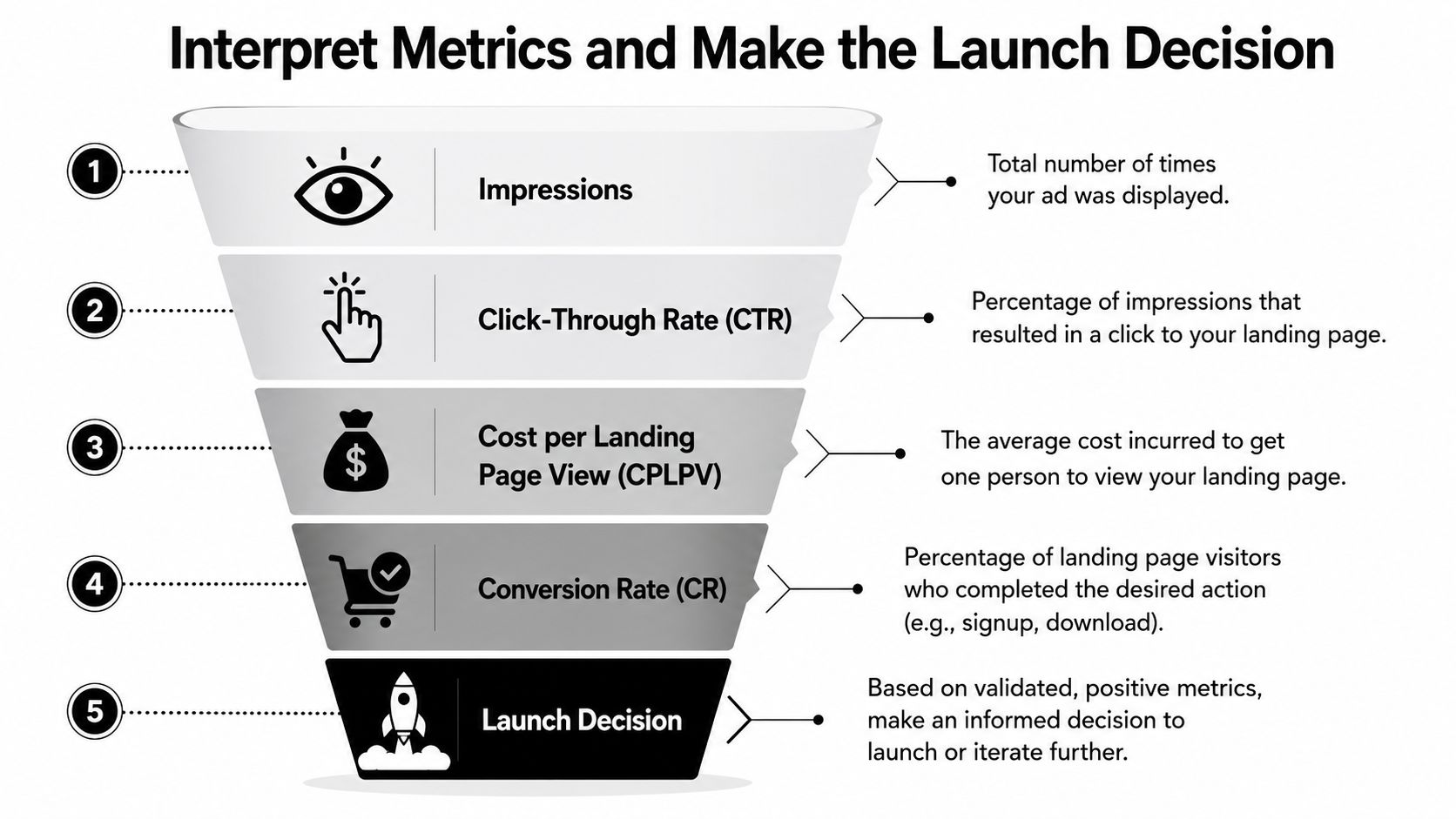
A better way is to read the funnel from top to bottom and make one decision at a time.
Read the funnel in order
Start with CTR. If nobody clicks, the problem is usually the angle, hook, visual, or audience fit.
Then check cost per landing page view. If it takes too much spend to generate visits, your ad may be attracting the wrong kind of curiosity or struggling to convert impressions into meaningful traffic.
Then look at conversion behavior on the page, including actions like add to cart or the primary action you asked for. That tells you whether the ad promise and page experience align.
Here's the practical read:
| Pattern | Likely issue | Best next move |
|---|---|---|
| Low CTR and weak page activity | Angle or creative isn't resonating | Replace the hook or change the angle |
| Good CTR but weak page behavior | Ad promise and page don't match | Rewrite headline, proof, and first-screen copy |
| Moderate CTR and moderate page behavior | There may be signal but not enough clarity | Keep the angle, sharpen the offer and page |
| Strong click quality and strong page action | Product-angle-audience fit is emerging | Scale carefully and add creative depth |
Don't force certainty where the data only gives direction. Early-stage testing is often about finding the most promising path, not declaring victory.
Make the decision without ego
A founder's biggest enemy at this point is attachment. You spent time sourcing the product, building the page, and creating ads. That sunk effort makes mediocre results feel more promising than they are.
Use blunt go, no-go, or retest logic instead:
- Scale when one angle consistently earns attention and the page carries buyers forward.
- Retest when the ad gets interest but the page or offer weakens the handoff.
- Pause when multiple angles fail to attract qualified clicks and the market evidence was thin to begin with.
- Kill the idea when repeated tests point to weak buyer interest and no clear differentiator.
One plain rule helps. Don't scale because you want the product to work. Scale because the product-angle-audience combination is showing repeatable evidence that it can.
Market research for products becomes useful when it leads to these decisions without drama. You stop guessing. You stop changing five things at once. You stop confusing activity with validation. And you protect cash for the products that actually earn the next round.
If you want help turning a product page into a practical Meta ads launch plan, Social Loop AI is built for that exact job. It helps first-time dropshippers and new ecommerce owners turn research into buyer profiles, angle choices, landing-page fixes, and a round-by-round testing plan without needing an agency.