Blog
Marketing Spend Optimization for Meta Ads & Ecommerce
Published June 9, 2026
You've got a store, a product you believe in, and a Meta Ads account staring back at you like a cockpit full of switches. That's where most first-time ecommerce owners freeze. They worry they'll burn cash, misread the data, and conclude the product “doesn't work” when the underlying problem was a bad page, weak creative, or sloppy setup.
That fear is justified. But it shouldn't stop you.
Pre-launch and early-stage brands don't win by spending aggressively. They win by building a system that turns every dollar into either a sale or a lesson. That's what marketing spend optimization means when your budget is small. It's not about acting like a Fortune 500 marketing team. It's about avoiding dumb mistakes, learning faster than your competitors, and keeping enough budget alive to test again.
Table of Contents
- Why Your First Ad Dollar is Your Most Important
- The Pre-Spend Audit for Your Landing Page and Creatives
- Architecting Your Test Budget for Maximum Learning
- Decoding Your Meta Ads Data Without Getting Overwhelmed
- The Rules of Scaling and When to Troubleshoot
- Making Spend Optimization a Repeatable Habit
Why Your First Ad Dollar is Your Most Important
Your first ad dollar matters more than your hundredth because it sets the standard for how you operate. If you launch with a messy product page, vague targeting, and random creatives, Meta will still spend your money. It just won't teach you anything useful.
That's why winging it is expensive. A widely cited benchmark from industry research says 30.6% of digital ad spend is wasted on low-quality traffic, mistargeted audiences, and preventable configuration errors, according to Improvado's ad spend optimization guide. For a new ecommerce owner, that number should change your mindset immediately. Your first job isn't “get traffic.” Your first job is “remove avoidable waste before traffic arrives.”
Most beginners think spending money is what creates clarity. Not exactly. Clean spending creates clarity. If your page promise doesn't match your ad, if your creative is generic, or if your checkout feels sketchy on mobile, the data you collect will be dirty. You won't know whether the product failed or the setup failed.
Practical rule: Don't spend to “see what happens.” Spend to answer one specific question.
That question might be simple. Does this hook stop the scroll? Does this offer attract the right click? Does this product page convert warm interest into checkout intent? Small budgets need sharp questions because they can't afford broad confusion.
Here's the standard I'd use before launch:
- Protect the learning: Only launch when your site, offer, and tracking are stable enough that any result means something.
- Buy signal, not hope: Run ads to generate feedback you can act on, not to satisfy launch-day excitement.
- Expect friction: Your first campaign is rarely your best one. That's normal. The mistake is treating early noise like final truth.
Marketing spend optimization starts before the campaign goes live. If you get this part right, every later decision becomes easier. If you skip it, Meta becomes an expensive way to diagnose obvious problems after the fact.
The Pre-Spend Audit for Your Landing Page and Creatives
A lot of ad accounts don't have an ad problem. They have a pre-spend problem. Traffic hits the site, gets confused, and leaves. Then the owner blames targeting.
That's backwards.
Before you spend on Meta, audit the two assets that carry the whole campaign. Your landing page makes the sale possible. Your creative earns the click.
Fix the page before you buy traffic
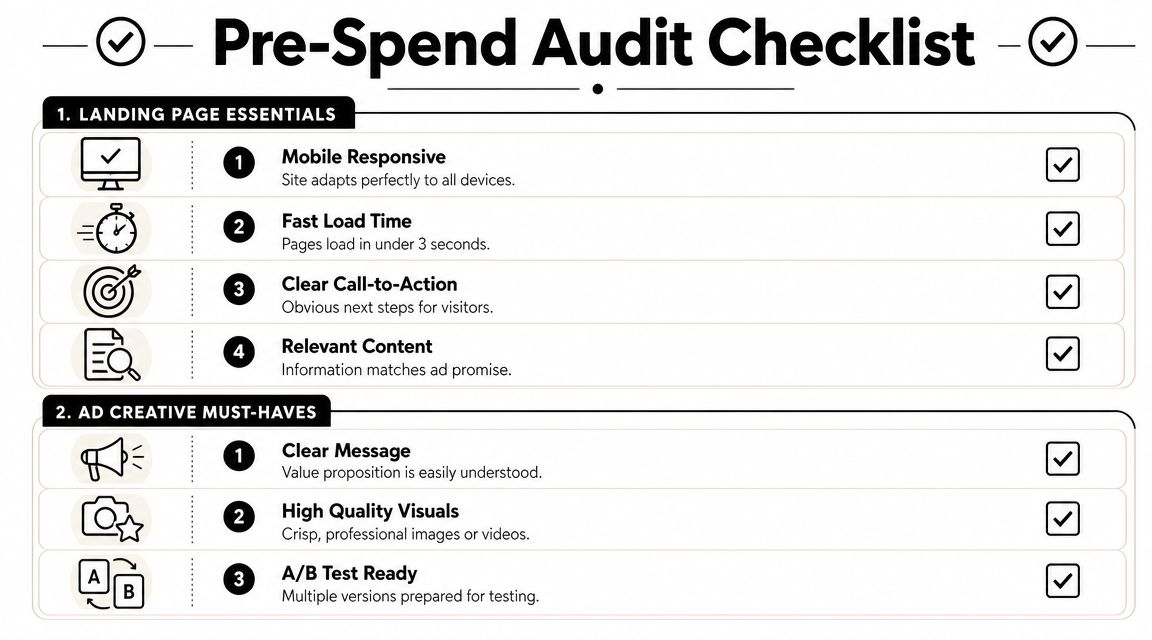
Your landing page doesn't need to be fancy. It needs to remove doubt fast. If a cold visitor lands and has to hunt for the product benefit, shipping info, reviews, or the buy button, you're paying for hesitation.
Use this audit before launch:
- Lead with the promise: Your headline and first product image should explain what the product is, who it's for, and why it matters.
- Match the ad: If the ad talks about pain relief, convenience, confidence, or time savings, the page should continue that same angle. Don't switch stories after the click.
- Show proof early: Reviews, testimonials, creator-style photos, or trust indicators should appear before the page feels like a wall of claims.
- Make the action obvious: Your add-to-cart button should be easy to find on mobile and repeat as people scroll.
- Reduce checkout friction: Hidden fees, confusing variants, or clunky mobile forms kill momentum.
If you need a practical framework for page cleanup, this guide to landing page best practices for ecommerce is worth reviewing before launch.
A simple question helps here. If someone gave you this page with no context, would you understand the product, trust the store, and know what to do next within a few seconds? If not, fix the page first.
Weak pages make decent ads look bad.
Build creatives that answer one clear objection
Most beginner creatives fail because they try to say everything. They show the product, mention a discount, hint at a lifestyle outcome, and toss in random branding. That kind of ad blends in.
Strong Meta creative does one job at a time.
Start with a few distinct angles instead of tiny visual tweaks. For a new product, the best tests usually come from different messages, not minor design edits. You want separate concepts such as:
- Problem to solution: Show the frustration first, then show how the product removes it.
- Social proof: Use review-style language, reactions, or real-user framing to make the product feel trusted.
- UGC style: Make it feel like a person discovered something useful, not like a polished brand shouting for attention.
- Identity angle: Speak to who the buyer believes they are, or wants to become.
- Comparison angle: Highlight why this is easier, cleaner, smarter, or more convenient than the old way.
Here's the discipline beginners need. Don't test five ads that all say the same thing in different colors. Test different reasons to care.
A strong creative audit looks like this:
| Creative check | What to look for |
|---|---|
| Hook | Does the first line or visual stop the scroll with a specific problem or desire? |
| Clarity | Can someone understand the product without turning on sound or reading a paragraph? |
| Relevance | Does the message speak to one buyer type, not everyone? |
| Proof | Is there something that makes the claim feel believable? |
| Next step | Does the ad create enough curiosity or urgency to earn the click? |
If your ads are weak and your page is weak, Meta can't rescue you. Fix those first, then buy traffic.
Architecting Your Test Budget for Maximum Learning
Small budgets get destroyed by one habit. New store owners spread money across too many audiences, too many creatives, and too many campaigns because they're scared to miss a winner. What they end up doing is underfund every test and learn nothing.
Treat budget like a finance decision, not a creative impulse. Marketing expenses account for 11.4% of a company's overall spend, and 59% of CMOs are under pressure to prove business impact, according to Keen Decision Systems' write-up on marketing budget optimization. That pressure exists at enterprise level, but the lesson applies even more to a solo ecommerce founder. Your ad budget is working capital. Respect it.
Stop treating budget like a dare
Don't launch with a “let's just put some money behind it” mindset. That's how first-time brands end up with scattered data, emotional decisions, and campaigns that die before they had a fair test.
A better starting point is a small-budget version of the 70/20/10 mindset:
- Put most of the budget into what is already most likely to teach you something useful.
- Keep a smaller portion for structured tests.
- Keep a tiny portion for riskier ideas you're curious about.
For a new Meta account, that usually means proven product angles first, not weird experiments. If you're testing your first product, “creative variety” doesn't mean chaos. It means disciplined variation.
One more thing. If you want to test multiple variables at once, learn the difference between random guessing and real test design. This overview of multivariate testing for marketers is useful because it shows why too many simultaneous changes muddy the result.
Use rounds instead of random daily spend
I like round-based testing because it forces clear decision points. You're not “running ads.” You're running a sequence of questions.
Here's a simple structure for an early-stage brand.
| Test Round | Budget Allocation | Primary Focus | Key Question to Answer |
|---|---|---|---|
| Round 1 | Largest share of budget | Broad audience and creative angle testing | Which message earns the best quality click? |
| Round 2 | Similar share to Round 1 | Narrowing winners | Which audience and creative combination deserves more spend? |
| Round 3 | Smallest share of budget | Early scaling | Can the winner handle more budget without losing efficiency? |
This works because each round has one purpose.
Round 1 is not about proving profitability forever. It's about identifying which ad concept deserves another chance. Round 2 is where you remove weaker combinations and look for stability. Round 3 is where you test whether the winner was real or just lucky.
Don't ask one campaign to do discovery, validation, and scaling at the same time.
If you're pre-launch, write the test plan before the campaign exists. Decide what counts as “interesting,” what counts as “bad,” and what would justify a retest. That way you won't rewrite the rules after money is spent.
The point of marketing spend optimization at this stage isn't squeezing every cent into immediate profit. It's building a repeatable testing machine that keeps you alive long enough to find the angle that works.
Decoding Your Meta Ads Data Without Getting Overwhelmed
Meta Ads Manager throws too much at beginners. Reach, frequency, CPM, thumb-stop ratio, outbound clicks, hook rate. Most of that can wait.
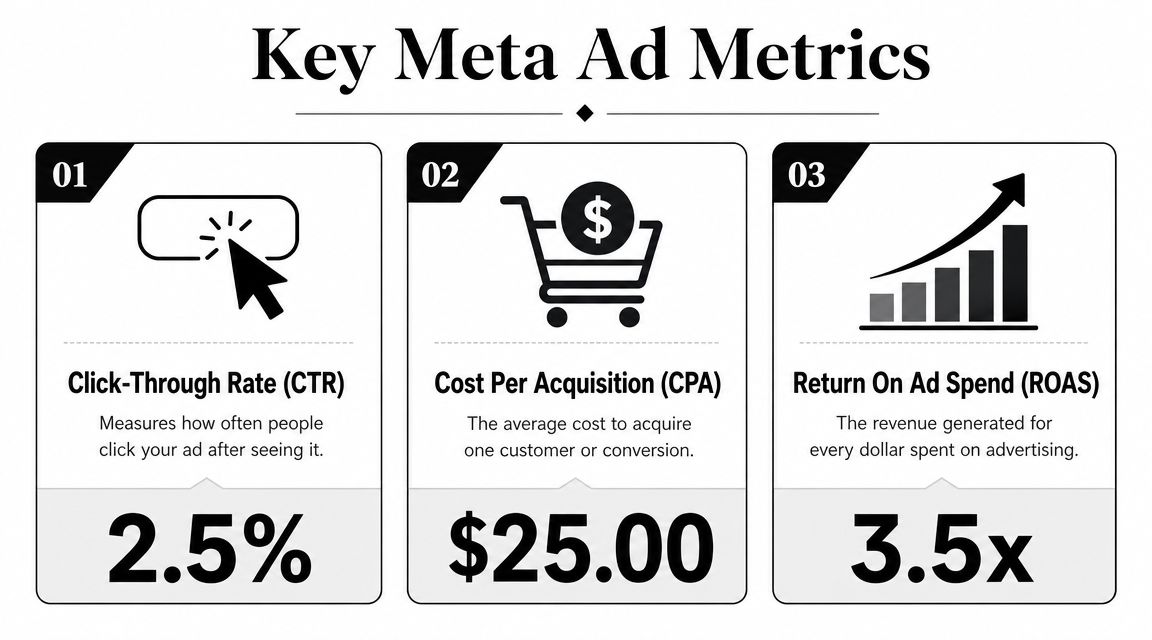
At the start, I care about three metrics because they tell a clean story together. CTR, CPA, and ROAS. Not in isolation. Together.
Early on, your dashboard should feel less like a report card and more like a diagnostic tool.
Read the story behind the metrics
Think of each metric as a different checkpoint in the buying journey.
- CTR tells you whether the ad deserves attention. If people aren't clicking, the hook, visual, or offer probably isn't strong enough.
- CPA tells you what it costs to turn interest into action. If clicks happen but conversions don't, the page, pricing, product-market fit, or trust layer may be off.
- ROAS tells you whether revenue justifies the spend. It's the reality check after clicks and conversions.
Here's how I'd read common scenarios:
| What you see | What it usually means | What to check first |
|---|---|---|
| Strong CTR, weak CPA | Ad is doing its job, page is not | Product page clarity, trust, offer, mobile checkout |
| Weak CTR, weak CPA | Bad traffic starts with bad creative | Hook, first visual, audience-message fit |
| Decent CTR, decent CPA, weak ROAS | Buyers may convert, but economics are thin | Average order value, bundle strategy, offer framing |
| Weak CTR, decent ROAS | Small pocket of right people is buying | Test stronger hooks without changing the page yet |
If you want a more detailed breakdown of how these metrics work together, this explainer on ad performance metrics for paid campaigns is a solid companion.
Don't obsess over one metric because it flatters the campaign. A high CTR with ugly economics isn't a winner. A low CPA with weak revenue quality isn't one either.
Build a clean baseline before you trust the dashboard
Many new brands get fooled. They stare at Meta reporting as if it's the whole truth. It isn't. You need a clean baseline for revenue and conversion tracking first.
A technically robust spend-optimization workflow starts with a unified revenue baseline, then measures incremental lift through methods like geo experiments, holdout tests, or structured lift studies, and only after that uses marketing mix modeling to estimate cross-channel effects, according to Fusepoint's guidance on marketing spend optimization.
That sounds advanced, but the beginner takeaway is simple: get your tracking and revenue view clean before you make aggressive budget decisions.
This video gives a useful visual walkthrough before you start overcomplicating the numbers.
For a small ecommerce brand, that means:
- Compare platform data to store revenue: Don't trust one screen blindly.
- Track one primary conversion goal: Usually purchase for ecommerce.
- Keep naming clean: Campaigns, ad sets, and creatives should be easy to trace.
- Record observations outside the platform: Note creative angle, landing page used, and any changes you made.
If your data setup is messy, optimization becomes storytelling, not analysis.
The Rules of Scaling and When to Troubleshoot
Once the first tests run, most beginners make one of two mistakes. They either scale too fast because one ad looked promising, or they kill a campaign too early because the first wobble scared them.
You need rules. Not vibes.
Marketing spend optimization gets harder when a campaign starts working because that's when greed and fear both show up. Greed says, “double it.” Fear says, “CPA went up, shut it off.” Both can wreck a good channel.
Use decision rules, not moods
A key part of optimization is understanding marginal spend. Cutting spend too aggressively can reduce total revenue if the channel is still on the efficient part of its response curve, which is why Tracklution's spend optimization guidance recommends controlled reductions and reallocations instead of pausing at the first CPA increase.
That's the right mindset for Meta.
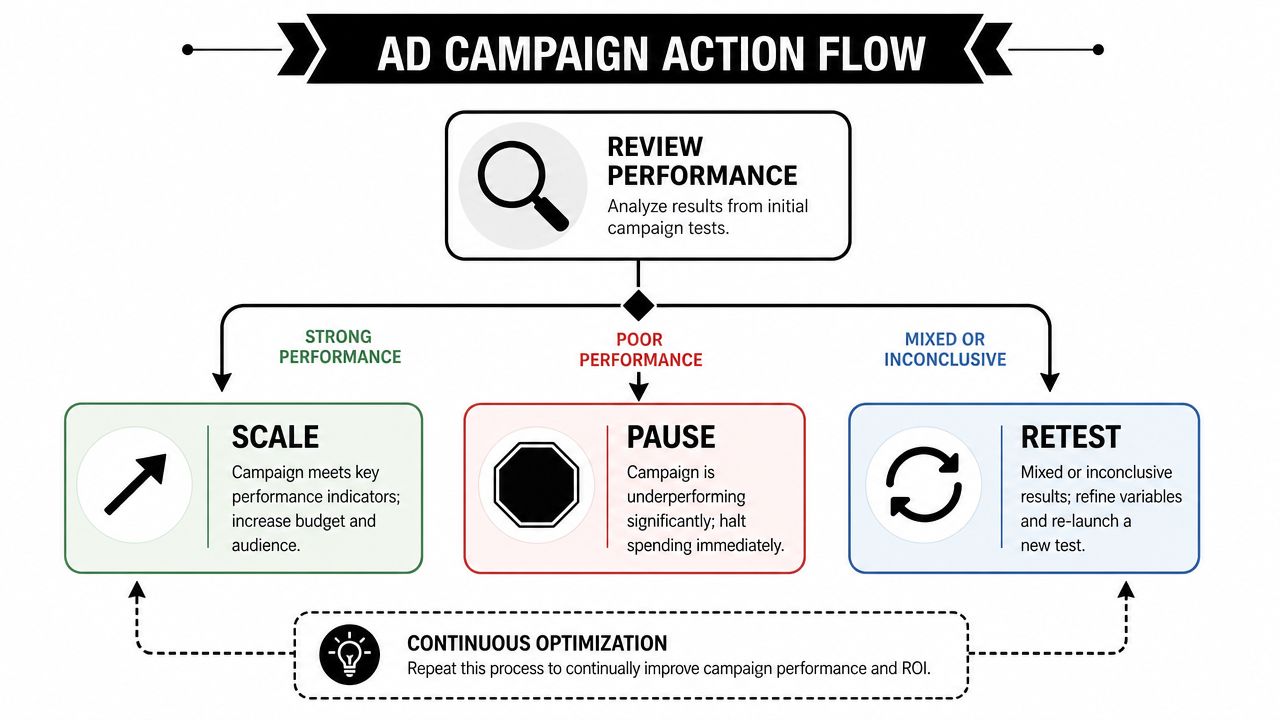
Use simple operating rules like these:
- If a campaign is producing purchases consistently, increase budget gradually. Don't make giant jumps that reset stability.
- If an ad gets clicks but no meaningful downstream action, troubleshoot the page before touching targeting.
- If one creative clearly outperforms others, keep it live and test fresh variations around the same angle.
- If results are mixed, retest by changing one variable only. Usually the hook, angle, or landing page message.
- If spend accumulates with no signs of qualified engagement, pause faster. Don't force Meta to “figure it out” forever.
The right move is often less dramatic than beginners expect. You usually don't need a full rebuild. You need a narrower correction.
Troubleshoot the bottleneck, not the symptom
When a campaign weakens, ask where the friction is.
If CTR drops, the issue is often creative fatigue, weak hooks, or message mismatch. If CTR holds but CPA worsens, the click quality or landing page experience may be slipping. If CPA stays acceptable but ROAS weakens, your economics may need work through offer changes, bundles, upsells, or product positioning.
Use this quick framework:
| Situation | Action |
|---|---|
| Ad once worked, then engagement fades | Refresh the hook or opening visual while keeping the winning angle |
| Plenty of clicks, weak conversion quality | Tighten message match between ad and page |
| Results are unstable across days | Wait for a clearer pattern before making multiple changes |
| Campaign slows after budget increase | Step back, reduce pressure, and scale more gradually |
| Nothing is clearly broken, but performance softens | Reallocate some spend to the next best test instead of shutting the whole thing down |
The first CPA increase isn't proof the campaign is dead. It's a signal to inspect marginal return.
The brands that scale best aren't the ones with the most aggressive budgets. They're the ones that can tell the difference between temporary noise, creative fatigue, and a real breakdown in efficiency.
Making Spend Optimization a Repeatable Habit
The founders who survive early paid acquisition do one thing well. They stop treating ads like isolated launches and start treating them like a routine.
That routine is simple. Audit. Launch. Observe. Decide. Repeat.
Run the same review rhythm every week
You do not need a giant analytics team. You need a consistent review habit that forces calm decisions.
A useful weekly rhythm looks like this:
- Review the winners: Which creative angles brought the best quality traffic?
- Review the leaks: Where did visitors lose trust or lose momentum?
- Review the economics: Which campaigns look promising enough to keep learning from?
- Choose one action per campaign: Scale, pause, or retest. Nothing fuzzy.
- Document the lesson: Write down what the result suggests.
That last point matters more than people think. Most small brands don't fail because they never get data. They fail because they keep generating data and never turn it into rules.
Protect your budget by staying boring and consistent
Good marketing spend optimization isn't flashy. It's repetitive on purpose. You check the page. You improve the creative. You isolate one variable. You compare result quality, not just clicks. You give promising campaigns room to prove themselves. You cut obvious waste quickly.
That discipline is a huge advantage for a new ecommerce brand. Bigger companies often move slowly, argue in meetings, and hide behind dashboards. You can move faster if you stay honest about what the data is saying.
If you remember one thing, remember this. Your small budget is not a handicap if it forces better decisions. It becomes a handicap only when you spend it emotionally.
The first version of your ad account won't be perfect. It doesn't need to be. It needs to become more accurate every week.
If you want help turning a product page into a practical Meta ads launch plan, Social Loop AI is built for exactly that. It helps first-time ecommerce owners audit their page, choose strong ad angles, generate brand-aware creatives, and map a budget into clear test rounds so you can scale, pause, or retest with a plan instead of guessing.