Blog
Meta Ads Learning Phase: The 2026 Beginner Playbook
Published July 28, 2026
The Meta Ads learning phase usually lasts about 7 days, and its key exit threshold is about 50 optimization events per ad set in 7 days. During that window, Meta is still experimenting, so early performance is unreliable and shouldn't be judged yet.
You hit publish, refresh Ads Manager, and the numbers look wrong. Spend is moving, clicks may be trickling in, and the CPA looks like it's mocking you before the campaign has even had time to breathe.
That moment is where most first-time dropshippers panic, kill the ad set, and conclude Meta ads “don't work.” Usually, the ad set is just inside the Meta Ads learning phase, which is Meta's testing window after a new launch or a significant edit. If the structure can't realistically reach about 50 optimization events in 7 days, the system stays in learning and the data is still noisy, not settled.
Table of Contents
- You Just Hit Publish and Nothing Is Working
- What the Meta Ads Learning Phase Actually Is
- The 3 to 7 Day Volatility Window
- Doing the Math on Whether You Can Exit Learning
- When to Stop Waiting and Change Something
- Edits That Reset Learning and How to Plan Around Them
- A First-Launch Workflow for a $20-a-Day Dropshipper
- Your Week-One Learning Phase Checklist
You Just Hit Publish and Nothing Is Working
The first 24 hours of your first campaign can feel brutal. You launch a fresh ad set, check back a few hours later, and it looks like Meta has either ignored you or chosen the most expensive possible way to teach you patience.
That's usually not what's happening. Meta's delivery system is in its learning phase, which starts when you launch a new ad set or make a significant edit, and it usually ends after the ad set gets about 50 optimization events in 7 days according to Meta's Help Center, which is why many advertisers use 50 weekly conversions as the practical finish line (Meta Help Center).
Why the first day feels so messy
A new ad set is not a finished machine. It's more like a new barista learning your regular order, except the barista is also deciding which shop, which counter, and which cup size works best before it settles in.
That means early cost swings are normal. Meta is still testing audiences, placements, and bidding patterns, so the numbers you see on day one are closer to a draft than a verdict (Meta Help Center).
Practical rule: don't treat the first few hours like a performance review. Treat them like setup time.
For a first-time dropshipper, this matters because the instinct is always to touch something. Change the creative. Tighten the audience. Drop the budget. Pause the ad set. The problem is that those reactions often make the campaign less stable right when it needs cleaner signal.
If you only keep one anchor in your head, make it this. Meta wants roughly 50 optimization events in 7 days, and until you're moving toward that number, the campaign is still learning, not failing (Meta Help Center).
What the Meta Ads Learning Phase Actually Is
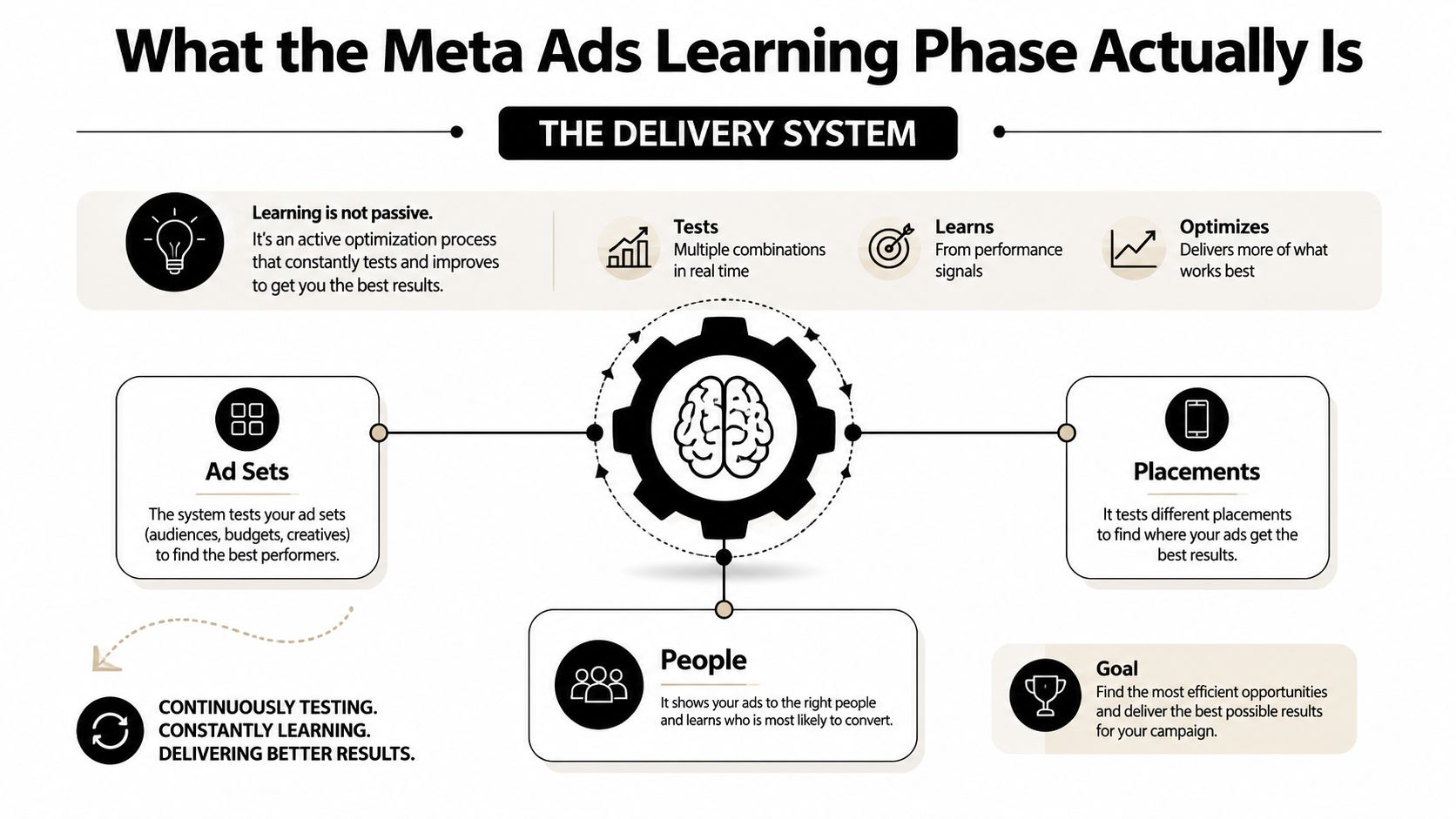
The Meta Ads learning phase is the stretch after you launch a new ad set or make a meaningful edit, when Meta's delivery system is gathering enough signal to predict which people are most likely to complete your chosen optimization event. In plain English, Meta is trying to figure out who, where, and under what bidding conditions your ad is most likely to get the result you want.
A new ad set behaves like a new barista learning your regular order, except the barista is also deciding which shop, which counter, and which cup size works best before the order becomes routine. Early on, the system is making guesses, then watching what gets acted on, what gets ignored, and which patterns start to repeat.
What Meta is testing behind the scenes
There are three main questions the system is working through.
- Audience response, who is reacting and converting.
- Placement performance, where the ad is working best.
- Bid efficiency, how much it needs to pay to win the auction and still get the event you want.
That is why the same ad can look uneven at the start. Meta is not just showing the ad, it is comparing conditions and building a prediction model from the results it sees, as described in Meta Help Center.
The useful vocabulary here is simple. Your ad set is the delivery unit. Your optimization event is the action you want. The exit criterion is the point where Meta has enough signal to move out of learning. The common operational benchmark is still about 50 events in 7 days.
Meta is not punishing you. It is collecting enough evidence to make a better prediction.
That is also why consolidation matters. When you split budget across too many ad sets, you split the signal too. A $20-a-day account feels this fast, because each ad set needs enough repeated events to give the system something stable to learn from, and thin budgets can leave every ad set underfed.
The 3 to 7 Day Volatility Window
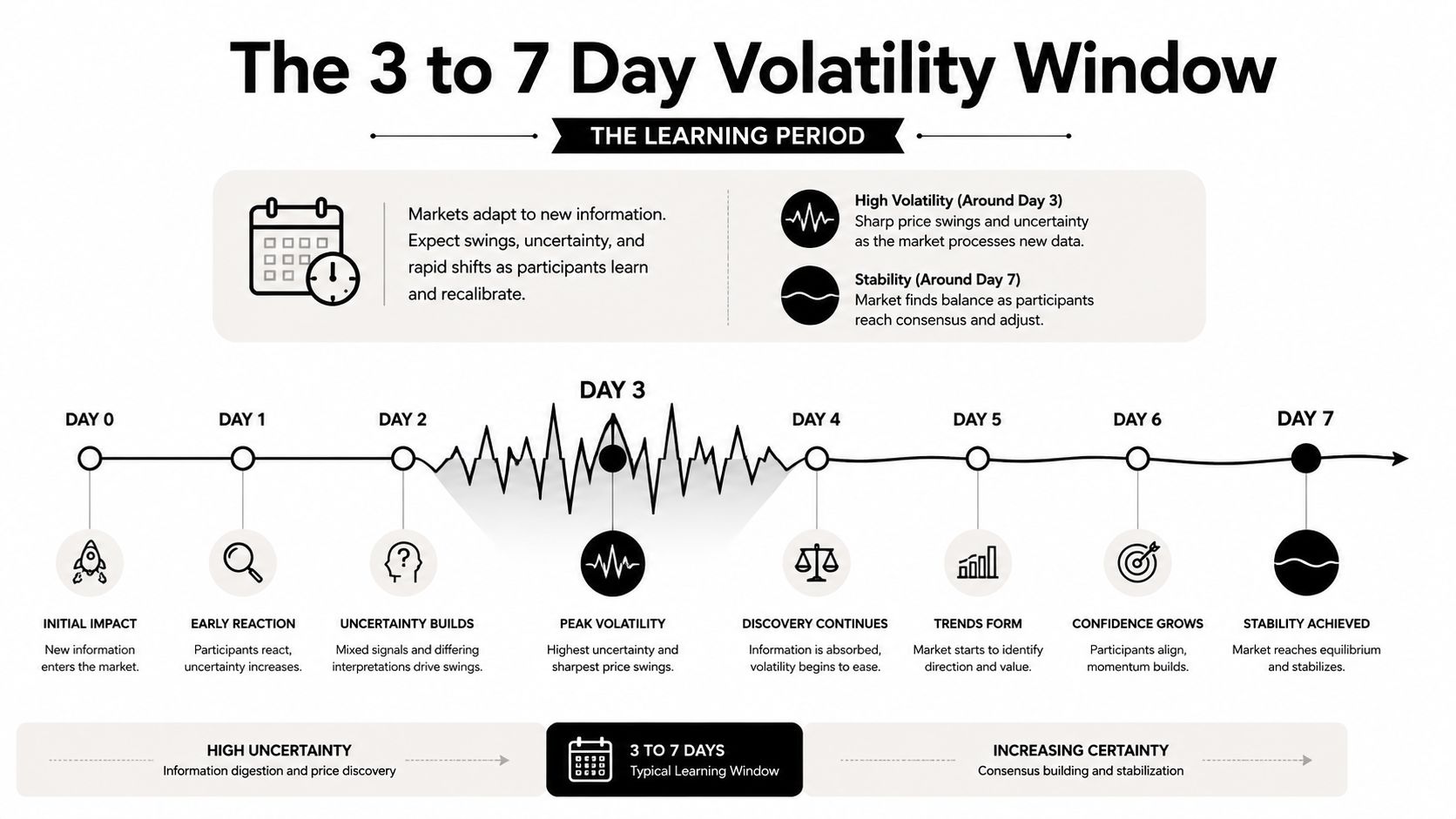
The part that trips up beginners is time. They expect a campaign to know whether it works in a few hours, but the practical learning window is often described as 3 to 7 days, with many guides recommending waiting at least 4 to 5 days before judging performance (Lionelz).
Those days still matter. The numbers are moving enough that one strong or weak pocket of delivery can make the whole picture look better or worse than it is.
What the window looks like in practice
At the start, performance can look jagged. CPA jumps, spend lags, and one placement may carry most of the delivery while the others barely move. That is the system collecting signal, not necessarily the campaign failing.
A campaign often looks less erratic once delivery settles. That shift from volatility to stability is the milestone that matters, and the usual advice is to leave the system alone long enough to get there (Lionelz).
The daily pace matters too. If the practical benchmark is about 50 events per week, that works out to roughly 5 conversions per day per ad set, which is the rough pace many practitioners use when deciding whether a setup can stay on track. A useful close look at reporting is this Meta ads reporting guide, because the learning problem gets easier to read when you know which numbers matter.
A beginner mistake is making a panic edit on day 2 because the first results look ugly. That often resets the clock or stretches the messy period, which means the campaign spends more time unstable and less time learning (Niblin).
Doing the Math on Whether You Can Exit Learning
The fastest way to confuse a beginner is to treat 50 events in 7 days like a test of patience. For a lot of $20-a-day accounts, the question is simpler. Can the account generate enough purchase signal to leave learning, or is the budget too small for that event?
Start with the expected CPA. If your account spends $20 a day and your offer usually converts at $30 CPA, one ad set is not going to reach the learning threshold on a steady basis. In plain terms, the account is trying to buy expensive signal with a small wallet, so the learning phase drags on instead of clearing.
Do the quick math before you launch
Use the spend you can comfortably give one ad set, then compare it with the event you want Meta to optimize for.
- Budget per ad set matters. If you split $20/day across two ad sets, each one gets a very thin slice of spend.
- CPA matters. If one purchase costs more than the daily delivery can support, the event flow stays thin.
- Signal flow matters more than waiting. If the structure cannot come close to 5 conversions per day per ad set, the problem is the setup, not your patience.
That is why the better question is not, “How long should I wait?” It is, “Can this ad set ever produce enough events to leave learning?” If the answer is no, time does not fix it. It only gives the same weak structure more days to underperform.
A more detailed guide on Meta reporting is a detailed guide on Meta ads reporting, because the numbers are much easier to read when you know which signals matter and which ones are just noise.
Rule of thumb: if the event rate cannot support the threshold, waiting for the system to recover is the wrong move. Change the structure.
For a first-time dropshipper, the cheapest improvement is usually the least exciting one. Run fewer ad sets. Pick one clear event. Stop splitting a tiny budget into fragments that each get too little traffic to learn from. Learning phase is asking for enough signal, not for hope.
When to Stop Waiting and Change Something
If your account cannot reasonably hit the threshold, the move is not to stare at the same setup longer. The move is to change the optimization event or the structure so Meta can learn from the volume you have.
There are three legitimate fixes for a low-budget account. Step up the funnel, consolidate ad sets, or broaden targeting so the system has more room to find buyers. Those are the moves that solve a volume problem without pretending the volume problem doesn't exist.
The three changes that make sense
- Step up the funnel: optimize for a higher-frequency event like add to cart or initiate checkout when purchase volume is too thin.
- Consolidate ad sets: one strong ad set usually learns better than three weak ones that split the same budget.
- Broaden targeting: give Meta more room to search instead of trapping it inside a narrow audience box.
The most useful thing to stop believing is that “just wait 7 days” is always good advice. If your event math is impossible at your current budget, waiting doesn't create signal. It just stretches the same weak setup over a longer calendar period.
That's also where statistical significance in ads testing matters conceptually, because a handful of conversions is not enough to draw a sturdy conclusion from a tiny account.
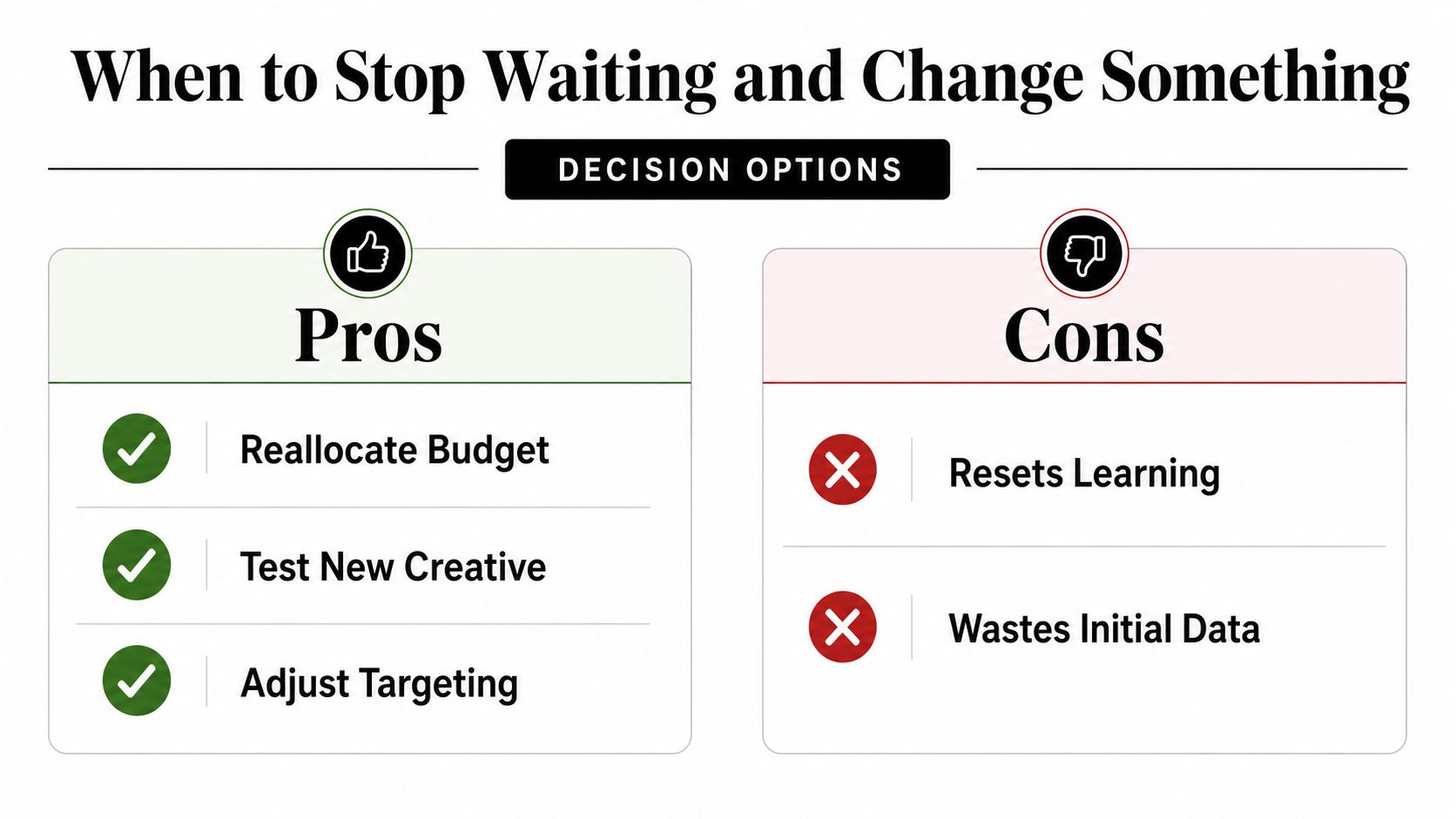
If purchase optimization can't get the needed volume, move one step up the funnel instead of forcing the account to prove something it can't prove yet.
That doesn't mean you abandon purchases forever. It means you use the event that matches your current budget reality, then move back down the funnel when the account has enough volume to support it.
Edits That Reset Learning and How to Plan Around Them
A campaign can look stable on Monday and feel like it slipped on Tuesday after a few small tweaks. That happens because Meta treats some edits as a fresh signal request, especially when the change affects who should see the ad or how delivery should optimize.
For a beginner with a $20 a day account, the main risk is not curiosity. It is making one tiny change after another and turning a steady setup into a moving target. A new store setup works best when the account gets a clean chance to gather signal, which is why choosing the right launch plan for a new product matters before you start editing.
The edits that most often disturb learning are the ones that change the shape of delivery. Audience edits, bigger budget moves, creative swaps, and tracking changes can all wipe out useful signal and make Meta reassess the ad set from scratch.
The safest way to judge an edit
Use one question before you touch anything. Does this change affect the kind of person Meta should find, or the action it should optimize for? If the answer is yes, treat it like a learning reset and plan for a fresh stabilization period.
If the change only adds a new ad into an already steady setup, the risk is lower. The account is still working with the same audience and the same optimization goal, so the disruption is usually smaller.
Meta's own guidance and independent explainers point to the same practical lesson, repeated edits keep the system from getting a clean run of data (Meta Help Center, Niblin).
A simple way to sort edits is to separate them by what they touch:
- Creative changes, such as new text, images, or video, can alter the signal path and should be planned rather than done casually.
- Budget and bid changes, especially larger ones, can shift delivery enough to send the ad set back into learning.
- Audience changes, like narrowing, replacing, or splitting the target group, often force Meta to recalculate.
- Objective or tracking changes, including Pixel or CAPI updates, can make older performance data less useful for the current setup.
The safest rhythm is to give a new setup a stable window before you interfere with it. Many practitioners use 48 to 72 hours as a minimum before judging a fresh change, and some teams keep a steady flow of new creatives entering live ad sets instead of tearing down the whole structure at once (Birch).
That removes the beginner confusion. Fresh creative is useful, but constant tinkering is not. You want the account to learn from stable inputs, then change one piece at a time so you can tell what helped.
A First-Launch Workflow for a $20-a-Day Dropshipper
A first launch with $20 a day should feel like setting a small boat in the water, not launching a cruise ship. Maya keeps her setup simple for that reason. She wants Meta to get a clean read on what people do, not a messy mix of too many ad sets, too many audiences, and too many tiny signals that never add up to anything useful.
She opens with one campaign and just enough structure to let the system learn. Then she prepares a batch of creatives before spending starts, so she is not forced into the common beginner habit of changing one ad at a time and hoping the algorithm figures out the rest.
What Maya changes before launch
The first decision is structure. Maya does not chase a long list of micro-audiences or split her spend into fragments that never get enough traffic. She keeps the optimization event realistic for her budget, because a small account needs volume more than cleverness.
The second decision is creative variety. She builds a set of ads that each say something different, one focused on the problem, one on the solution, one on social proof, one on identity, and one on urgency. That gives Meta separate signals to compare. A pile of near-duplicates behaves like a stack of nearly identical test cards, useful for confirming what already looks similar, not for revealing what changes behavior.
A launch plan for Maya stays grounded in that reality.
- Keep the structure compact. A small budget gets diluted fast when too many ad sets compete for the same learning signal.
- Use distinct creative angles. Different hooks give Meta cleaner early comparisons.
- Wait through the first 72 hours without panic edits. The early wobble is part of the process.
- Check the event math before you wait. If the account cannot realistically reach purchase volume, move to a higher-funnel event instead of hoping harder.
For product-level planning, a comprehensive guide on advertising a new product is a useful companion, because the learning phase is easier to handle when the offer is packaged clearly before the first dollar goes out.
By the third day, Maya is not asking whether the campaign feels polished. She is asking a more useful question, whether this setup can produce enough signal to deserve more time. If the answer is yes, she leaves it alone and lets the system work. If the answer is no, she trims the structure instead of expecting a small budget to survive a complicated launch.
Your Week-One Learning Phase Checklist
Use this before every launch.
- Check the math first. Can the ad set realistically reach about 50 optimization events in 7 days (Meta Help Center)?
- Consolidate before you launch. Don't split a tiny budget across too many ad sets.
- Match the optimization event to volume. If purchases are too rare, move up the funnel instead of waiting.
- Hold steady for 48 to 72 hours. Don't judge fresh delivery too early (Birch).
- Avoid significant edits while learning. Big changes can reset or prolong the process (Niblin).
- Watch for Learning Limited. It usually means the account needs more signal, not more anxiety.
The three week-one questions are simple. How long does learning phase last? Usually a few days, often framed as 3 to 7 days. Can you speed it up? Yes, by giving Meta enough clean volume and fewer interruptions. What does Learning Limited mean? The system doesn't expect enough optimization events at the current structure, so the account needs a better signal path.
Social Loop AI helps first-time dropshippers turn a product URL into a launch plan and a batch of brand-aware creatives without guessing in the dark. If you want a faster way to build a budget-aware Meta ad setup that fits the learning phase instead of fighting it, visit Social Loop AI and try it on your next product.