Blog
What Is Direct Response Copywriting? 2026 Ecommerce Guide
Published June 13, 2026
Direct response copywriting is copywriting with one single goal: to get an immediate, measurable action from the reader, like a click, a sign-up, or a sale. One practical benchmark shows why that matters: if you're spending $50,000 per month on traffic, a 1.2% landing-page conversion rate can change the economics fast.
If you're a new founder, you probably know the feeling. You're inside Meta Ads Manager, staring at the Primary Text field, and every option sounds either too salesy, too vague, or too much like something ChatGPT wrote in five seconds. You don't need prettier words. You need copy that gives a stranger a reason to act now, and a way to tell whether the message worked.
That is what direct response copywriting is for. It isn't about sounding clever. It isn't about making your brand feel premium in some abstract way. It's about writing messages that move someone from scroll to click to purchase, and doing it in a way you can test, measure, and improve.
In the 2026 Meta ads environment, that job looks different than it did in the old long-form sales letter era. You still need strong persuasion, but now you also need variation, angle testing, landing-page match, and creative volume. The winning mindset is no longer "write one perfect ad." It's "build a testable message system."
Table of Contents
- What Is Direct Response Copywriting and Why It Matters Now
- Direct Response vs Brand Copywriting The Critical Distinction
- The Anatomy of High-Converting Ad Copy
- Direct Response Examples and Micro-Templates for Meta Ads
- You Cannot Improve What You Do Not Measure
- Your First Steps with Direct Response Copywriting
- Frequently Asked Questions
What Is Direct Response Copywriting and Why It Matters Now
Most first-time advertisers think the hard part is launching the campaign. It isn't. The hard part is saying something specific enough to earn the click.
Direct response copywriting solves that by forcing clarity. You write with one outcome in mind. Buy now. Start the quiz. Claim the offer. Book the demo. The reader should know what to do next, and you should know whether the copy got them there.
That makes it different from broad, image-building marketing. Direct response lives or dies on response. Historically, that idea goes back to early direct marketing, where copy was treated as "salesmanship in print" and judged by the action it produced, not by vague awareness, as described in this history of direct response copywriting.
Why this matters more on Meta now
Meta doesn't reward hesitation. A user scrolls, glances, and decides in seconds whether your ad is relevant. If your copy opens with generic brand language, you've already lost the moment.
The bigger shift is platform reality. Classic direct response advice still matters, but modern ad systems demand more than one polished line. Current guidance notes that modern platform constraints and AI-generated creative have pushed advertisers toward broader testing, more variants, and stronger relevance. A projected 2026 view is that direct response copywriting is less about one persuasive letter and more about a testable message system across ads, pages, and iterations, as noted in Anyword's glossary on direct response copywriting.
Practical rule: On Meta, don't ask, "What's my best ad?" Ask, "What set of angles, hooks, and offers can I test quickly?"
Founders who get this early waste less money. They stop chasing a magic sentence and start building a repeatable process.
Direct Response vs Brand Copywriting The Critical Distinction
A simple way to think about it is this.
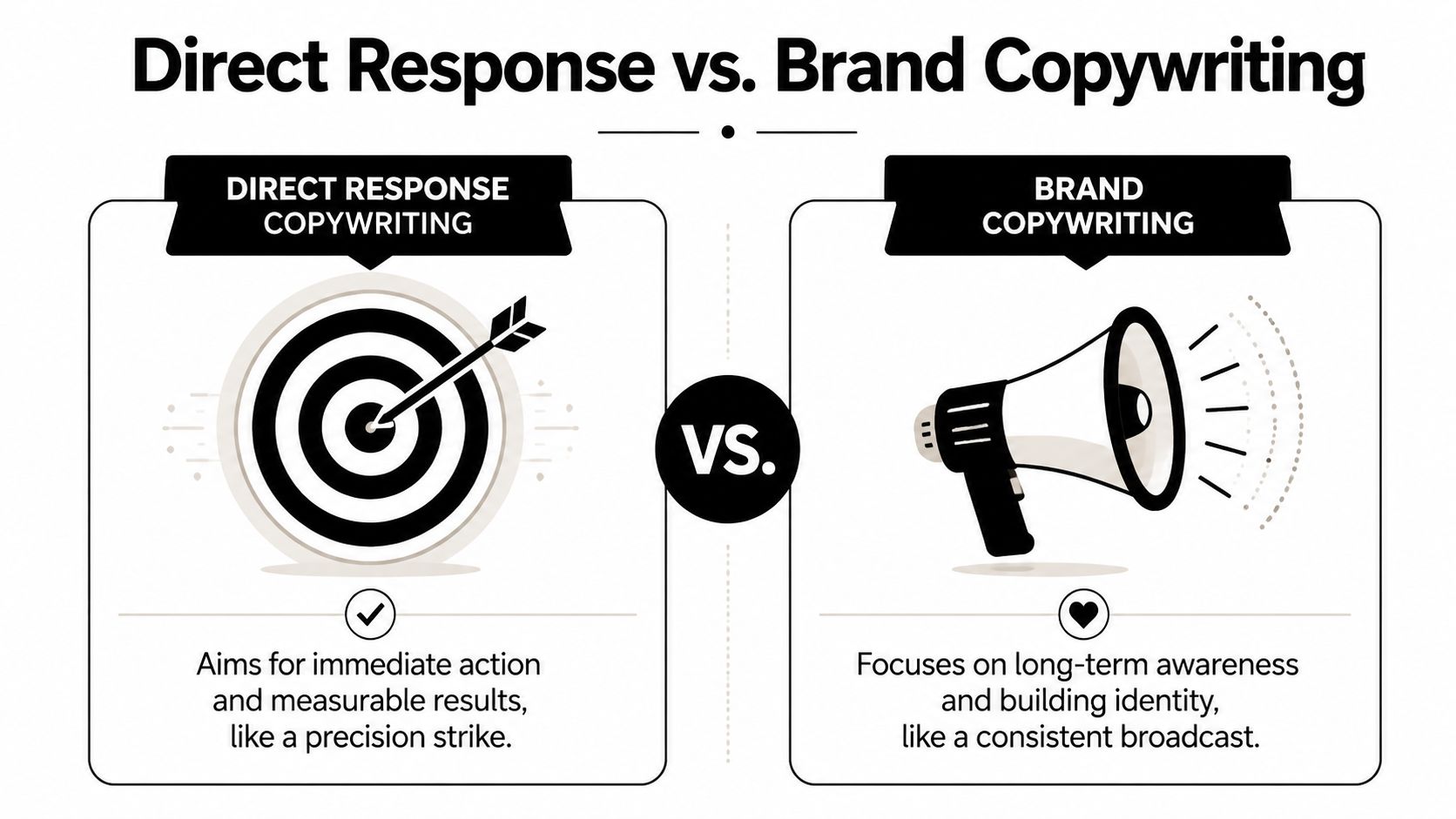
A direct response copywriter works like a salesperson trying to close the deal now. A brand copywriter works like a brand ambassador trying to shape perception over time.
Both matter. But they are not the same job.
The difference in plain English
Brand copy says, "This is who we are."
Direct response says, "This is why you should act now."
Brand copy can afford some abstraction. It can lean on tone, mood, identity, and repetition. Direct response can't hide there. It has to make a case. It has to connect a problem to an outcome and move the reader toward a next step.
Here is the cleanest comparison.
| Type | Main job | Time horizon | Typical channels | What good looks like |
|---|---|---|---|---|
| Direct response copywriting | Drive immediate action | Short-term | Meta ads, email promos, product pages, landing pages | Clear offer, relevance, click or conversion |
| Brand copywriting | Build memory and preference | Long-term | Homepages, brand films, organic social, packaging | Distinct voice, consistency, emotional association |
Why new ecommerce founders confuse them
A lot of new stores write ads the way they write an About page. They talk about craftsmanship, passion, mission, or the story behind the business. That can help later. It usually doesn't help cold traffic act today.
If you're selling on Meta, cold prospects usually care about four things first:
- Their problem: What pain, friction, or desire does this solve?
- Your claim: Why is this worth attention?
- The offer: What exactly do they get?
- The next step: What should they do now?
Brand copy can support the sale. It rarely replaces the sale.
When each one makes sense
Use direct response when you're asking for a measurable action. That includes most paid social, launch emails, lead-gen pages, and retargeting offers.
Use brand copy when you're shaping how people remember you over time. That includes packaging language, founder story pages, and campaigns where memorability matters more than immediate conversion.
The expensive mistake is trying to make one asset do both jobs equally well. Early-stage DTC brands usually need more direct response than they think. If the business needs revenue now, the copy should behave like a closer, not a poet.
The Anatomy of High-Converting Ad Copy
Strong ad copy isn't mysterious. In practice, the best-performing ads usually do five jobs in sequence. They stop the scroll, create relevance, make the value clear, reduce doubt, and tell the prospect what to do next.
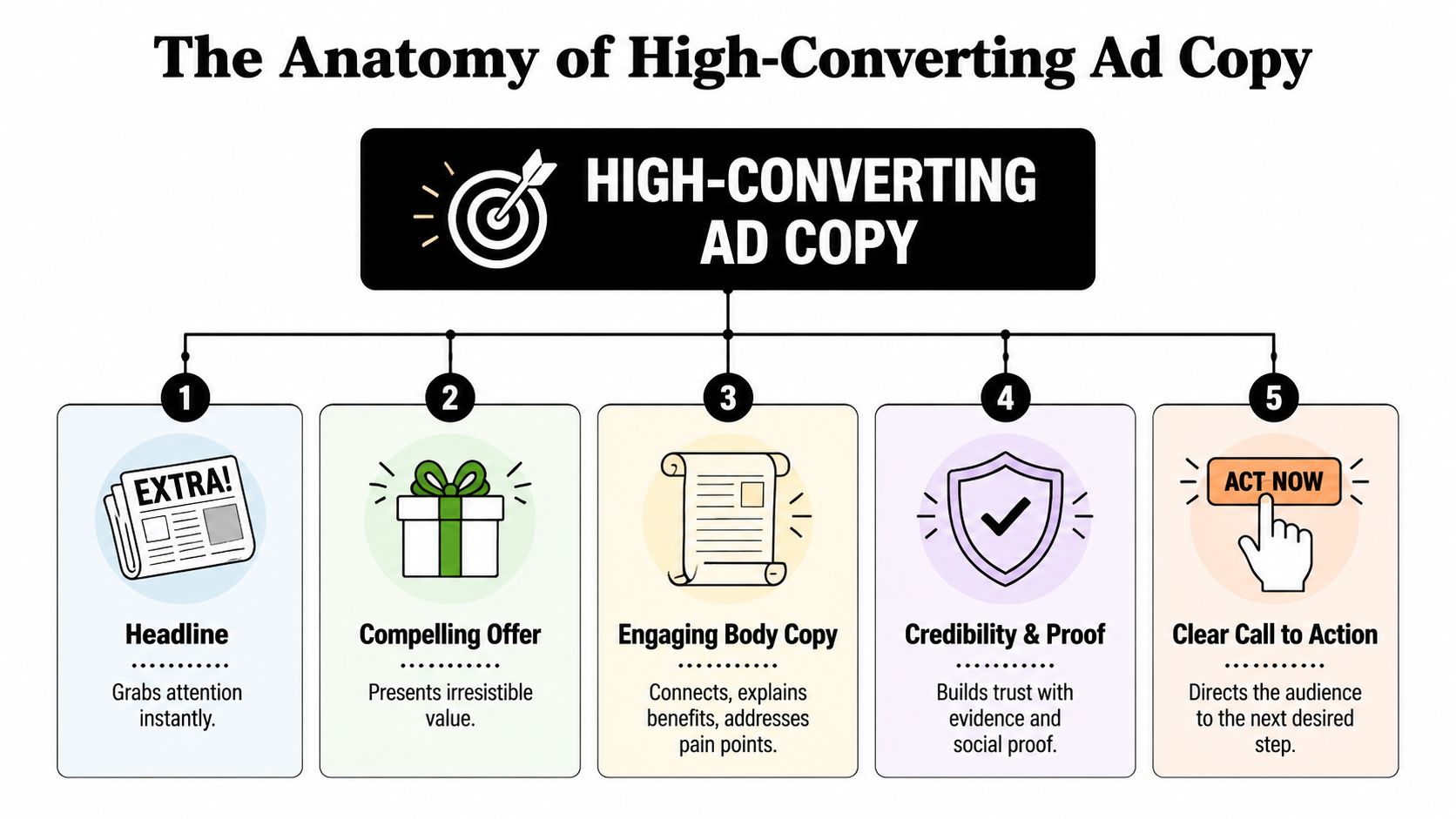
If you're learning what is direct response copywriting, this is the framework worth memorizing. It gives you a checklist for writing from scratch and a way to judge copy from freelancers, agencies, or AI tools. For a complementary breakdown of writing ad copy that fits paid traffic, see this guide on how to write ad copy.
The hook
The hook's job is simple. Earn the next second of attention.
On Meta, that usually means one of three things. You call out a problem. You state a sharp benefit. Or you make the person feel seen.
Good hook:
"Still scrubbing your water bottle with a sponge that never reaches the bottom?"
Weak hook:
"Meet the future of hydration."
The weak version sounds polished, but it doesn't create tension. It doesn't tell the right buyer, "This is for you."
The problem and promise
Once you have attention, you need relevance. Name the friction the buyer already feels, then point to the outcome they want.
Good example:
"Odor buildup, hard-to-clean lids, and forgotten bottles make staying hydrated more annoying than it should be. This bottle cleans itself and keeps daily use simple."
This section works because it connects pain to relief. It doesn't wander into features too early.
If your copy jumps straight into specs, you're often answering a question the buyer hasn't asked yet.
The offer
A lot of ads fail here. They hint at value without clearly presenting it.
The offer is not just the product. It's the deal the buyer is considering right now. That might include the product, bundle, bonus, guarantee, or the main reason the purchase feels worth it.
Examples:
- "Get the self-cleaning bottle designed for daily commuters."
- "Choose one for yourself or grab a two-bottle bundle for home and travel."
- "Shop the bottle and replace your old cleaning routine."
Notice what's happening. The offer turns abstract interest into a concrete buying option.
The proof
Proof lowers skepticism. Without it, your copy asks the reader to trust you because you said so.
On Meta, proof can come from several places:
- Customer language: A review that sounds like a real person
- Specific experience: "No more stale smell by day three"
- Product demonstration: Show the cap, the cleaning action, the everyday use
- Consistency: Copy that matches the landing page instead of overpromising
A simple proof line might look like this:
"Built for everyday use, easy to carry, and designed for people who are tired of bottles that end up smelling weird after a few days."
That isn't a statistic. It's believable product-level proof.
The call to action
The CTA finishes the job. It tells the reader what to do and reduces drift.
Weak CTA:
"Learn more."
Stronger CTA:
"Shop the bottle now."
"Pick your color and order today."
"See how it works."
The best CTA depends on buyer temperature. Cold traffic may click better on curiosity. Warm traffic often responds better to direct purchase language.
A quick self-check helps here:
- Can a stranger tell what you're selling?
- Do they understand why it matters now?
- Is the next step obvious?
If any answer is no, the copy probably needs another pass.
Direct Response Examples and Micro-Templates for Meta Ads
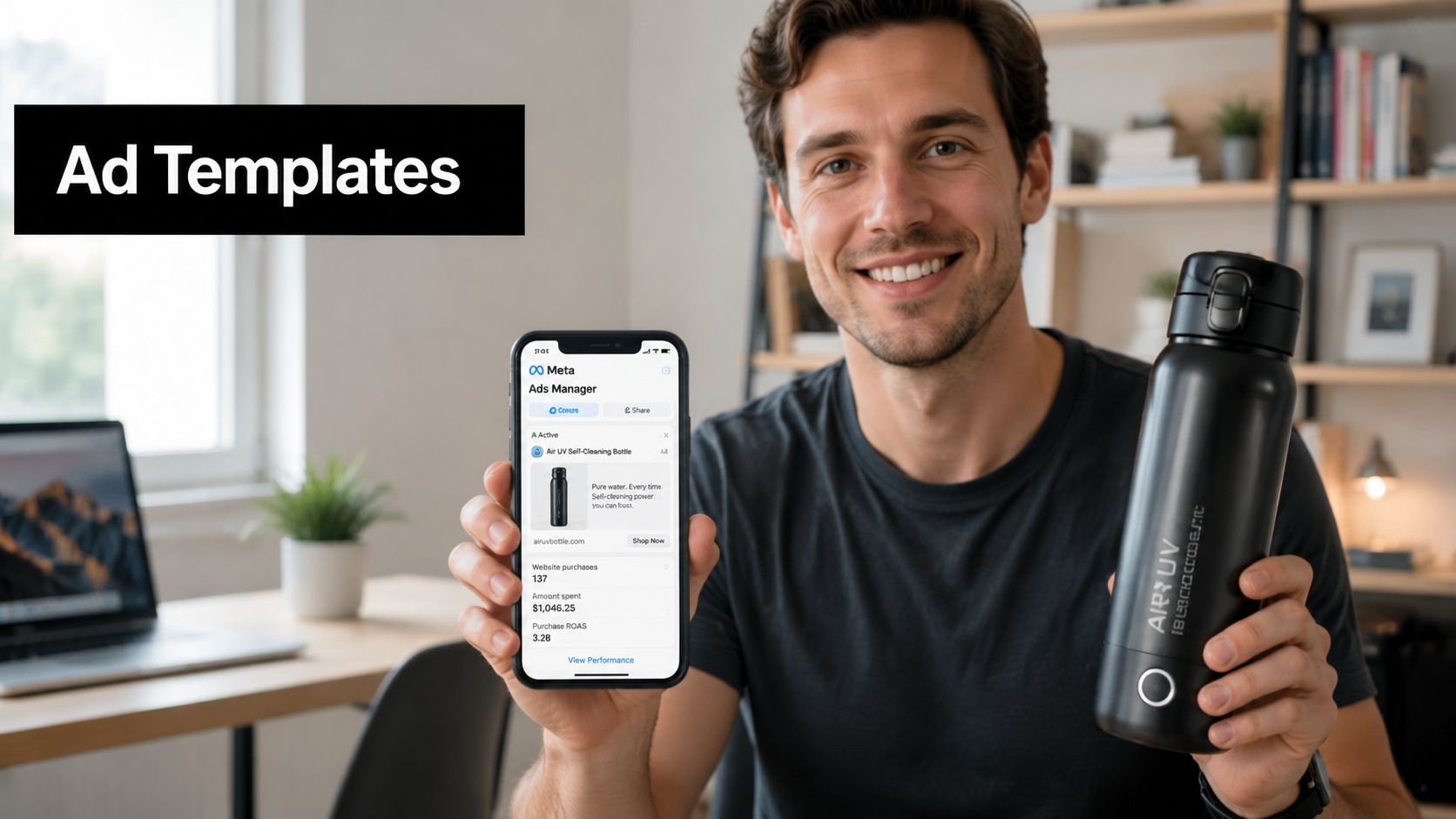
Theory is useful. Swipe-ready examples are better. Below are three ways to sell the same fictional product on Meta: a self-cleaning water bottle for commuters, gym-goers, and people tired of bottles that smell bad after a few days.
Use these as patterns, not scripts.
Example one problem-solution angle
This angle works when the pain is obvious and annoying.
Primary text
Your water bottle shouldn't become one more thing to deep-clean. If yours starts smelling weird, feels impossible to scrub properly, or gets ignored in the car cupholder for days, switch to a bottle designed to keep daily hydration simple. Clean design. Less hassle. Easier to use every day.
Headline
Stop babysitting your water bottle
CTA
Shop now
Why this works:
- The hook calls out a familiar annoyance.
- The body names the friction in plain language.
- The promise is convenience, not hype.
- The CTA matches purchase intent.
Example two UGC and social proof angle
This angle feels more native to the feed. It works well with creator-style video or simple talking-head creative.
Primary text
"I didn't realize how much I hated cleaning my bottle until I switched." That is the kind of reaction this product is built for. If you carry a bottle to work, the gym, or class, you want something easy to use and easy to keep fresh. This one was made for exactly that.
Headline
The bottle people keep using
CTA
See why
Why it works:
- It sounds more like a person than a brand.
- It lowers resistance by feeling observed, not pitched.
- It sets up strong creative if the video shows real use.
For sharper CTA language ideas that fit different buyer stages, this roundup of call to action phrases is worth bookmarking.
Example three urgency angle
Urgency works when it's tied to a real reason to act. It fails when it feels fake.
Primary text
If you've been meaning to replace your old bottle, do it before the habit slips again. A cleaner, easier daily bottle removes one more excuse to skip hydration. Pick the color you want and get your setup sorted today.
Headline
Upgrade your daily bottle now
CTA
Order today
This version doesn't scream scarcity. It uses momentum. The urgency comes from solving a problem the buyer already postpones.
A simple video can make these patterns easier to spot in live ad creative:
What changes between angles and what stays the same
The structure stays stable. The message angle changes.
| Angle | Best when | Core emotion | Copy emphasis |
|---|---|---|---|
| Problem-solution | Pain is obvious | Relief | Friction and fix |
| UGC and social proof | Product needs trust | Familiarity | Real-world use |
| Urgency | Buyer already wants the category | Action | Why now |
One good product should support multiple valid messages. If you only have one angle, you probably haven't done enough customer thinking.
You Cannot Improve What You Do Not Measure
A founder launches three Meta ads on Monday. By Friday, one has a much lower CPA, one gets cheap clicks but no purchases, and one never leaves learning. That is direct response in practice. The job is not to admire the copy. The job is to find which message produced the sale, then build the next round from that signal.
Measurement matters because Meta in 2026 rewards teams that can generate, test, and replace messages fast. AI can help produce more variations, but volume alone does not help if the test setup is sloppy. If the hook, offer, creative, and CTA all change at once, the result is noise.
Treat the first ad like a test setup
The first draft needs one thing above all else. It needs to make a clear promise you can evaluate.
Mailchimp's direct response copywriting guide makes the practical point well. Small lifts in conversion rate can change revenue fast once spend scales. That is why experienced DTC teams care less about whether copy sounds clever and more about whether a specific message lowers CPA, raises CTR, or improves conversion rate on the landing page.
This is also the part new founders often miss. A losing ad is still useful if it isolates a bad angle early. A winning ad is only useful if you can explain why it won.
Three beginner tests worth running
Keep each test tight. Change one variable, keep the rest stable, and log the result.
-
Test two hooks
Keep the offer, creative, and CTA the same. Change only the opening line. One version can call out the buyer's friction. The other can lead with the end benefit. -
Test two value propositions
Sell the same product from two different buying motives. One ad might focus on convenience. Another might focus on consistency, confidence, or saving time every day. -
Test CTA strength
Cold traffic often needs a lower-pressure ask than warm traffic. Compare a direct purchase CTA against one that invites the click with less commitment.
A lot of bad testing on Meta comes from mixing message testing with creative testing. If the video, headline, primary text, and offer all change together, you cannot tell what drove the result. For a clean explanation of when a result is strong enough to trust, this guide to statistical significance in ad tests is worth reading.
Buyers do not grade your copy for effort. They respond to the message that matches their problem, timing, and level of intent.
Keep a simple record for every ad: hook, angle, offer, CTA, format, audience, and outcome. Over time, patterns show up. Maybe problem-aware buyers click on pain-led hooks, but purchase more often from proof-led ads. Maybe your UGC creative works, but only when the headline makes the outcome specific. That is how direct response becomes a message system for Meta, not a one-off ad that happened to work once.
Your First Steps with Direct Response Copywriting
You launch a Meta campaign, spend a few hundred dollars, and the result is disappointing. CTR is soft. CPA is high. The first instinct is usually to blame the copy.
The copy might be part of it. But for new founders, the bigger issue is usually diagnosis. The message is trying to do too much, the offer is vague, or the ad is speaking to the wrong stage of awareness.
That matters even more in Meta's 2026 environment. AI can spin up endless variations fast. That does not fix a weak angle. It just helps you produce more versions of the same unclear message. Good direct response starts with a message system you can test, not one clever ad you hope will carry the account.
Three mistakes new founders make
Mistake one: they write from the brand's point of view
The ad opens with the founder story, product philosophy, or brand mission. That can help later. Cold traffic usually needs a faster entry point. Start with the buyer's problem, desired outcome, or objection.
Mistake two: they list features without connecting them to a buying reason
"Leakproof lid." "Stainless steel." "Premium finish." Those details only matter if the buyer can see the payoff. Leakproof means no bag spills on the commute. Stainless steel means it still looks clean after months of use. Premium finish means less if the outcome is still fuzzy.
Mistake three: they confuse production volume with testing
Uploading five AI-generated variations is not the same as structured testing. If every version changes the hook, angle, proof, and CTA at once, you learn almost nothing. The goal is to isolate what message gets attention and what message gets purchases.
A better starting process
Start with one product and one audience segment. Do not try to cover everyone.
Then build three pieces.
- Offer: What is the buyer getting right now, and why act now instead of later?
- Angle: What is the strongest buying motive for this audience? Convenience, relief, proof, identity, speed, cost, confidence.
- Action: What should the person do next? Buy now, shop the bundle, take the quiz, see how it works.
From there, write a small batch of ads around the same core message. On Meta, that usually means keeping the offer stable while testing different hooks or proof points. The point is clarity. If a founder cannot explain why Ad B exists beside Ad A, the test is probably messy.
A simple check helps. A stranger should understand the ad in seconds.
What is this?
Why should I care?
What do I do next?
If one of those answers is missing, fix that before writing more variations.
The tool view matters too. When you review ads in Meta, don't stare only at creative thumbnails. Look at the message architecture behind them.
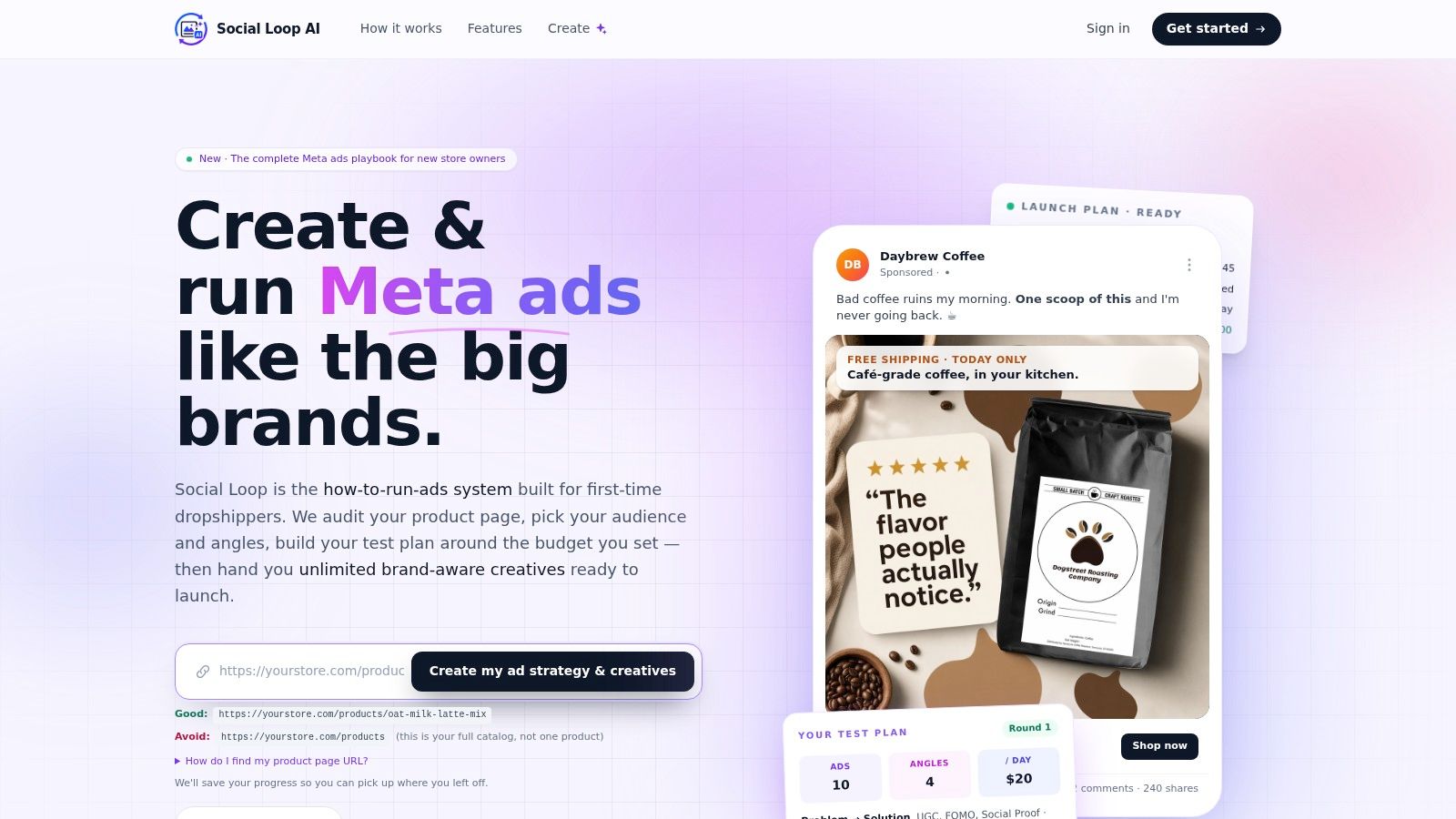
Strong direct response copy is easy to map. Clear angle. Clear offer. Clear action. If you cannot label those parts, the ad is not ready for spend.
Frequently Asked Questions
Can AI fully replace direct response copywriters?
No. AI can produce drafts, variations, hooks, and angle ideas fast. That's useful. But direct response still depends on judgment. Someone has to decide which claim is believable, which angle fits the product, and which message matches the landing page.
AI is a multiplier, not a substitute for thinking.
What's the ideal length for Meta ad copy?
There isn't one ideal length. The better question is whether the copy earns its length. Some products need a short, sharp hook and a direct CTA. Others need a little more context to overcome skepticism.
A good rule is simple. Use as many words as needed to create clarity and no more.
Do I need a big budget to test my copy?
No. You need discipline more than you need scale. Small-budget testing still teaches you which hooks attract attention, which offers create interest, and which messages deserve another round.
What you can't do is test sloppily and expect clarity.
Is direct response copywriting only for sales pages?
No. It works anywhere you want an immediate, measurable action. Meta ads, email campaigns, landing pages, product pages, and lead forms all use the same logic. The format changes. The goal doesn't.
What is direct response copywriting in one sentence?
It is writing designed to trigger a specific action now, in a way you can measure and improve.
If you're new, keep the process simple. Pick one offer. Choose one angle. Write several testable variations. That alone will put you ahead of most first campaigns, because you'll be building copy for response instead of writing vague brand language and hoping it works.
If you want a faster way to turn a product URL into test-ready Meta ad angles, creatives, and launch guidance, Social Loop AI helps first-time ecommerce founders go from blank page to structured ad system without hiring an agency.